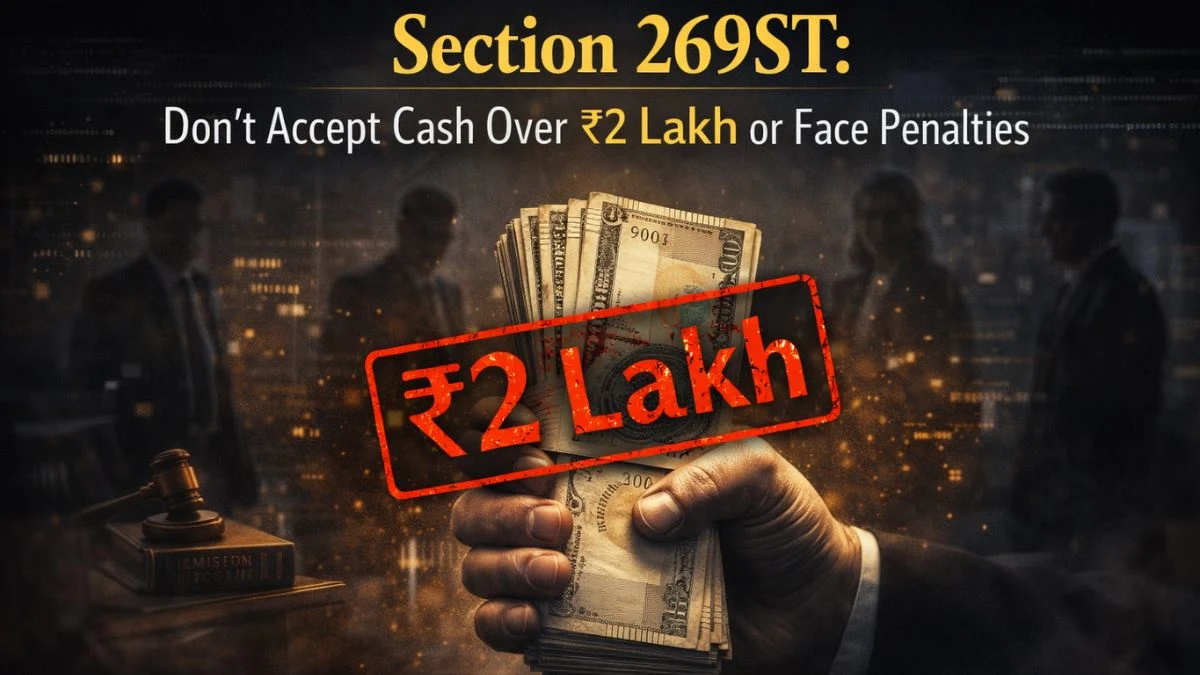
Section 269ST of Income Tax Act: Why Receiving ₹2 Lakh in Cash Can Cost You Dearly
Cash feels simple. Quick. No bank delays.
But the Income Tax Department doesn’t see it that way anymore.
That’s exactly why Section 269ST exists.
Introduced to choke unaccounted cash flow, this section puts a clear restriction on receiving large amounts in cash. If you receive ₹2 lakh or more, in cash, in certain situations — you’re already in trouble. Whether you meant it or not doesn’t really matter.
This rule applies to everyone. Individuals. Businesses. Professionals. Even charitable entities in many cases.
What Section 269ST Actually Says (In Simple Words)
Section 269ST basically says this:
You cannot receive ₹2 lakh or more in cash:
-
From one person, or
-
In one transaction, or
-
For transactions relating to one event or occasion
And no, breaking it into parts doesn’t save you.
If the total crosses ₹2 lakh and cash is involved, the law steps in.
Who Needs to Worry About This?
Honestly? Almost everyone.
This rule applies to:
-
Individuals
-
Businesses
-
Professionals
-
Firms
-
Companies
-
Trusts
If you’re receiving money — for goods, services, loans, advances, or repayments — Section 269ST is watching.
It doesn’t care whether you’re selling furniture, providing consultancy, or collecting money for an event.
Transactions That Usually Get People Stuck
This is where most mistakes happen.
Common problem areas:
-
Sale of goods against cash
-
Service fees received in cash
-
Loan or deposit repayments
-
Advance payments
-
Property-related transactions
-
Wedding or event-related collections
People assume that cash is fine if it’s split.
It’s not.
₹1 lakh today ₹1.2 lakh tomorrow = still a violation if it’s linked to the same transaction or occasion.
How Should Payments Be Received Then?
Simple. Use the banking system.
Allowed modes include:
-
Cheque
-
Demand draft
-
NEFT / RTGS
-
UPI
-
Any prescribed electronic mode
If it leaves a bank trail, you’re generally safe.
Are There Any Exceptions?
Yes, but they are limited.
Section 269ST does not apply to:
-
Government bodies
-
Banks and post offices
-
Certain notified institutions
-
Transactions specifically exempted under law
But don’t assume you fall under an exception.
Most people don’t.
Why This Section Is Taken Very Seriously
Because the penalty is brutal.
If you violate Section 269ST, the penalty is equal to the cash received.
Received ₹2.5 lakh in cash?
Penalty = ₹2.5 lakh.
No upper cap. No percentage. Full amount.
That’s why even genuine transactions become expensive mistakes.
Real-Life Situations Where People Slip Up
A shop owner accepts ₹2.3 lakh in cash for bulk goods.
Penalty applies.
A borrower repays ₹3 lakh in cash to a lender.
Violation.
A consultant accepts ₹2.2 lakh as professional fees in cash.
Problem.
All of these could have been avoided with a simple bank transfer.
What Businesses and Individuals Should Actually Do
Practical steps that work:
-
Keep strict control on cash receipts
-
Train staff not to accept large cash payments
-
Encourage UPI and bank transfers
-
Mention “No cash above ₹2 lakh” on invoices
-
Maintain proper transaction records
-
Be extra careful during events, weddings, and bulk deals
Most penalties happen because of ignorance, not intention.
Impact on Daily Business and Personal Deals
For businesses, this means:
-
Cleaner books
-
Better audit trails
-
Less tax trouble
For individuals, especially in property or loan transactions, it means safety. Bank records protect both sides.
Cash may feel convenient. But it’s risky now.
A Quick Reality Check
Section 269ST isn’t about harassment.
It’s about traceability.
The government wants money to move through banks. That’s the direction. Ignoring it only leads to notices, penalties, and stress.
Final Thoughts
Section 269ST of the Income Tax Act is one of those provisions where a small mistake can turn into a big loss. Receiving ₹2 lakh or more in cash, even once, can invite a penalty equal to the amount received.
Using digital or banking modes is no longer optional for high-value transactions. It’s survival.
If you’re unsure about compliance, exemptions, or structuring payments correctly, Callmyca.com can help you stay on the right side of the law — without unnecessary penalties or surprises.