
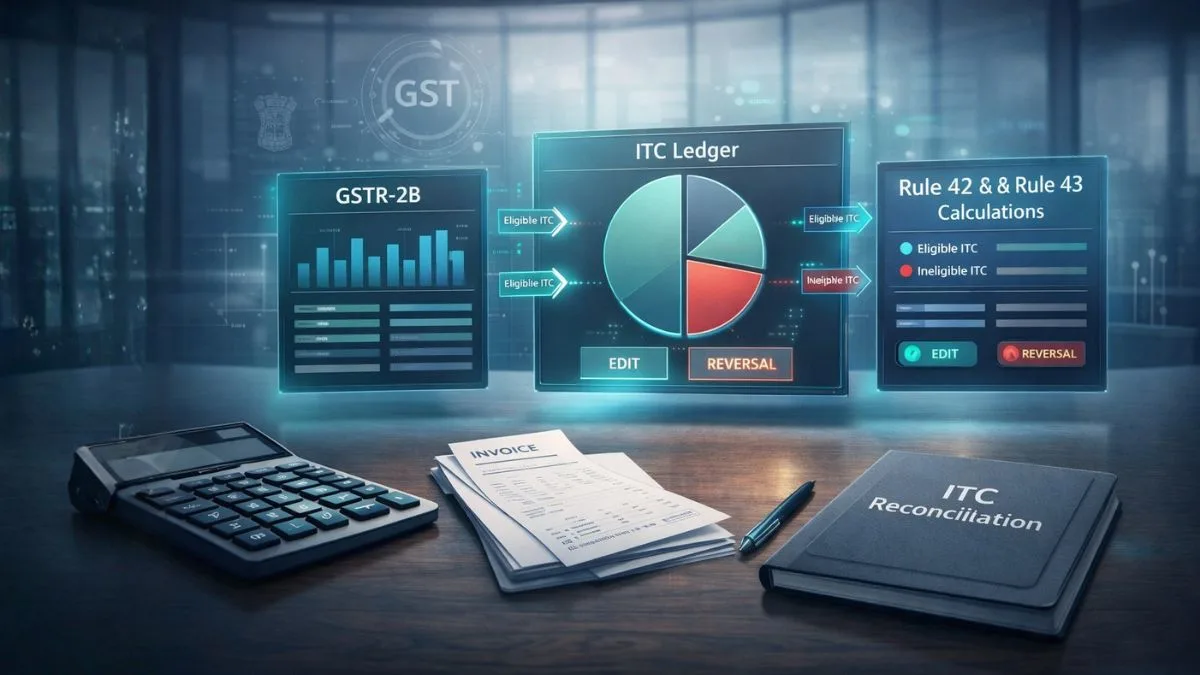
Sections 42 & 43 of GST—Explanation of ITC Reversal Rules
If you have ever handled GST compliance—either as a business owner, accountant, or consultant—you already know that Input Tax Credit (ITC) is both the biggest benefit and the biggest headache under GST.
I still remember the early GST days when clients would call almost every month asking:
“The supplier has not filed their return… will I lose my ITC?”
Those fears, confusions, and Excel reconciliations all revolved around Sections 42 & 43 of GST.
Today, these sections are technically removed, but understanding them is still crucial because:
- Their logic still impacts ITC reversals
- CGST Rules (especially Rule 42 & 43) still operate
- Many notices and audits are based on their principles
Why Sections 42 & 43 of GST Were Introduced in the First Place
When GST was launched, the government had one big concern:
“How do we ensure that ITC is claimed only when tax is actually paid by the supplier?”
That’s where Section 42 & 43 of GST came in.
These sections:
- Dealt with matching, reversal, and reclaim of Input Tax Credit (ITC)
- We're based on supplier returns vs recipient claims
- Worked through forms like GSTR-1, GSTR-2, and GSTR-3
In theory, it sounded perfect.
In practice, it was messy.
What Exactly Did Section 42 of the GST Deal With?
Section 42 focused on ITC on inward supplies (purchases).
In simple words, it said:
- You can apply for the input tax credit claimed
- But that ITC must match with supplier’s data
- If it doesn’t match, it can be reversed
So Section 42 mainly:
- deals with the reversal of ITC
- Based on mismatch between supplier and recipient data
What About Section 43 of GST?
Section 43 was similar in spirit but applied specifically to:
- Capital goods
It laid down:
- Matching of ITC on capital goods
- Reversal if supplier did not upload invoice
- Reclaim once mismatch was resolved
Together, Sections 42 & 43 of GST tried to create a “perfect matching system.”
Why This Matching System Failed in Real Life
Let me be very honest here.
On paper, the system looked brilliant. On the ground, it created chaos.
Here’s why:
- GSTR-2 was suspended
- Suppliers delayed filing returns
- Buyers were penalised for suppliers’ mistakes
- Businesses had no control over vendor compliance
Clients would say:
“Sir, the invoice is genuine, and payment has been made. Still, does ITC need to be reversed?”
That frustration is exactly why reforms happened later.
Removal of Section 42 & 43—What Changed in Finance Bill 2022
A major shift came when:
Sections 42 & 43 of GST, which dealt with the matching, reversal, and reclaim of Input Tax Credit (ITC) based on supplier returns, were removed in the Finance Bill 2022 to simplify the process around the GSTR-2B form.
This was a big relief for taxpayers.
The government acknowledged that:
- Real-time matching was not practical
- The compliance burden was too high
- Automation via GSTR-2B was better
So instead of dynamic matching, GST moved to static ITC statements.
Does Removal Mean ITC Reversal Is Gone? ❌ No
This is where many people misunderstand.
Even though Sections 42 & 43 are gone:
- ITC reversal still exists
- It is now governed mainly by CGST Rules, especially Rule 42 & Rule 43
- And Section 16 & Section 17 of the CGST Act
So the mechanism changed, not the principle.
Understanding CGST Rule 42—The Heart of ITC Reversal
Let’s come to the most practically used rule.
👉 CGST Rule 42 deals with the reversal of ITC on inputs and input services
This rule applies when:
- Inputs or services are used for both taxable and exempt supplies
- Or partly for business and partly for non-business purposes
Rule 42:
- provides the method for determining the ITC to be reversed
- Works on proportionate reversal
Simple Example of Rule 42
Suppose:
- Total ITC in a month: ₹1,00,000
- Used for taxable supplies: 70%
- Used for exempt supplies: 30%
Then:
- ₹70,000 ITC allowed
- ₹30,000 ITC reversed
This is Rule 42 in action.
Understanding CGST Rule 43 – Capital Goods ITC Reversal
Now let’s talk about capital goods.
👉 CGST Rule 43 deals with the reversal of ITC on capital goods
If a machine, equipment, or asset is used:
- Partly for taxable
- Partly for exempt supplies
Then:
- ITC is spread over 5 years (60 months)
- Reversal is done proportionately every month
This ensures fairness and long-term compliance.
How Section 42 & 43 Logic Still Applies Today
Even after removal:
- GST audits still examine ITC logic
- Notices still question mismatch and reversals
- Rule 42 & 43 calculations are mandatory
So practically:
- Section 42 & 43 of GST still live through the rules.
Ignoring them is risky.
Role of GSTR-2B After Removal of Section 42 & 43
GSTR-2B changed everything.
It is:
- Auto-generated
- Static (doesn’t change later)
- Supplier-driven
Now:
- ITC eligibility is checked via GSTR-2B
- If the invoice is not in 2B, ITC not allowed
- This replaced old matching logic
That’s why removal was linked to 2B simplification.
Common ITC Reversal Situations Businesses Face Today
From real experience, reversals usually happen due to:
- Exempt supplies
- Personal use expenses
- Blocked credits (Section 17(5))
- Non-payment to supplier within 180 days
- Capital goods used partly for exempt supplies
Rules 42 & 43 handle most of these.
Practical Compliance Tips (From Ground Reality)
Here are some things that actually help:
- Track exempt turnover monthly
- Separate expense heads clearly
- Reconcile GSTR-2B every month
- Maintain Rule 42 & 43 working papers
- Reverse ITC voluntarily to avoid notices
Small discipline saves big penalties.
Mistakes I See Businesses Make Repeatedly
Let me be blunt here:
- Claiming full ITC despite exempt supplies
- Ignoring Rule 43 completely
- Assuming removal of Section 42 & 43 means “no reversal”
- Not documenting reversal calculations
- Relying blindly on software
GST still expects human judgment.
Why Understanding Section 42 & 43 Still Matters
Even though they’re removed:
- Notices still refer to their logic
- Past period cases still apply
- Rules are based on them
For professionals and businesses, they form the foundation of ITC discipline.
Final Thoughts—Don’t Ignore What’s “Removed”
Sections 42 & 43 of GST may be deleted from the Act, but their soul still exists in:
- CGST Rule 42
- CGST Rule 43
- GSTR-2B compliance
- ITC audits and notices
If you understand their intent, GST becomes manageable.
If you ignore them, ITC becomes risky.
For businesses struggling with ITC reversals, Rule 42 & 43 calculations, or GST notices, getting expert guidance early makes a huge difference.
For practical, experience-backed GST support—just like in our previous blogs—you can confidently rely on callmyca.com, because GST compliance works best when rules are understood like real life, not like a law book.









