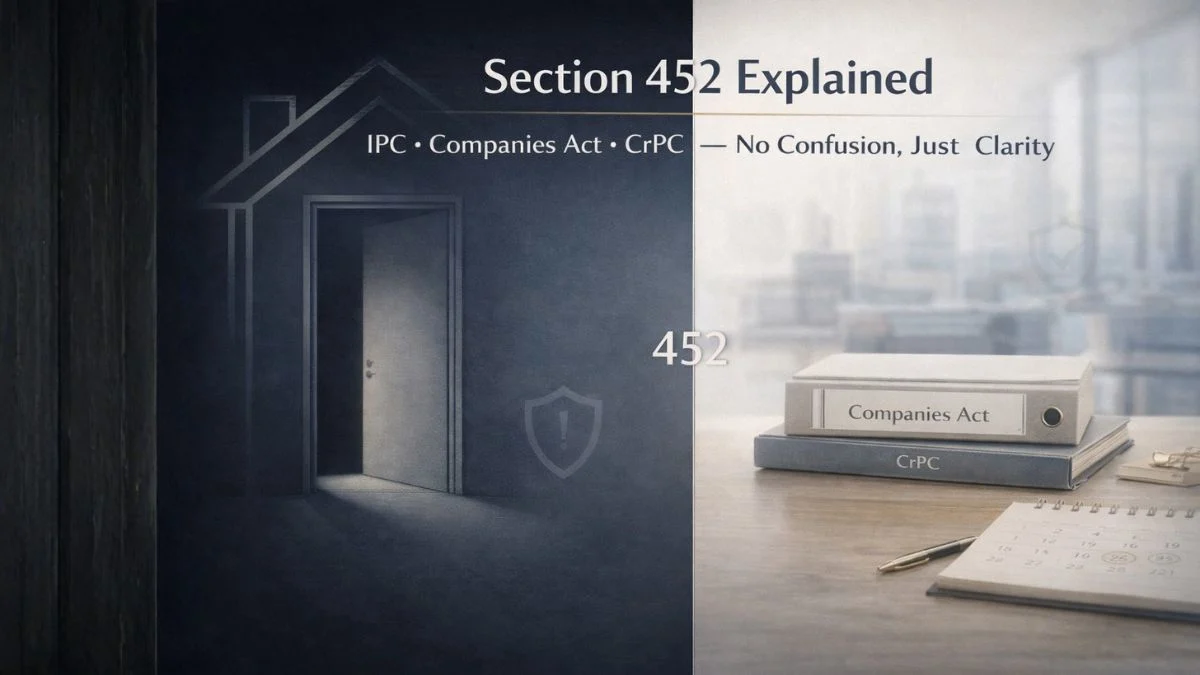
Section 452 Explained (IPC, Companies Act & CrPC)—No Confusion, Just Clarity
When someone searches “452 section,” they are usually confused—and for a good reason.
Because Section 452 does not belong to just one law.
Depending on the context, Section 452 can mean three completely different things under three different laws:
- Section 452 of IPC – Criminal offence
- Section 452 of Companies Act, 2013 – Corporate offence
- Section 452 of CrPC – Court procedure
Most confusion happens because people read the wrong one.
Let’s clear it properly—one by one.
Section 452 IPC—The One Most People Mean
In real life, when police, FIRs, or criminal lawyers mention Section 452, they almost always mean:
👉 Section 452 of the Indian Penal Code (IPC)
What Section 452 IPC Is About (In Simple Words)
Section 452 IPC deals with:
House-trespass after preparation for causing hurt, assault, or wrongful restraint
In plain language:
- Someone enters your house illegally
- And they come prepared to hurt, assault, or restrain someone
That preparation makes it a serious offense, not a simple trespass.
Why Section 452 IPC Is Considered Serious
Normal trespass = illegal entry
Section 452 trespass = illegal entry with violent intention
The law assumes:
“If someone came prepared, they meant harm.”
That’s why punishment is higher.
Essential Ingredients of Section 452 IPC
For Section 452 IPC to apply, all of these must exist:
- House-trespass
(Entry into a house, building, or dwelling without permission) - Preparation
(Weapon, force, planning, or readiness) - Intention
- To cause hurt
- Or assault
- Or wrongful restraint
- To cause hurt
If preparation is missing, Section 452 usually fails.
Punishment Under Section 452 IPC
This is a common search:
section 452 ipc punishment
Punishment can be:
- Imprisonment up to 7 years
- Fine
- Or both
There is no minimum punishment, but courts take it seriously.
Is Section 452 IPC Bailable or Not?
Another frequent question:
section 452 IPC is bailable
Answer:
👉 It is a non-bailable offense.
This means:
- Bail is not automatic
- Court discretion is required
- Anticipatory bail may be possible depending on facts
Is Anticipatory Bail Granted in Section 452 IPC?
People often search:
452 ipc anticipatory bail granted
Courts look at:
- Nature of preparation
- Weapon involved or not
- Injury caused
- Past criminal record
- Possibility of misuse
So yes, anticipatory bail can be granted, but it is case-specific, not guaranteed.
Section 452 IPC in BNS (New Criminal Law)
Many now ask:
section 452 ipc in bns
Under the Bharatiya Nyaya Sanhita (BNS):
- IPC sections are being renumbered
- The offence still exists
- The concept remains the same
So even though the section number may change, the offense of violent house trespass continues.
Now Let’s Clear the Other Two Section 452s (Often Confused)
Section 452 of Companies Act, 2013
This has nothing to do with crime or trespass.
It deals with:
Punishment for wrongful withholding of company property
In simple terms:
- When officers, employees, or others illegally keep company assets
- After termination or without authority
This is a corporate compliance offense, not a police case like IPC 452.
Section 452 of CrPC
This is procedural, not criminal.
Section 452 CrPC deals with:
Disposal of property by court after trial
After a criminal case ends, the court decides:
- Who gets seized property
- Whether it is returned, confiscated, or destroyed
Again—completely different from IPC Section 452.
Why People Get Confused About “452 Section”
Because:
- Same section number
- Different laws
- Different meanings
- Google mixes everything together
That’s why context matters more than the number.
Quick Comparison to Remove All Doubt
|
Law |
Section 452 Means |
|
IPC |
House-trespass with preparation for violence |
|
Companies Act |
Wrongful withholding of company property |
|
CrPC |
Disposal of property after trial |
Most criminal cases = IPC Section 452
Section 452 IPC Explained in One Honest Line
If we reduce everything to one sentence:
Section 452 IPC punishes illegal entry into a house when the person comes prepared to cause violence.
Final Thought (Very Important)
Whenever you see “Section 452,” always ask:
👉 Which law?
Because:
- Under IPC, it’s a serious criminal offense.
- Under Companies Act, it’s corporate misconduct
- Under CrPC, it’s court procedure
Same number.
Completely different consequences.
Understanding that difference alone puts you ahead of 90% of people searching this term.