
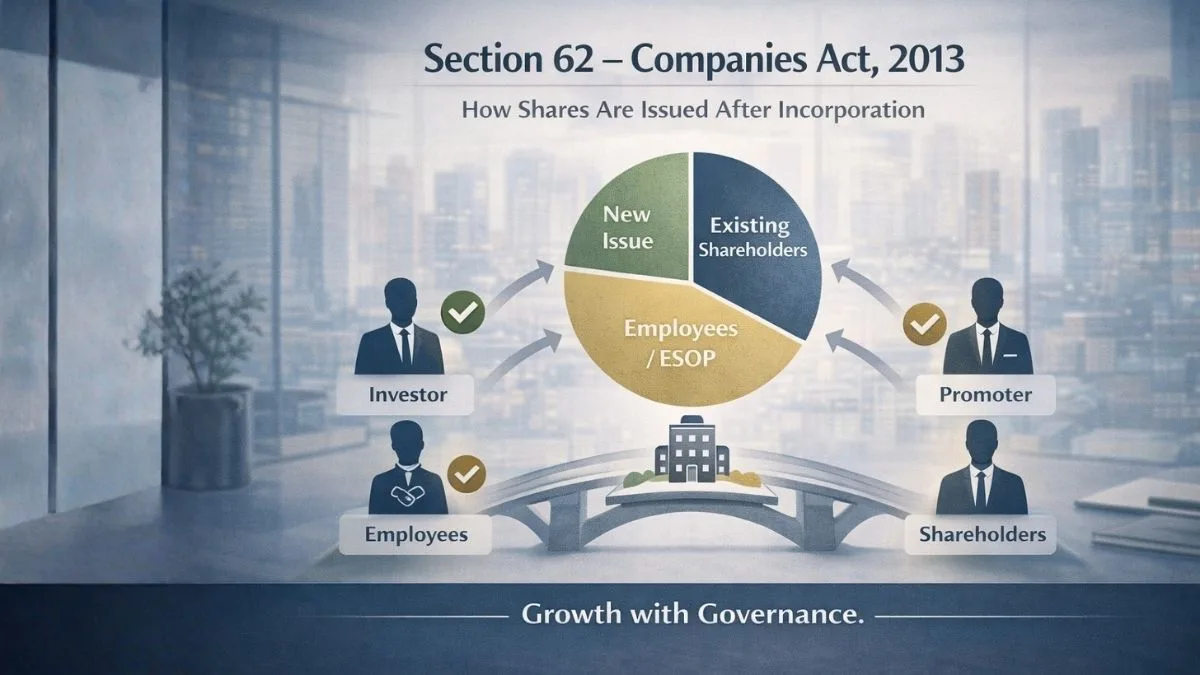
Section 62 of the Companies Act, 2013—How Companies Issue Shares After Incorporation
Raising capital sounds exciting.
More funds.
More growth.
More ambition.
But under Indian company law, a company cannot issue shares just because it wants to. Once a company is incorporated, any further issue of share capital is tightly regulated.
That regulation comes from Section 62 of the Companies Act, 2013.
This section controls how, to whom, and on what terms a company can issue new shares after incorporation. It protects existing shareholders, prevents misuse by promoters, and ensures transparency.
Let’s unpack it properly—without legal jargon overload.
First Things First: What Is Section 62 About?
At its core, Section 62 of the Companies Act 2013 governs the further issue of share capital.
In simple words, it answers this question:
“If a company wants to issue new shares after it is formed, what rules must it follow?”
This section applies to:
- private companies
- public companies
- listed and unlisted entities
Unless specifically exempted, everyone must follow it.
Why Section 62 Exists at All
Imagine this scenario.
You invest in a company owning 20% equity.
Suddenly, the promoters issue fresh shares to themselves or outsiders.
Your holding drops to 10%.
No consent. No notice.
That would be unfair.
Section 62 exists to stop exactly this kind of dilution abuse. It ensures existing shareholders get priority and transparency.
The Three Routes Under Section 62
Section 62 clearly lays down three legal methods for issuing shares.
Each one serves a different purpose.
1. Rights Issue – Section 62(1) (a)
This is the most common and most protective route.
Under section 62(1)(a) of the Companies Act 2013, a company must first offer new shares to its existing equity shareholders in proportion to their current holding.
This is called a rights issue.
Why Rights Issue Matters
- It protects ownership percentage
- It prevents forced dilution
- It respects shareholder rights
Shareholders can:
- accept the offer
- reject it
- or renounce it in favour of someone else
The choice remains theirs.
2. ESOPs – Section 62(1) (b)
Companies don’t run on capital alone. They run on people.
That’s where section 62(1)(b) of the Companies Act 2013 comes in.
This clause allows companies to issue shares to employees under Employee Stock Option Plans (ESOPs).
But this isn’t casual generosity.
It requires:
- special resolution
- disclosures to shareholders
- compliance with valuation norms
ESOPs align employee interest with company growth—but only under strict governance.
3. Preferential Allotment – Section 62(1) (c)
Sometimes companies want to issue shares to:
- strategic investors
- private equity funds
- promoters
- select individuals
This is allowed under Section 62(1)(c) of the Companies Act 2013, commonly called preferential allotment.
But this route is the most sensitive—and heavily regulated.
Preferential Allotment: Why the Law Is Strict
Preferential allotment can easily be misused.
That’s why section 62(1)(c) of the Companies Act 2013 requires:
- special resolution
- detailed disclosures
- valuation by a registered valuer
- pricing justification
The idea is simple:
If dilution is happening, shareholders must know why and at what price.
Section 62(3): When Section 62 Does Not Apply
Here’s an important carve-out.
Section 62(3) of the Companies Act 2013 states that Section 62 does not apply when shares are issued:
- to lenders on conversion of loan or debentures
- under terms already approved by special resolution
This prevents double approvals and unnecessary delays.
Section 62 Applies Even to Private Companies (With Some Flexibility)
A common myth is that private companies can do whatever they want.
Not true.
Section 62 of the Companies Act applies to private companies too, although:
- Articles may provide flexibility
- procedural requirements may differ
But shareholder consent cannot be bypassed entirely.
Section 62 vs Other “Section 62” in Different Laws
This is where confusion arises.
The term "section 62" appears in multiple statutes.
For example:
- Indian Contract Act, 1872 → novation of contracts
- CGST Act → best judgment assessment for non-filers
- Bharatiya Nyaya Sanhita (BNS) → criminal attempts
But in corporate law, section 62 of the Companies Act, 2013, always refers to further issues of share capital.
Context is everything.
Practical Example (Real-Life Style)
Let’s say a startup wants to raise ₹5 crore.
Option 1: Rights issue
→ Existing shareholders get first right.
Option 2: ESOP
→ shares to key employees.
Option 3: Preferential allotment
→ VC fund comes in.
Each option triggers section 62 of the Companies Act 2013, but with different compliance steps.
Choosing the wrong route = invalid allotment.
Common Mistakes Companies Make Under Section 62
From practice, these mistakes are common:
- issuing shares without offering rights
- skipping special resolutions
- incorrect valuation reports
- poor disclosure in explanatory statements
- mixing ESOP and preferential rules
These mistakes invite:
- ROC objections
- penalties
- invalid share allotment
Fixing them later is painful.
Section 62 and Shareholder Trust
Capital raising is not just financial—it’s emotional.
Existing shareholders want fairness.
Section 62 ensures:
- transparency
- predictability
- protection
That’s why investors look closely at compliance with Section 62 of the Companies Act 2013.
Does Section 62 Apply to Listed Companies?
Yes—but with additional layers.
Listed companies must comply with:
- SEBI regulations
- pricing guidelines
- disclosure norms
Section 62 becomes the base layer; SEBI builds on top of it.
Why Section 62 Still Matters Today
Startups.
Unicorns.
Public companies.
Everyone raises capital.
But capital without governance destroys trust.
Section 62 balances growth with fairness. That’s why it hasn’t lost relevance.
Final Thoughts
Section 62 of the Companies Act, 2013, is not just about issuing shares. It’s about how power, ownership, and control change hands.
Whether it’s
- section 62(1)(a) of the Companies Act 2013 (rights issue)
- section 62(1)(b) of the Companies Act 2013 (ESOPs)
- section 62(1)(c) of the Companies Act 2013 (preferential allotment)
- or section 62(3) of the Companies Act 2013 (exceptions)
Each route exists to protect stakeholders.
Capital raising done right builds companies.
Done wrong, it breaks them.
🔗 Need Help With Share Allotment or Capital Raising?
Issuing shares under Section 62 involves more than filings—it affects ownership, valuation, and future disputes. If you’re planning a rights issue, ESOP, or preferential allotment, getting the structure and approvals right from day one matters. You can explore professional support for share allotment and Companies Act compliance at Callmyca.com









