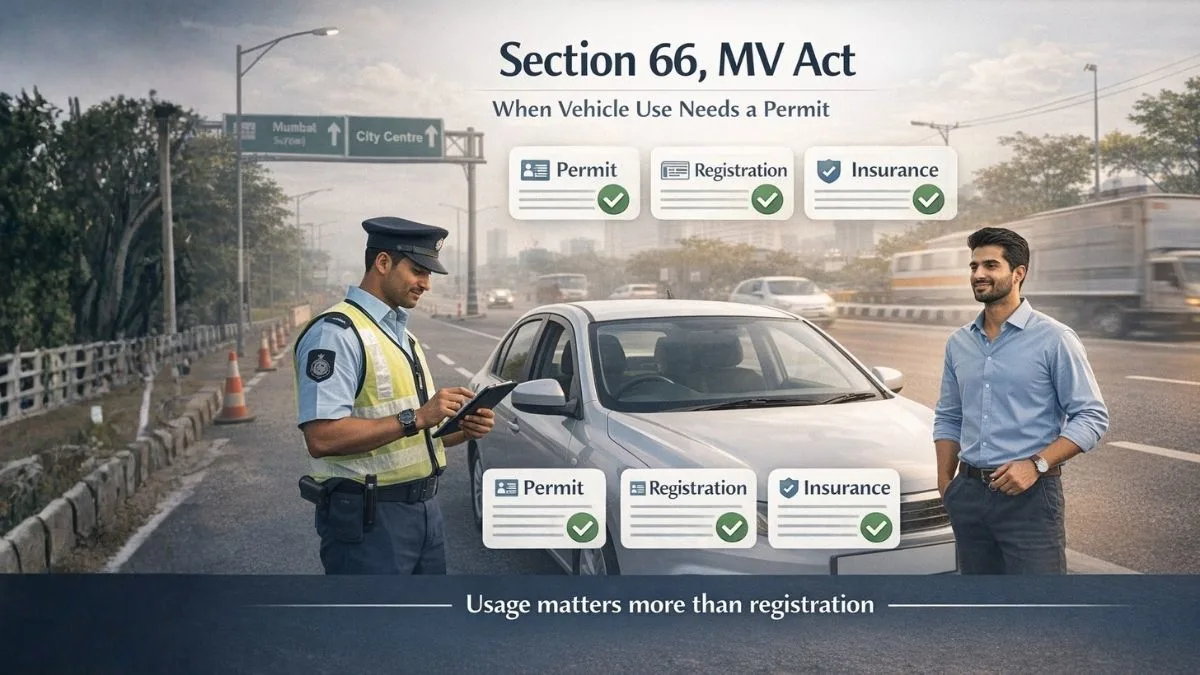
Section 66 of the MV Act: Why Vehicle Permits Matter More Than You Think
If you are a car owner in India, especially if you are using the car for business, transport, and so on, then you must have surely heard the casual query, “You have the permit, right?”
It is in giving an answer to just what that one question is that Section 66 of the MV Act becomes relevant.
Most vehicle owners don’t intentionally break the law. The problem is that many genuinely don’t understand when a permit is required, when it is not, and how easily a normal-looking situation can turn into a challan or even vehicle seizure.
In this blog, I’ll break down Section 66 of the MV Act in a clear, practical, and real-world manner—no legal jargon, no textbook language. Think of this as advice from someone who has seen real cases, real penalties, and real confusion on Indian roads.
What Is Section 66 of the MV Act?
Section 66 of the MV Act (Motor Vehicles Act, 1988) clearly states that:
No owner of a motor vehicle shall use or permit the use of the vehicle as a transport vehicle in any public place unless the vehicle carries a valid permit issued by the appropriate Transport Authority.
In simple words:
If a vehicle is used to carry passengers or goods for hire or reward, it must have a valid permit.
This section exists to prevent unauthorized commercial use of vehicles, ensure safety, regulate transport operations, and maintain fair competition.
Understanding “Transport Vehicle” Under Section 66
This is where most confusion starts.
A transport vehicle means:
- Goods carriage (trucks, tempos, delivery vans)
- Passenger vehicles (buses, taxis, autos, cabs)
- Any vehicle used for commercial purposes
Even a private vehicle can become a “transport vehicle” based on how it is used, not how it is registered.
That’s a critical point many people miss.
The Core Rule Under Section 66 of MV Act
Let’s simplify the heart of the law.
The Legal Line
- Private use → No permit required
- Commercial use → Permit mandatory
If money, consideration, or business purpose is involved, Section 66 of the MV Act applies.
This is why authorities focus on usage, not just registration.
Necessity for Permits Under Section 66
The necessity for permits exists to:
- Control traffic and congestion
- Ensure vehicle fitness and safety
- Regulate commercial transport
- Prevent misuse of private vehicles for business
Without this regulation, anyone could run a taxi, transport goods, or operate passenger services without accountability.
Types of Permits Under the MV Act
Under Section 66 of the MV Act, permits are issued by:
- Regional Transport Authority (RTA)
- State Transport Authority (STA)
Common permits include:
- Goods carriage permit
- Stage carriage permit
- Contract carriage permit
- National permit
- Temporary permit
Each permit has conditions, validity periods, and geographical limits.
Exceptions to Section 66 Permit Requirement
Now comes the relief part.
Section 66(3) lists specific exceptions where permits are not required.
Some important exceptions include:
- Vehicles used for government purposes
- Fire brigade vehicles
- Ambulances
- Vehicles used for personal use only
- Certain agricultural and emergency uses
- Vehicles used for non-commercial purposes as notified
This is why not every vehicle on the road needs a permit—only those falling under transport usage.
Subsection 3 of Section 66 of Motor Vehicle Act, 1988
Subsection 3 of Section 66 of the Motor Vehicle Act, 1988, is extremely important because it carves out these exemptions.
It protects genuine private users from harassment while still allowing authorities to act against misuse.
However, the burden often lies on the owner to prove the vehicle was not used commercially.
Section 66 of the MV Act 2019: What Changed?
With the Motor Vehicles (Amendment) Act, 2019, enforcement became stricter.
While the core idea of Section 66 of the MV Act 2019 remained the same, penalties and enforcement mechanisms became sharper.
Authorities were given more power to:
- Impound vehicles
- Levy higher fines
- Enforce compliance strictly
This amendment significantly reduced casual violations.
What Happens If You Violate Section 66?
Violation of Section 66 of the MV Act does not stand alone.
The penalty comes under Section 192A.
Section 192A MV Act: The Penalty Provision
If you use a vehicle as a transport vehicle without a valid permit, Section 192A applies.
Possible Penalties:
- Fine up to ₹10,000
- Imprisonment (in repeated or serious cases)
- Vehicle detention or seizure
This is why 66 mv act fine discussions are common among commercial vehicle owners.
Real-Life Example: How People Get Caught Unknowingly
Let me share a situation I’ve seen multiple times.
A proprietor of a small business uses his private pickup van for the purpose of delivering goods to customers. No branding, no driver, no transport registration.
He supposes,
It means, "This is my stuff; it isn't any taxi."
Authorities notice repeated commercial use during checks.
Result:
- Vehicle treated as transport vehicle
- No permit
- Challan under Section 66 of MV Act
- Penalty under Section 192A
Intent doesn’t matter—usage does.
Section 66(1) of Motor Vehicle Act: The Foundation
Section 66(1) of the Motor Vehicle Act lays down the primary prohibition:
No transport use without a permit.
Everything else—exceptions, penalties, amendments—flows from this one clause.
Connection With Section 163A and Other Sections
Many people confuse permit issues with accident compensation laws.
- Section 163A of the Motor Vehicle Act amendment deals with compensation on structured formula basis
- It has no direct connection with permit violations
However, lack of a permit can still create complications in insurance claims.
Insurance Problems Due to Section 66 Violation
Here’s something people realize too late.
If your vehicle:
- Is insured as private
- Used commercially
- Has no permit
Insurance companies may:
- Reject claims
- Reduce compensation
- Raise legal objections
So Section 66 of the MV Act compliance is not just about fines—it’s about financial protection.
Common Myths Around Section 66
Let’s bust a few myths I hear all the time:
Myth 1: Private vehicle never needs a permit.
Truth: If used commercially, permit is mandatory
Myth 2: One-time use doesn’t matter
Truth: Even single commercial use can attract action
Myth 3: Only trucks need permits
Truth: Any vehicle can become a transport vehicle
Practical Compliance Tips for Vehicle Owners
If you want to stay safe and stress-free:
- Understand how your vehicle is actually being used
- If business-related, check permit requirements early
- Keep documents updated and accessible
- Don’t rely on “everyone does it this way.”
- When in doubt, take professional advice
Compliance is always cheaper than penalties.
Why Section 66 Still Matters Today
With app-based deliveries, gig economy drivers, and small businesses booming, Section 66 of the MV Act is more relevant than ever.
Authorities are not against business—they are against unauthorized use.
Knowing the law keeps you protected.
Final Thoughts: Section 66 Is About Discipline, Not Harassment
At its core, Section 66 of the MV Act exists to:
- Maintain order on roads
- Protect passengers and goods
- Ensure accountability
- Create a fair transport ecosystem
Once you understand this, the law stops feeling scary and starts making sense.
If you’re unsure whether your vehicle usage requires a permit, don’t guess. A small clarification today can save you from a big penalty tomorrow.
For expert guidance on motor vehicle compliance, permits, documentation, and legal clarity, you can always reach out through callmyca.com—because compliance is not about fear; it’s about being informed and prepared.