
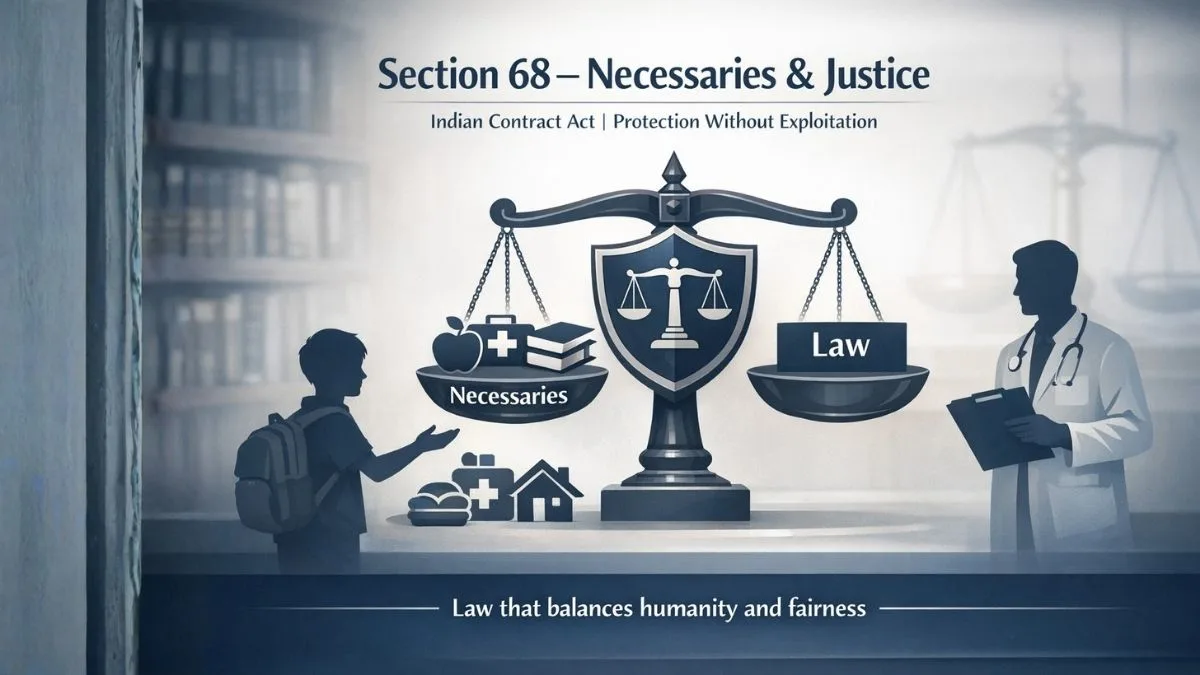
Section 68 of Indian Contract Act – Claim for Necessaries Supplied to Persons Incapable of Contracting
In everyday life, we assume that contracts are made only between people who are legally capable of understanding what they are agreeing to. But real life is not always that neat. What happens when a minor, or a person of unsound mind, urgently needs food, clothes, education, medical treatment, or shelter—and someone supplies these essentials?
Can the supplier recover the money?
This is exactly where section 68 of the Indian contract act steps in.
This provision may look small, but it plays a very important role in balancing humanity with law. It protects people who supply essential goods or services while also safeguarding vulnerable individuals from exploitation.
In this blog, I’ll explain section 68 of the Indian Contract Act in a clear, conversational, and practical way—using real-life logic instead of textbook language.
Why Section 68 of Indian Contract Act Exists
Under contract law:
- A minor cannot enter into a valid contract
- A person of unsound mind cannot be bound by a contract
This means:
- Any agreement with them is void
- They cannot be personally sued for payment
Now imagine this situation:
A minor is admitted to a hospital for emergency treatment. The hospital provides medical care. Later, can the hospital recover its charges?
Without Section 68 of the Indian Contract Act, the answer would be unfairly “no.”
So the law steps in—not to create a contract, but to ensure fair reimbursement.
What Is Section 68 of the Indian Contract Act?
In simple words, Section 68 of the Indian Contract Act deals with:
Claims for necessaries supplied to persons incapable of contracting, or to someone legally bound to support them.
It allows the supplier to be reimbursed from the property of the person who is incapable of contracting.
This section is not about enforcing a contract.
It is about preventing unjust loss to the supplier.
Who Is Considered “Incapable of Contracting ”?
Under the Indian Contract Act, the following persons are considered incapable:
- Minors (below 18 years of age)
- Persons of unsound mind
- Persons temporarily incapable (due to intoxication or illness)
Section 68 of the Indian Contract Act specifically protects suppliers who deal with such persons in good faith.
What Are “Necessaries” Under Section 68?
This is the most important concept.
Necessaries do not mean luxury items.
Under section 68 of the Indian Contract Act, necessaries are goods or services that are:
- Essential for survival or basic living
- Suited to the person’s condition in life
Examples include:
- Food and groceries
- Clothing
- Shelter or accommodation
- Medical treatment
- Education
- Basic household needs
The definition is flexible, not rigid.
“Suited to His Condition in ”Life”—What Does This Mean?
The law does not judge necessity in isolation.
If a minor belongs to:
- A wealthy family → quality education, proper medical care, reasonable comfort can be “necessaries.”
- A modest background → only basic needs qualify
So, if a minor is supplied with necessaries suited to his condition in life, reimbursement is allowed under Section 68 of the Indian Contract Act.
Important Point: No Personal Liability on Minor
This is where people get confused.
Under section 68 of the Indian Contract Act:
- The minor or incapacitated person is not personally liable
- You cannot sue the minor directly
Instead:
- The supplier can claim reimbursement from the property of that person
This distinction is crucial.
How Section 68 Protects Suppliers of Necessaries
Without this provision:
- Suppliers would hesitate to help minors
- Hospitals might refuse emergency treatment
- Landlords might deny accommodation
- Schools might refuse admission
Section 68 of the Indian Contract Act ensures that:
- Humanity is not punished
- Genuine suppliers are protected
- Vulnerable persons are not exploited
It creates a fair middle ground.
Real-Life Example to Understand Section 68
Let’s take a simple example.
A 16-year-old student lives away from home for studies. A hostel provides food and accommodation.
- The student is a minor
- No valid contract exists
- But food and shelter are necessities.
Under section 68 of the Indian Contract Act, the hostel can:
- Recover expenses
- From the minor’s property or guardian-managed assets
But the hostel cannot:
- Arrest the minor
- Enforce a personal decree
Medical Emergencies and Section 68
This section is especially relevant in medical cases.
Suppose:
- A person of unsound mind is admitted to a hospital
- Emergency surgery is performed
- The patient cannot consent legally
Under section 68 of the Indian Contract Act, the hospital:
- Can recover charges
- From the patient’s property
This provision saves lives by removing legal hesitation.
Difference Between Contract and Claim Under Section 68
This is very important to understand.
|
Aspect |
Normal Contract |
Section 68 Claim |
|
Valid agreement |
Required |
Not required |
|
Capacity |
Mandatory |
The person is incapable |
|
Liability |
Personal |
Limited to property |
|
Purpose |
Enforce promise |
Prevent unfair loss |
Section 68 of the Indian Contract Act is not contract enforcement—it is equitable relief.
Who Can Supply Necessaries Under Section 68?
Any person can:
- Individual
- Business
- Hospital
- Educational institution
- Landlord
As long as:
- The supply is genuine
- The goods/services are necessary
- No exploitation is involved
The law looks at intention and fairness.
When Section 68 Will NOT Apply
There are limits.
Section 68 of the Indian Contract Act does not apply if:
- Items supplied are luxuries
- Minor already has sufficient supply
- Goods are unnecessary or excessive
- The supplier acted in bad faith
For example:
- Supplying an expensive smartphone to a minor ≠ necessity
- Supplying designer clothes when basic clothing already exists ≠ necessity
Section 68 vs Section 70—Common Confusion
People often mix these two.
- Section 68: Necessaries supplied to incapable persons
- Section 70: Non-gratuitous acts benefiting another person
Both prevent unjust enrichment, but Section 68 of the Indian Contract Act is specifically for minors and incapacitated persons.
Why Section 68 Is Based on Equity, Not Contract
This section is rooted in fairness, not strict legality.
The law recognizes that:
- Some people cannot legally consent
- But their basic needs must still be met
- And those who help should not suffer loss
So instead of contract law, equitable principles are applied.
Court Interpretation of Section 68
Courts usually check:
- Was the person incapable of contracting?
- Were the goods/services necessary?
- Were they suited to the person’s condition in life?
- Was the claim reasonable?
If answers are “yes,” reimbursement is allowed.
Practical Takeaways for Suppliers
If you supply necessaries to:
- Minors
- Persons of unsound mind
Always:
- Keep proper records
- Ensure goods are genuinely necessary
- Avoid luxury or excess
- Document the condition and requirement
This strengthens your claim under Section 68 of the Indian Contract Act.
Why Section 68 Is Still Relevant Today
Even today:
- Students live away from home
- Medical emergencies happen
- Elderly persons lose mental capacity
Section 68 of the Indian Contract Act ensures society functions smoothly without legal fear.
It quietly supports compassion—without allowing misuse.
Final Thoughts
Section 68 of the Indian Contract Act is a perfect example of how law balances logic with humanity.
It recognizes that:
- Some people cannot contract
- But their basic needs don’t disappear
- And those who help them deserve protection
If you’re a supplier, guardian, institution, or professional dealing with such situations, understanding Section 68 of the Indian Contract Act can save you from confusion and loss.
For expert legal guidance on contract law, compliance, and practical business issues, visit callmyca.com—where law is explained in a way that actually makes sense.









