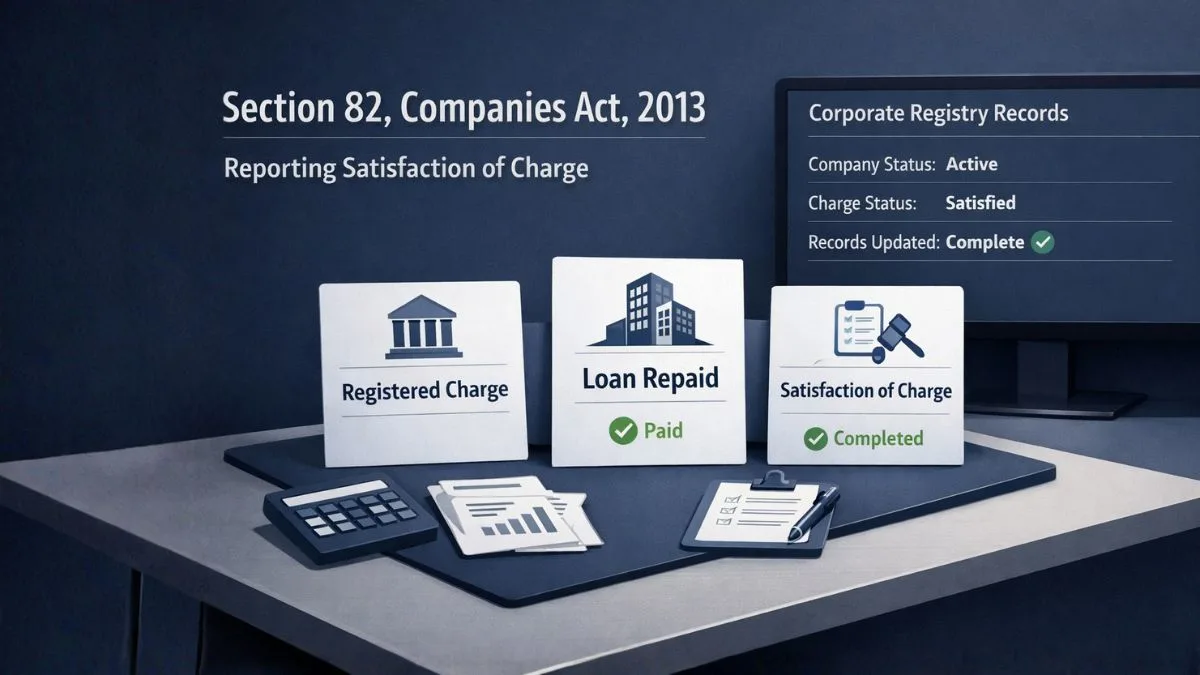
Section 82 of Companies Act, 2013: Company to Report Satisfaction of Charge
When a company takes a loan, it usually creates a charge on its assets—like land, building, machinery, or even receivables. That charge is registered with the Registrar of Companies (ROC) so that everyone knows the lender has a legal claim.
But what happens after the loan is fully repaid?
Many companies think:
“Loan is over, bank NOC mil gaya, kaam khatam.”
Legally, that’s not the end.
This is where Section 82 of the Companies Act 2013 becomes important.
This section ensures that once a company clears its debt, the public records must also reflect that the charge no longer exists. In simple words, Section 82 is about closing the loop properly.
What Is Section 82 of the Companies Act, 2013?
Section 82 of the Companies Act 2013 deals with one specific but very important compliance:
👉 Company to report satisfaction of charge.
It mandates that a company must inform the Registrar of Companies (ROC) about the satisfaction of a charge within 30 days of paying off the debt.
In short:
- Loan repaid ✅
- Charge removed from records ❌ (unless Section 82 is complied with)
The law does not assume compliance—it demands proof.
Meaning of “Satisfaction of Charge”
Before going further, let’s clarify the term.
Satisfaction of charge means:
- The company has fully repaid the loan or obligation
- The lender no longer has any claim on the charged asset
Once satisfied:
- The charge should be marked as “satisfied” in ROC records
Until that happens, the charge legally appears as active, even if the loan is fully paid.
Why Section 82 Exists
From a legal and public-record perspective, this section exists to ensure:
- Transparency in company financial records
- Accuracy of MCA/ROC data
- Protection of future lenders and investors
- No false impression that assets are still encumbered
A satisfied charge left unreported can:
- Create problems in future borrowings
- Delay due diligence
- Raise unnecessary red flags
Legal Requirement Under Section 82
Section 82 clearly states:
A company shall give intimation to the Registrar in the prescribed form, on payment or satisfaction of the charge, within the prescribed time.
This makes it a mandatory compliance, not an optional filing.
Time Limit Under Section 82
The most critical aspect of Section 82 is the timeline.
👉 The company must report satisfaction of charge within 30 days from the date of full repayment of the debt.
This 30-day period starts from:
- The actual date of payment/closure of loan
- Not from the date of NOC receipt (if delayed)
Missing this timeline leads to additional fees and compliance risk.
Who Is Responsible for Compliance?
The responsibility lies with:
- The company, and
- Its officers (directors, company secretary, etc.)
Even if the lender has issued an NOC:
- The obligation to inform ROC remains with the company
Banks do not file this form on behalf of the company.
Prescribed Form for Section 82 Compliance
Although Section 82 mentions “prescribed form,” practically:
- The company must file Form CHG-4 with ROC
This form includes:
- Details of the original charge
- Date of satisfaction
- Confirmation from charge-holder (lender)
Without filing this form, ROC records remain unchanged.
Role of the Registrar of Companies (ROC)
Once the form is filed:
- ROC verifies the details
- Records satisfaction of charge
- Updates the public register
Only after this:
- The charge is officially removed from company records
Until then, legally, the charge still exists on paper.
What If the Company Fails to File Satisfaction of Charge?
Non-compliance with Section 82 can create serious issues.
Some common consequences:
- Additional ROC fees
- Penalties on the company and officers
- Active charge still visible in MCA records
- Difficulty in raising future loans
- Issues during audits, due diligence, or sale
In M&A or funding deals, this single oversight can delay transactions by weeks.
Can ROC Mark Satisfaction on Its Own?
In certain cases:
- If the company fails to file
- The charge-holder (lender) may apply to ROC
ROC may then:
- Issue notice to the company
- Record satisfaction after verification
But relying on this route is risky and avoidable.
Practical Example to Understand Section 82
Let’s take a real-life style example.
ABC Pvt Ltd took a term loan from a bank:
- Charge registered on factory land
- Loan fully repaid on 10th June
Now:
- By 10th July, ABC Pvt Ltd must file satisfaction of charge
If ABC forgets:
- The land still appears encumbered
- The new lender hesitates
- Due diligence flags the issue
All this—even though the loan is already paid.
That’s the practical importance of Section 82.
Section 82 vs Section 77 (Quick Context)
To understand Section 82 better, compare it with Section 77:
- Section 77 → Registration of charge (when loan is taken)
- Section 82 → Satisfaction of charge (when loan is repaid)
They are two ends of the same compliance cycle.
Ignoring either creates incomplete records.
Common Mistakes Companies Make
From real-world practice, these mistakes are very common:
- Assuming bank NOC is enough
- Missing the 30-day deadline
- Filing incorrect charge ID
- Not taking lender confirmation
- Forgetting old loans after closure
These mistakes often surface years later—during funding or sale.
Why Section 82 Matters in Due Diligence
Investors and lenders always check:
- MCA master data
- Register of charges
If they see:
- Unsatisfied charges
They assume:
- Outstanding liabilities
- Hidden risks
Even if you verbally explain, paper records matter more.
Best Practices for Companies
To stay compliant with Section 82:
- Track loan closure dates carefully
- File satisfaction immediately after repayment
- Don’t wait for audits or due diligence
- Maintain proper charge registers
- Cross-check MCA records after filing
These small steps save big problems later.
Is Section 82 Applicable to All Companies?
Yes.
Section 82 applies to:
- Private companies
- Public companies
- OPCs
- Any company that has registered a charge
If a charge exists, satisfaction must be reported.
Does Section 82 Apply to Partial Repayment?
No.
Section 82 applies only when:
- The charge is fully satisfied
Partial repayment:
- Does not trigger satisfaction
- Charges continue until full payment
Key Takeaways
- Section 82 of Companies Act 2013 deals with satisfaction of charge
- The company to report satisfaction of charge is mandatory
- The company must inform ROC within 30 days
- A company shall give intimation to the Registrar in the prescribed form
- Filing satisfaction updates public records
- Non-compliance leads to penalties and practical issues
Final Thoughts
Section 82 may look like a small procedural section, but in practice, it carries huge importance.
Loans don’t truly end when money is repaid.
They end when records are clean.
By ensuring timely reporting of satisfaction of charge, Section 82 protects:
- Companies
- Lenders
- Investors
- The integrity of corporate records
If you’re a director, founder, or compliance professional, treat Section 82 not as a formality but as a critical closing step in every borrowing cycle.
For proper legal guidance, structured advice, and compliance clarity, professional help can make a real difference—callmyca.com is always there when clarity matters most.