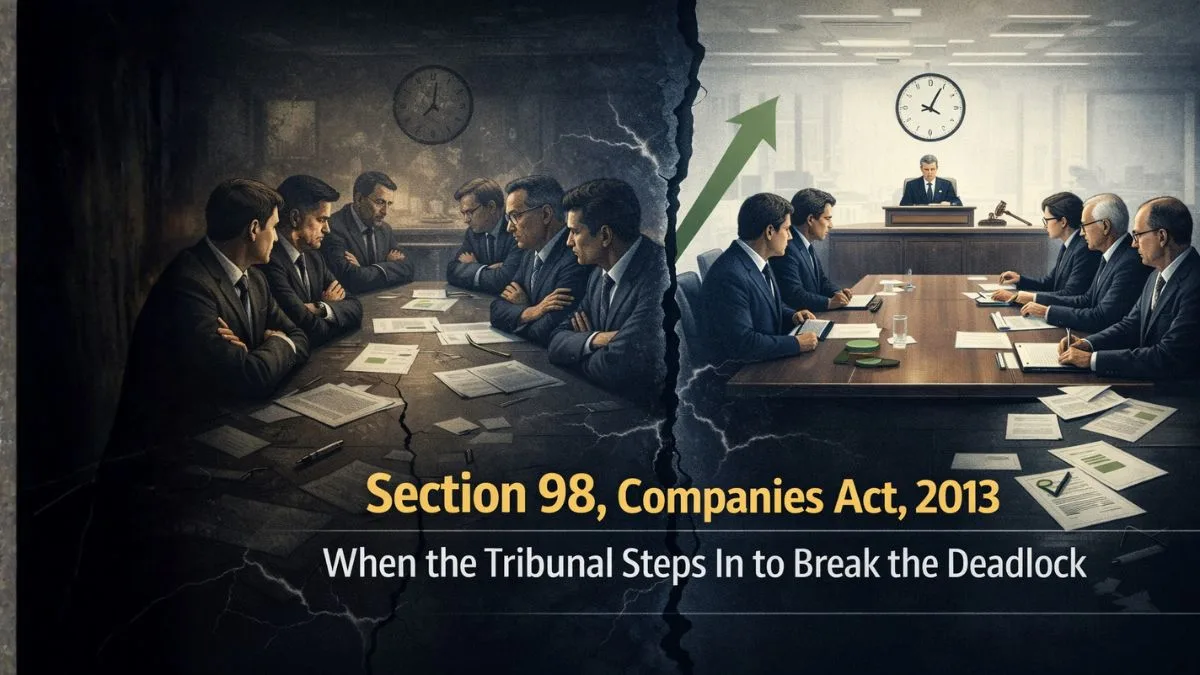
Section 98 of Companies Act, 2013: When the Tribunal Steps In to Keep the Company Moving
Running a company isn’t only about profits, growth charts, or expansion plans. At its core, it’s about decisions. And in company law, decisions don’t just happen casually — they happen through meetings.
But what if a company simply cannot hold a meeting?
Not because it doesn’t want to, but because internal disputes, deadlocks, or management conflicts make it practically impossible.
That’s exactly where Section 98 of the Companies Act, 2013 steps in. Quietly powerful. Often overlooked. But extremely important.
This provision gives the National Company Law Tribunal (NCLT) the authority to step in when a company’s decision-making process comes to a halt.
Why Section 98 Exists at All
In an ideal world, every company would follow its Articles, issue notices on time, conduct meetings smoothly, and respect shareholder rights.
But reality doesn’t always cooperate.
Sometimes directors don’t cooperate.
Sometimes shareholders are divided.
Sometimes meetings are deliberately blocked.
And sometimes, governance just collapses.
Section 98 exists for exactly these moments. It ensures that a company doesn’t become paralysed simply because the usual process has broken down.
The law recognises that procedure should never become a weapon to block decision-making.
What Exactly Does Section 98 Allow?
Section 98 empowers the Tribunal to call, hold or conduct a meeting of the company when it becomes impractical to do so in the normal manner.
And the word “impractical” is important.
It doesn’t mean inconvenient.
It doesn’t mean uncomfortable.
It means genuinely unworkable.
When normal routes fail, the Tribunal can step in and decide:
-
how the meeting will be conducted
-
when it will be held
-
what quorum will apply
-
and even how voting should take place
The idea is simple: corporate governance must continue, no matter the internal chaos.
When Does Section 98 Actually Apply?
Section 98 usually comes into play in situations like:
-
Serious disputes between shareholders
-
Boardroom deadlocks
-
Directors refusing to call meetings intentionally
-
Failure to issue statutory notices
-
Situations where Articles of Association cannot be practically followed
In such cases, expecting the company to function “normally” is unrealistic. That’s when the Tribunal steps in.
Who Can Approach the Tribunal?
The law keeps this very open.
Any director or member of the company can approach the NCLT under Section 98.
You don’t need majority control. Even minority shareholders can seek relief.
This is important because it prevents misuse of power by dominant groups inside the company.
How Much Power Does the Tribunal Really Have?
Quite a lot.
The Tribunal can:
-
Order the calling of a meeting
-
Decide how it will be conducted
-
Modify procedural requirements
-
Ensure fairness in participation
And yes, this power applies not only to general meetings but also to Extraordinary General Meetings (EGMs).
So if an urgent matter requires shareholder approval and management is blocking the process, Section 98 becomes extremely relevant.
Why Section 98 Matters in Real Life
This section becomes especially important in:
-
Family-owned companies
-
Closely held businesses
-
Companies with shareholder disputes
-
Situations involving removal or appointment of directors
Without this provision, companies could remain stuck for years — unable to pass resolutions, take decisions, or move forward.
Section 98 ensures that corporate paralysis doesn’t become permanent.
Tribunal’s Role: Balanced, Not Biased
The NCLT does not blindly allow applications under Section 98.
It examines:
-
Whether the situation is genuinely unworkable
-
Whether the applicant is acting in good faith
-
Whether intervention is actually required
The Tribunal may also impose safeguards such as neutral supervision, proper notice to all members, and transparent voting mechanisms.
The goal is fairness — not favouritism.
Section 98 and Corporate Democracy
Corporate democracy works only when members can express their will.
Section 98 protects that principle.
It ensures that no individual or group can hijack the company by simply blocking meetings. Everyone gets a voice — even minority shareholders.
That’s what makes this section so powerful.
Impact on Management and Directors
For directors, Section 98 is a reminder that control comes with responsibility.
Blocking meetings or manipulating procedures can backfire badly. Tribunal intervention often brings scrutiny that could have been avoided through cooperation.
Good governance isn’t optional anymore.
Compliance and Risk Perspective
From a compliance standpoint, companies should aim to never reach a point where Section 98 is needed.
Clear communication, proper notices, and timely meetings reduce risk significantly.
But if conflict arises, knowing this provision exists can prevent long-term damage.
Difference Between Section 97 and Section 98
This is often misunderstood.
-
Section 97 applies when an AGM is not called.
-
Section 98 applies when any meeting (including EGMs) cannot be conducted practically.
Section 98 is broader and more flexible.
Why Section 98 Truly Matters
This provision doesn’t run the company for you.
It simply ensures the company doesn’t stop functioning.
In a legal system where delays can be costly, Section 98 acts as a safety valve — keeping governance alive when internal systems fail.
Final Thoughts
Section 98 of the Companies Act, 2013 is one of those provisions you hope you never need — but are grateful exists when things go wrong.
It protects members, restores balance, and ensures that corporate decision-making never completely breaks down.
If your company is facing governance challenges, internal disputes, or blocked meetings, professional guidance becomes crucial.
For expert assistance on Section 98 applications, NCLT procedures, and corporate compliance, connect with specialists at Callmyca.com and ensure your next step is legally sound and strategically strong.