
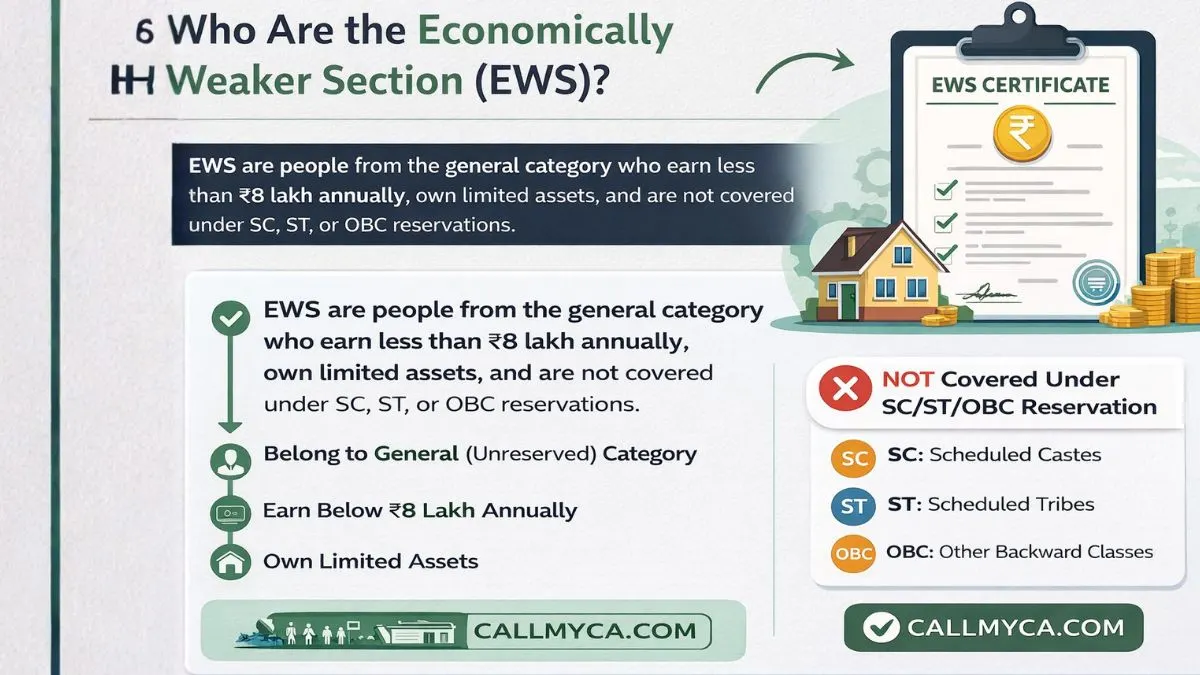
Who Are the Economically Weaker Section (EWS)?
If you’ve ever filled an admission form, applied for a government job, or searched for reservation eligibility, you’ve probably typed who are economically weaker sections into Google.
And the confusion is understandable.
People often ask:
- Is EWS a caste category?
- Is EWS for everyone with low income?
- Can OBC or SC apply for EWS?
- What exactly is the ₹8 lakh limit?
What Is the Economically Weaker Section (EWS)?
Economically Weaker Section (EWS) refers to a group of people in India who:
- Belong to the General (Unreserved) category, AND
- Have low family income and limited assets, AND
- Do not fall under SC, ST, or OBC reservation categories
They are eligible for a 10% reservation in:
- Government jobs
- Educational institutions
This reservation was introduced to address economic disadvantage, not caste-based backwardness.
Who Are Economically Weaker Section—In Simple Words
If we define it simply:
Economically Weaker Section (EWS) are people from the general category who are financially weak but are not covered under SC, ST, or OBC reservations.
That one line clears up most confusion.
Is EWS a caste category?
No. Absolutely not.
EWS is:
- Not a caste
- Not a community
- Not a religion-based category
It is purely an economic category, applicable only to people who otherwise have no reservation benefit.
Who Is Eligible for EWS Reservation?
This is the most searched question:
who is eligible for an EWS certificate
To be eligible, all the following conditions must be met.
1. Category Requirement (Most Important)
EWS applies only to:
- General / Unreserved category candidates
People belonging to:
- SC
- ST
- OBC (Non-Creamy Layer or Creamy Layer)
❌ Are NOT eligible for EWS
This is why people often search for news—to understand who is excluded.
2. Income Limit for EWS
The annual family income must be:
👉 Less than ₹8 lakh per year
This income includes:
- Salary
- Business income
- Professional income
- Pension
- Agricultural income
- Income of parents, spouse, and minor children
This ₹8 lakh limit is the most widely known EWS criterion.
3. Asset Limits for EWS (Often Ignored but Crucial)
Even if income is below ₹8 lakh, asset ownership can disqualify you.
You are NOT eligible for EWS if your family owns:
- Agricultural land of 5 acres or more, OR
- Residential flat of 1000 sq. ft. or more, OR
- Residential plot of 100 sq. yards or more in notified municipalities, OR
- Residential plot of 200 sq. yards or more in non-notified areas
This is why EWS is not just about income—it’s about overall economic status.
Family Definition for EWS
For EWS calculation, “family” includes:
- Applicant
- Parents
- Spouse
- Minor children
The income and assets of all these members are combined.
Who Are NOT Economically Weaker Section (Non-EWS)?
Let’s clearly define non-EWS candidates.
You are NOT EWS if:
- You belong to SC, ST, or OBC (even if income is low)
- Your family income is ₹8 lakh or more
- Your family owns assets beyond prescribed limits
Low income alone does not guarantee EWS status.
EWS Category Caste List—Does It Exist?
Many people search:
ews category caste list
Here is the truth:
👉 There is NO caste list for EWS.
EWS applies to:
- All castes
- All communities
- All religions
As long as:
- You are in the General category
- You meet income and asset criteria
So EWS is casteless but category-restricted.
Why EWS Reservation Was Introduced
Before EWS:
- Reservation was based on social backwardness
- The general category poor had no reservation benefit
EWS was introduced to:
- Address economic disadvantage
- Provide opportunities to poor in unreserved category
- Balance social justice with economic reality
It was introduced through the 103rd Constitutional Amendment (2019).
What Benefits Do EWS Candidates Get?
EWS candidates are entitled to:
- 10% reservation over and above existing reservations
- Applicable in:
- Government jobs
- Central government educational institutions
- Some state institutions (subject to state rules)
- Government jobs
This does not reduce the SC/ST/OBC quota.
What Is an EWS Certificate?
An EWS certificate is an official document that proves:
- You belong to the Economically Weaker Section
- You meet income and asset criteria
It is mandatory to:
- Claim EWS reservation
- Submit during admission or job application
How to Apply for EWS Certificate
This is another common query:
how to apply for an EWS certificate
The general process is:
- Apply through:
- Tehsildar
- Revenue officer
- Online state portal (where available)
- Tehsildar
- Submit:
- Income proof
- Asset declaration
- Identity documents
- Income proof
- Verification by local authority
- Issuance of EWS certificate
Procedures may vary slightly by state.
General EWS Certificate – Validity
Most EWS certificates:
- Are valid for one financial year
- Must be renewed every year
Using an expired certificate can lead to rejection.
EWS vs OBC (Important Difference)
|
Basis |
EWS |
OBC |
|
Basis of reservation |
Economic |
Social & educational |
|
Income limit |
₹8 lakh |
₹8 lakh (NCL) |
|
Category |
General only |
Reserved |
|
Caste-based |
No |
Yes |
|
Reservation % |
10% |
27% (Central) |
This is why OBC/EWS certificate confusion exists—but they are mutually exclusive.
Can OBC apply for EWS?
No.
Even if:
- OBC person earns ₹2 lakh
- The family has no assets
They cannot apply for EWS.
Why?
Because OBC already falls under a reserved category.
Common Misunderstandings About EWS
Let’s clear some myths:
❌ “Anyone earning below ₹8 lakh is EWS.”
❌ “EWS is for poor people of all castes.”
❌ “OBC can choose between OBC and EWS.”
❌ “EWS certificate is permanent.”
All of these are incorrect.
EWS in Admissions and Jobs – Practical Reality
In practice:
- EWS reservation applies only if certificate is valid
- Cut-offs are often high
- Documentation scrutiny is strict
False claims can lead to:
- Cancellation of admission
- Termination from job
- Legal consequences
Judicial View on EWS
Courts have upheld:
- Constitutional validity of EWS
- Income and asset criteria
- Exclusion of SC/ST/OBC from EWS
EWS is now a settled legal position.
Who Are Economically Weaker Section—One-Line Summary
If we summarize who the economically weaker section is in one line:
EWS are people from the general category who earn less than ₹8 lakh annually, own limited assets, and are not covered under SC, ST, or OBC reservations.
Why Understanding EWS Correctly Matters
Misunderstanding EWS leads to:
- Wrong applications
- Rejection of forms
- Loss of opportunity
- Legal trouble
Understanding it correctly saves:
- Time
- Effort
- Stress
Final Thoughts: EWS Is About Economic Fairness, Not Caste
Economically Weaker Section (EWS) was introduced to ensure that:
- Poverty alone is not ignored
- Opportunities reach those who truly need them
- The reservation system remains balanced
But it works only when:
- Rules are understood
- Criteria are respected
- Claims are genuine
If you fall under EWS, it’s a right.
If you don’t, it’s important to respect the boundary.
Need help with EWS certificate eligibility, documentation, or legal clarity?
Visit callmyca.com for clear, practical guidance on certificates, eligibility, and compliance.









