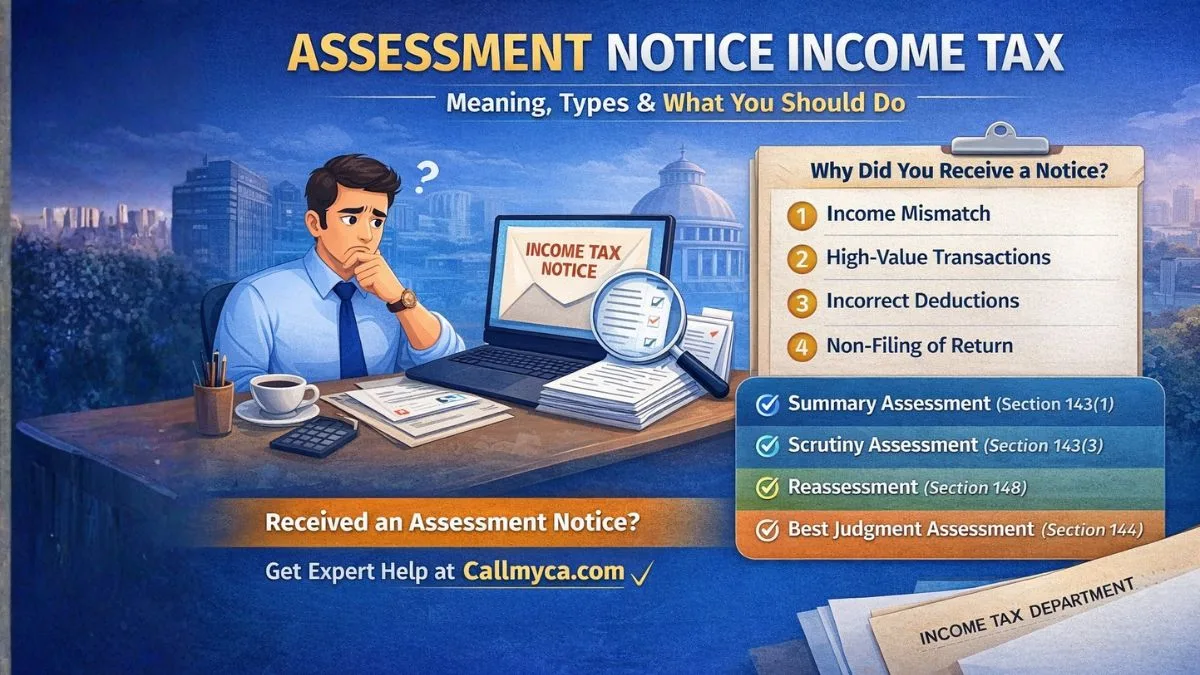
Assessment Notice Income Tax: Meaning, Types & What You Should Do
You file your return.
You think everything is done.
And then… a message pops up —
“You have received an income tax notice.”
Suddenly, things feel serious.
But here’s the truth.
An assessment notice for income tax is not always a problem. In many cases, it’s just the Income Tax Department reviewing your return to ensure everything is correct.
It’s more about verification than punishment.
What is an Assessment Notice in Income Tax?
An assessment notice income tax is an official communication sent by the department when they want to:
👉 Verify your income
👉 Check your deductions
👉 Recalculate your tax
It gives authority to the Assessing Officer to review your return.
In simple words, the department is asking you to confirm your details.
Why Do You Receive an Assessment Notice?
Let’s be practical.
You may receive a notice for reasons like:
1. Income Mismatch
Your income does not match AIS, TDS, or bank data.
2. High-Value Transactions
Large investments or cash deposits.
3. Incorrect Deductions
Deductions claimed without proof.
4. Non-Filing of Return
You had income but didn’t file.
5. Random Selection
Sometimes cases are picked randomly.
So not every notice means something is wrong.
1. Summary Assessment (Section 143(1))
This is the first step.
👉 Automated processing
👉 No detailed check
This is part of self assessment in income tax.
2. Scrutiny Assessment (Section 143(3))
This is a detailed verification.
Under scrutiny assessment under the income tax section 143(3):
👉 Documents are requested
👉 Income is checked deeply
This is known as scrutiny assessment in income tax.
If income is missed, the department can reopen your case.
👉 Called reassessment in income tax
👉 Even past years can be checked
4. Best Judgment Assessment (Section 144)
If you don’t respond:
👉 Department estimates your income
👉 Tax demand can increase
Income Tax Scrutiny Time Limit
The department has a fixed timeline.
👉 Income tax scrutiny time limit applies to issuing notices
Usually:
- Notices must be issued within a certain period after filing
- Delayed notices may not be valid
Sometimes you may hear the income tax scrutiny notice time limit extended due to updates.
Assessment Under Income Tax Act, 1961
All assessments are governed by the Income Tax Act, 1961.
This law defines:
- Types of notices
- Powers of officers
- Procedures
Understanding the section helps you respond properly.
Assessment Procedure of Income Tax
Many people search for the assessment procedure of income tax notes PDF, but here’s the simple version:
Process:
- You file your return
- Department reviews data
- Notice is issued (if needed)
- You submit documents
- Final order is passed
Today, everything happens online under the faceless assessment system.
What Should You Do After Receiving an Assessment Notice?
Don’t panic.
Follow these steps:
1. Read the Notice Carefully
Understand the reason and section.
2. Check the Deadline
Every notice has a time limit.
3. Gather Documents
Prepare proofs of income and deductions.
4. Respond Online
Submit your reply on the portal.
What Happens If You Ignore the Notice?
Ignoring an assessment notice for income tax can lead to:
- Penalties
- Higher tax demand
- Best judgment assessment
- Legal action
So always respond on time.
Tips to Handle Assessment in the Faceless Era
Now everything is digital.
👉 No physical visits
👉 Communication through the portal
👉 Online submission of documents
To handle it smoothly:
- Keep records ready
- Respond quickly
- Upload clear documents
Common Mistakes to Avoid
Many taxpayers make these mistakes:
Ignoring notices
Missing deadlines
Submitting incomplete information
Not understanding the section
Delaying response
Avoid these to stay safe.
When Should You Take Expert Help?
You should consult a professional if:
- Scrutiny notice is received
- Demand is high
- Reassessment is involved
- Case is complex
Experts can help avoid errors.
Final Thoughts
An assessment notice income tax is not something to fear.
It simply means your return is being reviewed.
The key is:
- Understand the notice
- Respond on time
- Provide correct details
If handled properly, most cases are resolved easily.
Don’t Risk Penalties on Tax Notices
Received an assessment notice and are confused about what to do? Don’t take chances. Let experts handle your case — visit Callmyca.com and get your income tax notice resolved quickly and stress-free.