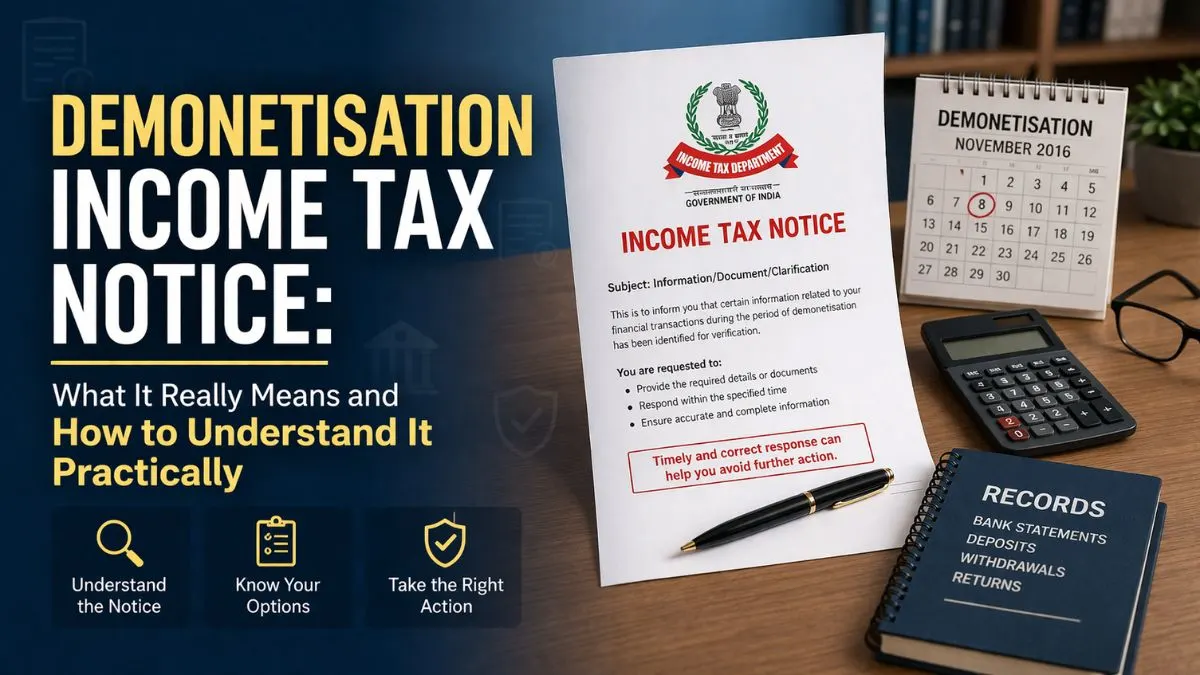
Demonetisation Income Tax Notice: What It Really Means and How to Understand It Practically
What exactly is a demonetisation income tax notice?
At its core, a Demonetisation & notice situation happens when the tax department notices a mismatch between what you reported as income & what you actually deposited during that period.
Specifically, between November 9 & December 30, 2016."
Now think about this.
During demonetisation, people deposited cash — sometimes savings, sometimes business collections, sometimes… things they’d rather not explain. The system recorded everything.
Years later, algorithms & data matching tools flagged certain accounts."
And that’s how Understanding Income Tax Notices for Demonetisation Cash Deposits becomes important."
Because the notice isn’t random.
Why did you receive this notice?
Most people assume receiving a notice means they’ve done something wrong.
Not necessarily.
It usually means one thing:
The department wants clarity.
Here are some common reasons:
- Large cash deposits made during demonetisation are not taxable by default — but unexplained ones can raise questions
- Deposits did not match declared income-tax returns
- No return filed despite high deposits
- Business income not properly recorded
- Cash in hand reported was unusually high
And yes, All the assessees who have deposited good amount of cash during the demonetisation period were under scrutiny.
Not all. But many.
Sections under which notices are issued
Most notices related to Demonetisation fall under:
- Section 142(1) → Asking for information or clarification
- Section 143(2) → Case selected for scrutiny
These are not penalties.
They are questions.
What the notice is actually asking you
Here’s the part people overlook.
The department is not asking for money immediately."
They are asking for an explanation."
Simple question:
Where did the cash come from?
And your answer needs to be clear, logical, & backed by some form of reasoning or records.
Common acceptable explanations include:
- Cash in hand from previous years
- Business sales
- Agricultural income"
- Savings over time"
- Withdrawals redeposited
The real risk: Section 115BBE
Now think about this carefully.
If your explanation doesn’t satisfy the department, the deposited amount can be treated as unexplained income.
And that’s where Section 115BBE comes in.
Tax surcharge penalty = up to 77.25%
Yes. That high.
This is why ignoring a Notification or delaying response is not a good idea.
How to respond to the notice
You don’t need to visit any office immediately. Most responses happen online.
Steps usually involve:
- Log in to the income-tax e-filing portal
- Go to “Pending Actions” or “e-Proceedings”
- Select the relevant notice
- Submit your explanation with details
- Attach supporting documents if required
That’s it.
A small but important detail
Your explanation should:
- Match your financial history
- Be consistent with your ITR
- Not contradict previous filings
- Be reasonable for your income level
Let’s be honest.
If someone with ₹3 lakh annual income claims ₹20 lakh cash savings… it raises questions.
Are all cash deposits taxable?
No.
And this is where confusion spreads.
Cash deposits made during demonetisation are not taxable automatically.
Tax applies only if:
- Source is unexplained
- Income is not declared
- Books/accounts don’t support the claim
So depositing cash itself isn’t the problem.
Explaining it is.
What happens if you ignore the notice?
Ignoring a notice can lead to:
- Best judgment assessment
- Heavy penalties
- Legal proceedings in extreme cases
And once things escalate, fixing them becomes harder.
So even if you’re unsure — respond.
Common mistakes people make
Most people don’t mess up because of tax law.
They mess up because of small errors.
Like:
- Delaying response
- Giving vague answers
- Not checking AIS/Form 26AS
- Copy-pasting generic explanations
- Ignoring mismatch in income
Most people overlook this part.
The system already has your data.
Your response should align with it.
One thing people don’t talk about enough
Time gap.
Why notices come after years.
It feels strange, right?
But here’s the reality:
Data analytics in taxation has improved massively. Old data gets re-analysed with new tools. What was ignored earlier may now get flagged.
So yes, even old Demonetisation deposits can trigger a fresh Income-tax review.
Final thought
If your situation feels even slightly complicated, getting clarity from professionals can save you from unnecessary stress later. Platforms like Callmyca.com can help you understand your case properly & respond in a way that actually makes sense — not just legally, but practically too.