One of the most common doubts among freelancers, small business owners, and startup founders is whether GST registration is actually mandatory for them. Many people assume GST applies only to “big businesses.” In reality, it depends on something far more specific — your aggregate annual turnover and the nature of your supply.
I’ve seen people panic and register too early, and I’ve also seen others ignore GST until a notice arrives. Both situations can be avoided if you clearly understand the GST turnover limit that decides registration.
What Decides Whether GST Registration Is Mandatory?
GST registration is not optional once certain conditions are met. The primary deciding factor is your aggregate annual turnover.
In simple terms:
- What you sell (goods or services)
- How much you sell in a year
- Where you sell from
Together, these determine whether GST registration is compulsory.
Understanding “Aggregate Annual Turnover”
This is where confusion usually begins.
Aggregate turnover includes:
- Taxable supplies
- Exempt supplies
- Zero-rated supplies (like exports)
- Inter-state supplies
It is calculated on a PAN-India basis, not state-wise, and before GST.
Even if you operate in multiple states, turnover from all locations is clubbed together.
GST Turnover Limit for Mandatory Registration
Here’s the most important part.
For Service Providers
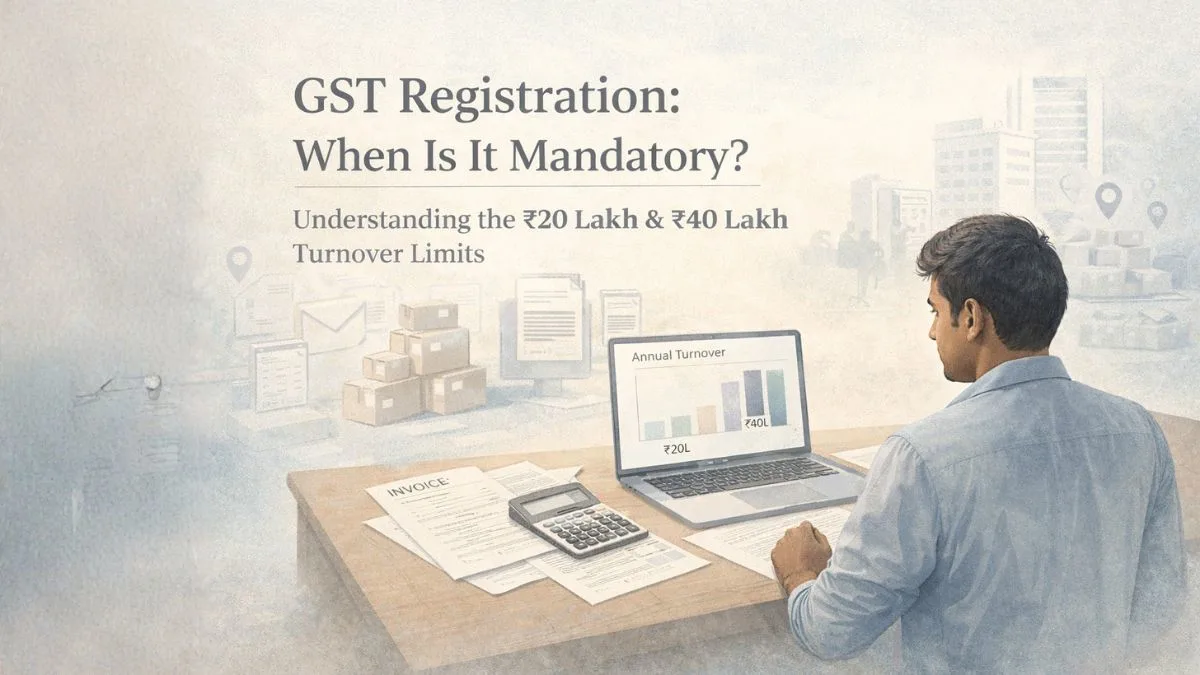
- GST registration becomes mandatory if aggregate turnover exceeds ₹20 lakh in a financial year.
- This ₹20 lakh limit applies in most states across India.
✅ If your annual turnover is below the exemption limit, GST registration is not mandatory.
For Suppliers of Goods
- GST registration is required if your annual revenue exceeds ₹40 lakh.
- This threshold applies only to goods suppliers in most states.
✅ Businesses are required to register for GST and pay tax on their annual turnover if their annual revenue exceeds ₹40 lakh in the case of goods supplied.
Why ₹20 Lakh and ₹40 Lakh Are Treated Differently
This difference exists because:
- Service income is harder to track
- Goods movement is easier to monitor
- Compliance burden varies by nature of supply
That’s why the aggregate turnover limit for mandatory GST registration is ₹20 lakh for services and ₹40 lakh for goods.
Cases Where GST Is Required Even Below the Limit
This is where many people slip up.
You must register for GST regardless of turnover if you:
- Make inter-state taxable supplies
- Sell through online marketplaces
- Are an e-commerce operator
- Are required to deduct or collect TDS/TCS under GST
- Supply goods notified under compulsory registration
I’ve personally seen freelancers cross state lines digitally and assume GST doesn’t apply — until the compliance issue surfaces.
Voluntary GST Registration: Is It a Good Idea?
Yes, sometimes.
Even if your annual turnover is below the exemption limit, GST registration may still make business sense if:
- Your clients demand GST invoices
- You want to claim input tax credit (ITC)
- You plan to scale soon
- You work with GST-registered vendors
But remember — voluntary registration also means regular GST returns. It’s a commitment, not just a certificate.
What Happens If You Skip Registration After Crossing the Limit?
If your business exceeds the prescribed turnover limit, you are required to register.
Failure can lead to:
- Penalty of 10% of tax due (minimum ₹10,000)
- Interest on tax payable
- Mandatory backdated registration
- Compliance notices
I’ve seen businesses lose peace of mind simply because they delayed this decision.
Special Category States: A Quick Note
Some states have lower GST thresholds, but the general limits of:
- ₹20 lakh for services
- ₹40 lakh for goods
apply in most states across India.
Always double-check your state-specific rules if you’re close to the limit.
GST and Small Businesses: A Practical Reality
GST isn’t just about tax; it’s about:
- Business credibility
- Client trust
- Structured growth
But it’s also about compliance. Register when required — not out of fear, not out of assumptions.
Common Misunderstandings to Avoid
- “I don’t charge GST, so I don’t need registration” ❌
- “I worked only half the year” ❌
- “My bank receipts are lower” ❌
GST looks at aggregate turnover, not convenience.
Conclusion
GST registration isn’t something to guess or delay. It is clearly defined by your aggregate annual turnover and the nature of your supply.
- Services: Mandatory above ₹20 lakh
- Goods: Mandatory above ₹40 lakh
- Below the exemption limit? GST registration is not mandatory — unless special conditions apply
If you’re unsure where you stand, getting clarity early can save you money, stress, and legal trouble.
👉 Need help deciding or registering correctly? Visit callmyca.com and get expert guidance tailored to your business.