
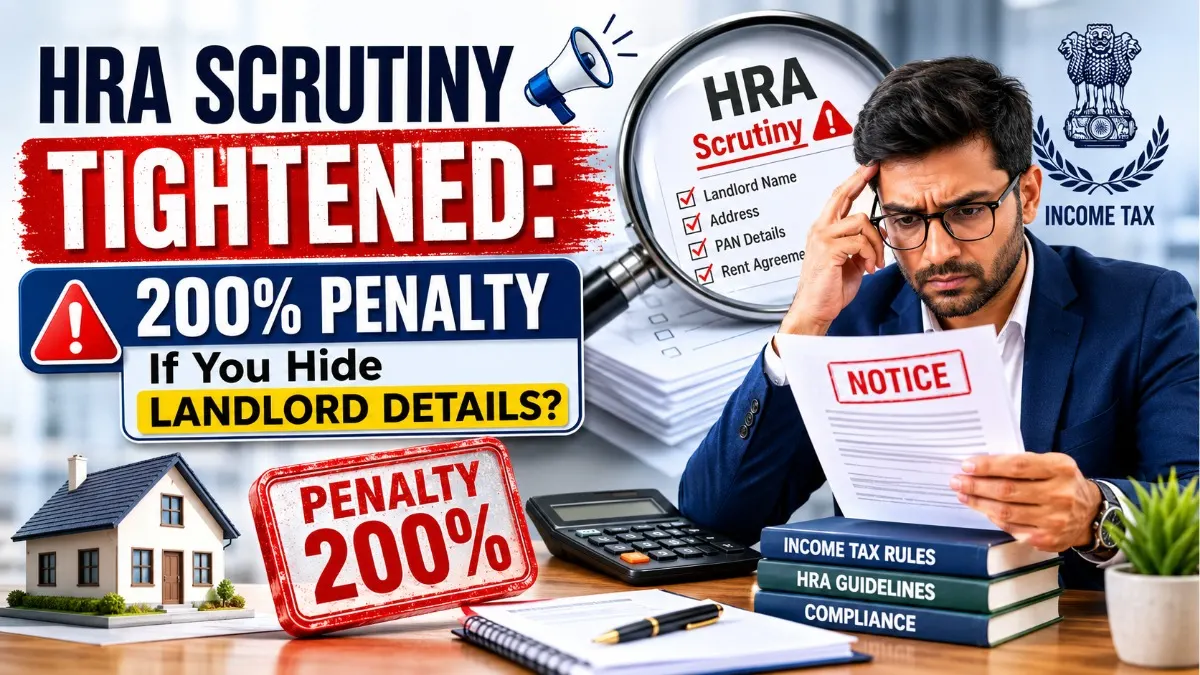
HRA & Rent Income Scrutiny: New Rules, PAN Requirements & 200% Penalty Risk
For years, many of us have been claiming HRA without thinking too much about it. A few rent receipts here, a signature from a family member there. Nobody really checked, right?
Those days are over.
The Income Tax Department has significantly tightened scrutiny on House Rent Allowance (HRA) claims and rental income reporting. Taxpayers must now provide detailed documentation, including the landlord's Permanent Account Number (PAN), rent proofs, and disclosure of any familial relationship with the landlord, to avoid audits or hefty penalties.
I know this sounds scary. But do not worry. I have broken down everything you need to know into simple questions and answers.
When is a Landlord PAN required for ITR Filing?
This is the most common question.
The answer: If your total rent paid in a financial year exceeds ₹1,00,000 (one lakh rupees), you MUST provide your landlord's PAN to claim HRA exemption.
What if my landlord has no PAN? You must obtain a self-declaration from your landlord stating they do not have a PAN, along with their name and address. You will also need a filled Form 60.
What changed in 2026? From April 1, 2026, the old Form 12BB has been replaced with a new declaration form called Form 124. This new form requires the landlord's PAN, your relationship with the landlord, and detailed rent payment information.
Who can Claim HRA Exemption?
Not everyone can claim HRA. Let me make this clear.
You CAN Claim HRA If:
- You are a salary earner – HRA is only for salaried employees. Self-employed people cannot claim it.
- HRA is part of your salary – Your employer must actually give you HRA.
- You live in a rented house – You must actually reside there.
- You pay rent – Actual money must change hands.
- You are under the Old Tax Regime – HRA is NOT available under the new tax regime.
Can I claim HRA if I pay rent to my parents?
Yes. But the arrangement must be genuine. You must actually transfer money. And your parents must show that rental income in their own income tax return.
Can I claim both HRA and home loan benefits?
Yes! If you own a house in one city but live on rent in another city for work, you can claim both the HRA exemption and the home loan interest deduction.
Documents Required for Claiming HRA Deduction
Here is your complete checklist.
|
Document |
When Required |
|
Rent Receipts |
Always |
|
Form 124 (new) |
Always |
|
Landlord's PAN |
If annual rent > ₹1,00,000 |
|
Rent Agreement |
Strongly recommended |
|
Bank/UPI Payment Proof |
Strongly recommended |
Do I need a rent agreement? A formal rent agreement is NOT mandatory. But from April 1, 2026, you are expected to maintain one. My advice? Just get one. It takes one hour and saves you from questions later.
Why digital payment proof matters – Always pay rent through bank transfer or UPI. Avoid cash. The tax department loves a digital trail.
HRA Rent Receipt Format
What should a rent receipt actually look like?
Minimum information your rent receipt must have:
- Date of receipt
- Your full name (tenant)
- Landlord name
- Complete property address
- Rent amount in numbers and words
- Month and year of rent
- Landlord signature
Sample format you can copy:
text
RENT RECEIPT
Receipt No: [001] | Date: [01/04/2026]
Received from Mr./Ms. [Your Name] a sum of Rs. [25,000]
towards rent for the month of [April 2026] for property at:
[Full Property Address]
Landlord Name: [Name]
Landlord PAN: [ABCDE1234F] (if rent > ₹1 lakh/year)
Signature: ____________
Important rule: If your monthly rent is more than ₹3,000, you must furnish rent receipts to claim HRA exemption.
Is It Mandatory to Provide a Rent Receipt to Claim HRA Exemption?
Yes, it is mandatory.
If your monthly rent exceeds ₹3,000, you must provide rent receipts to your employer. Without receipts, your employer will not reduce your TDS.
Even if your employer does not ask, you MUST keep receipts yourself. If the tax department selects your return for scrutiny, you will have to produce all rent receipts.
What happens if you have no receipts? In a real case, an income tax tribunal rejected someone's HRA claim because there was no proof that rent was actually paid apart from a receipt that could have been easily faked.
So yes, rent receipts are mandatory. And so is proof of actual payment.
Consequences of Not Disclosing Rent Receipts
This is the scary part. But you need to know the truth.
Consequence 1: Your HRA Claim Will Be Rejected
If you fail to provide correct details, your HRA claim can be completely disallowed. Your taxable income will increase.
Consequence 2: Penalty Under Section 270A – Up to 200%
Under Section 270A, penalties can be 50% of tax payable for under-reporting, and up to 200% of the tax payable for misreporting.
If your tax on the disallowed HRA claim was ₹50,000, you could pay ₹1,00,000 penalty. Plus original tax. Plus interest.
Consequence 3: Scrutiny Assessment
Your return may be selected for complete scrutiny. A tax officer will examine everything.
Consequence 4: Landlord Will Also Be in Trouble
When you claim HRA using your landlord's PAN, the department knows your landlord received rental income. If they have not shown it in their return, they will get a notice too.
Consequence 5: Interest on Tax Due
You will pay original tax 1% monthly interest penalty up to 200%. You could pay double or triple what you tried to save.
How the Tax Department Verifies HRA Claims
Method 1 – PAN matching: When you provide your landlord's PAN, computers check if that landlord showed rental income in their return.
Method 2 – AIS: The Annual Information Statement shows all your transactions. If rent payments don't match bank statements, you are flagged.
Method 3 – Data analytics: If your rent seems too high for your area or your salary, you may be selected.
Method 4 – Cross-verification with employers: Any mismatch between what you told your employer and what you filed will be caught.
New HRA Rules from April 1, 2026 – Summary
|
Particular |
Before |
After April 1, 2026 |
|
Disclose relationship with landlord |
Not required |
Mandatory |
|
Declaration form |
Form 12BB |
Form 124 |
|
Landlord PAN (rent > ₹1 lakh) |
Required |
Same, strictly enforced |
|
Rent agreement |
Recommended |
Expected |
|
Metro cities for 50% HRA |
Delhi, Mumbai, Kolkata, Chennai |
Added Bengaluru, Hyderabad, Pune, Ahmedabad |
|
Penalty for misreporting |
50-200% |
Same, actively enforced |
Important: If you live in Bengaluru, Hyderabad, Pune, or Ahmedabad, you can now claim HRA at 50% of basic salary (instead of 40%). Do not miss this.
What Should You Do Right Now?
Step 1: Calculate your total annual rent. If over ₹1 lakh, get landlord's PAN.
Step 2: Get a proper rent agreement.
Step 3: Pay rent digitally – UPI, bank transfer, or cheque.
Step 4: Collect monthly rent receipts. Do not skip any month.
Step 5: If paying rent to family, do it properly – agreement, actual transfer, and they must show rental income in their ITR.
Step 6: Disclose relationship honestly in Form 124. Hiding it is misreporting = 200% penalty.
Step 7: Keep all documents for 6 years.
My Personal Take
I understand the temptation. HRA is legitimate tax saving. But people have misused it for years.
The Income Tax Department has had enough. The new rules requiring disclosure of relationship with the landlord are specifically aimed at catching fake family rent claims.
If your arrangement is genuine – you actually pay rent, your parent actually receives it and pays tax – you have nothing to worry about.
But if you have been faking it, stop now. A 200% penalty will wipe out years of "savings" in one go.
HRA means House Rent Allowance – it is meant for actual rent paid. Be honest. Keep proper documents. Pay digitally. Disclose everything.
Need Help with HRA Claims or ITR Filing?
HRA rules have changed significantly in 2026. Between Form 124, mandatory PAN disclosure, relationship reporting, and the expanded metro city list, it is easy to make a mistake. A mistake can cost you tax, interest, and penalties.
Visit Callmyca.com today and connect with a Chartered Accountant who can help you file your ITR correctly, claim the right HRA exemption, and keep you safe from scrutiny.









