Section 13 CrPC Explained: Special Judicial Magistrates and Their Role in the Criminal Justice System
If you have ever gone through court orders, police proceedings, or criminal case filings, you may have noticed something interesting. Some orders are passed not by regular magistrates, but by officials designated as Special Judicial Magistrates.
That naturally raises questions:
- Who are these special judicial magistrates?
- How are they appointed?
- What powers do they have?
- And most importantly, where does the law allow this?
What Is Section 13 CrPC?
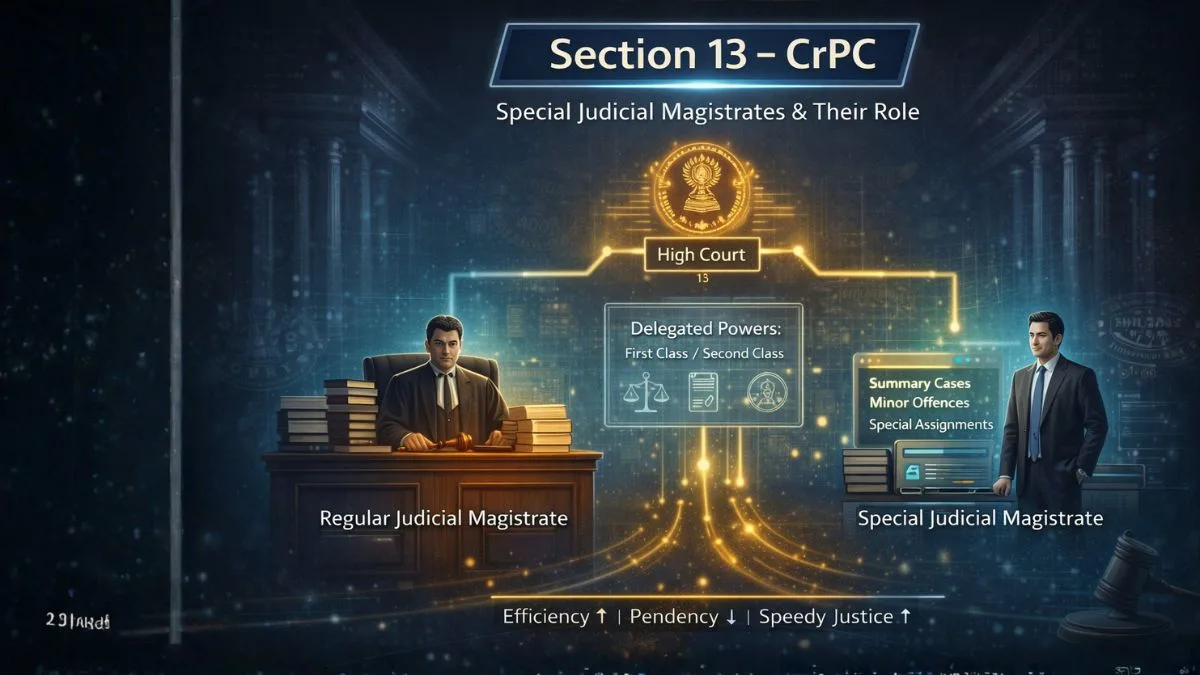
Section 13 CrPC is a provision under the Code of Criminal Procedure, 1973, that empowers the High Court to appoint Special Judicial Magistrates (SJMs).
In simple words:
Section 13 of the CrPC allows certain qualified government officials to function as judicial magistrates for specific purposes, areas, or cases.
This provision exists to improve efficiency, speed, and specialization in the criminal justice system.
The Core Idea Behind Section 13 CrPC
Indian courts deal with an enormous volume of cases. Regular magistrates often handle hundreds of matters every month. To reduce pressure and ensure quicker disposal of specific types of cases, the law allows temporary judicial appointments.
That is exactly what Section 13 CrPC provides.
Instead of creating permanent courts, the system temporarily empowers experienced officials to act as magistrates.
Who Can Be Appointed Under Section 13 CrPC?
Under Section 13 CrPC, the High Court may appoint:
- Government servants
- Officers with legal knowledge or judicial experience
- Persons considered suitable for handling judicial work
These individuals are then designated as Special Judicial Magistrates.
They are not random officers. The emphasis is always on experience, competence, and suitability.
What Is a Special Judicial Magistrate (SJM)?
A Special Judicial Magistrate (SJM) is a person who:
- Is not a regular member of the judiciary
- Is temporarily empowered to exercise magistrate powers
- Functions only within the scope assigned by the High Court
This is why Section 13 CrPC is often referred to simply as the provision dealing with Special Judicial Magistrates.
Powers Granted Under Section 13 CrPC
Once appointed, an SJM may be given powers of:
- Judicial Magistrate First Class, or
- Judicial Magistrate Second Class
The extent of power depends on:
- The High Court’s notification
- The nature of cases
- The purpose of appointment
They do not automatically get full powers. Everything is clearly defined.
Duration of Appointment Under Section 13 CrPC
One very important feature of Section 13 CrPC is the limited tenure.
An SJM is appointed for:
- A term not exceeding one year at a time
The appointment can be:
- Renewed, or
- Allowed to lapse automatically
This ensures flexibility and prevents misuse of authority.
Why Section 13 CrPC Exists (Practical Reasoning)
From real-world practice, Section 13 CrPC is commonly used to:
- Handle minor offenses.
- Dispose of summary cases
- Deal with specific categories like traffic, regulatory, or local offenses.
- Reduce pendency in regular magistrate courts
Instead of burdening full-time judges with routine matters, the law creates functional relief points.
Relationship Between Section 13 CrPC and Judicial Hierarchy
A common doubt arises:
Are Special Judicial Magistrates independent?
The answer is no.
As per the CrPC structure:
- Every Chief Judicial Magistrate shall be subordinate to the Sessions Judge
- Special Judicial Magistrates also function within this hierarchy
They are subject to:
- Supervisory jurisdiction
- Administrative control
- Judicial oversight
This maintains discipline and uniformity.
Section 13 CrPC vs Regular Judicial Magistrates
Let’s clarify this with a simple comparison.
Regular Judicial Magistrate
- Permanent judicial officer
- Member of judicial service
- Broad jurisdiction
- Full-time role
Special Judicial Magistrate (Section 13 CrPC)
- Temporary appointment
- Often government official
- Limited jurisdiction
- Specific purpose or area
This distinction is crucial when questioning the authority or validity of orders.
Common Situations Where Section 13 CrPC Is Used
You will often find Section 13 CrPC appointments in cases involving:
- Municipal or local law offences
- Special drives (traffic, sanitation, encroachment)
- Regulatory compliance cases
- Summary criminal matters
These appointments help in fast-track handling of repetitive cases.
Legal Validity of Orders Passed by SJMs
A frequently asked question:
Are orders passed by Special Judicial Magistrates legally valid?
Yes—completely valid, provided:
- The appointment is properly notified
- Powers are exercised within scope
- Jurisdictional limits are respected
Courts have repeatedly upheld actions taken by SJMs when Section 13 CrPC procedures are followed.
Can Section 13 CrPC Be Challenged?
Yes, but only on specific grounds, such as
- Lack of valid appointment
- Acting beyond granted powers
- Jurisdictional overreach
- Violation of principles of natural justice
A challenge cannot succeed merely because the officer is not a regular magistrate.
Difference Between Section 11, 12, and 13 of the CrPC
To fully understand Section 13 CrPC, it helps to see it in context.
- Section 11 CrPC – Establishment of Courts of Judicial Magistrates
- Section 12 CrPC – Appointment of Chief Judicial Magistrates
- Section 13 CrPC – Appointment of Special Judicial Magistrates
So, Section 13 is a supplementary provision, not a replacement.
Why the High Court’s Role Is Crucial
Under Section 13 CrPC, only the High Court can:
- Decide suitability
- Define jurisdiction
- Specify duration
- Grant or restrict powers
This ensures:
- No political or administrative misuse
- Judicial independence
- Uniform standards across the state
Practical Example to Understand Section 13 CrPC
Imagine a city flooded with minor regulatory offenses—traffic violations, local rule breaches, and petty offenses.
Instead of assigning hundreds of such cases to regular courts, the High Court appoints a legally trained government officer as an SJM for six months.
Result:
- Faster disposal
- Reduced pendency
- Efficient use of judicial resources
That’s Section 13 CrPC working as intended.
Common Misunderstandings About Section 13 CrPC
Let’s clear a few myths:
Myth 1: SJMs are not real magistrates
Truth: They exercise real judicial powers within limits
Myth 2: Their orders are inferior
Truth: Orders are legally enforceable
Myth 3: Anyone can be appointed
Truth: Only suitable, experienced officials qualify
Why Section 13 CrPC Is Still Relevant Today
With increasing litigation and limited judicial manpower, Section 13 CrPC has become more important than ever.
It allows the system to:
- Adapt to workload
- Respond to local needs
- Maintain efficiency without compromising legality
That’s why high courts continue to rely on it.
Key Takeaways on Section 13 CrPC
- Section 13 CrPC deals with Special Judicial Magistrates
- Appointments are made by the High Court
- Powers can be First or Second Class Magistrate
- Tenure is temporary (maximum one year)
- The purpose is efficiency, not replacement of the judiciary.
Final Thoughts: Section 13 CrPC Is About Smart Administration
At its core, Section 13 CrPC is not about shortcuts—it’s about smart judicial administration.
It balances:
- Judicial independence
- Administrative efficiency
- Speedy justice
Once you understand its purpose, the provision feels logical rather than confusing.
If you’re dealing with a criminal case, an SJM order, or jurisdiction-related confusion under Section 13 CrPC, professional clarity makes all the difference.
For expert legal and procedural guidance across criminal law, compliance, and court matters, you can always connect with professionals through callmyca.com—because clarity in law is the first step toward confidence.