
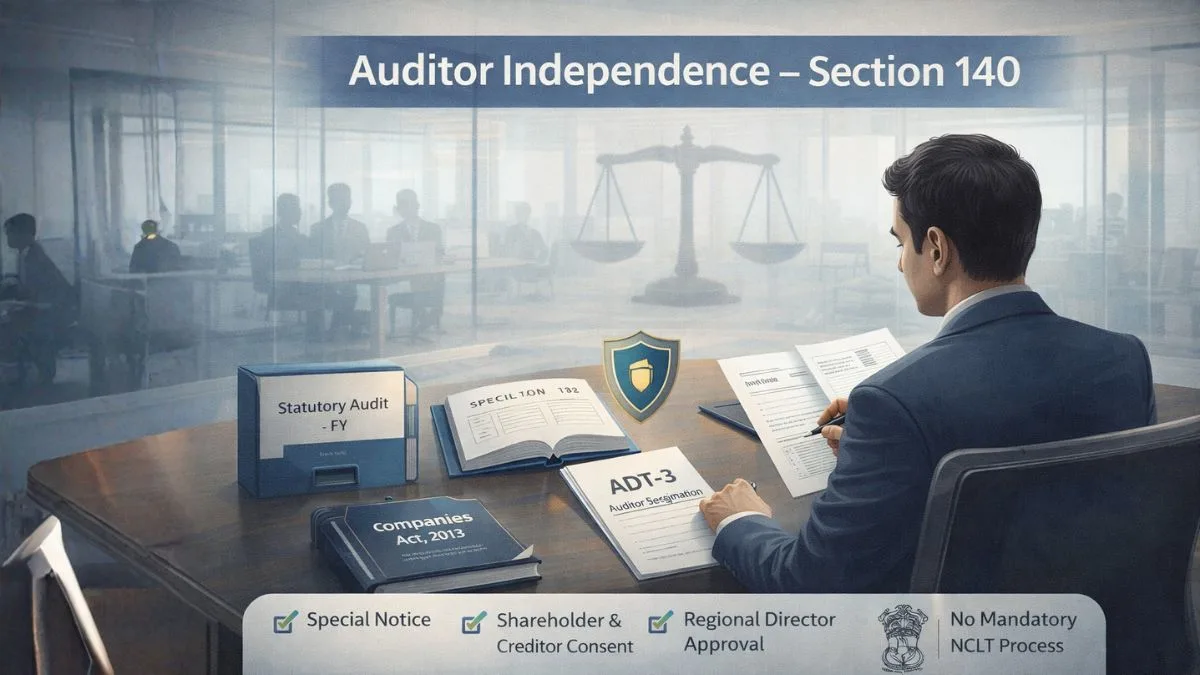
Section 140 of the Companies Act, 2013: Why Auditor Independence Is Not Just a Legal Formality
Auditors are often seen as outsiders who simply come in once a year, check numbers, sign reports, and leave. But in reality, they play a far deeper role. An auditor is one of the very few people in a company who is legally expected to question management, challenge explanations, and point out things that may not look right.
That is exactly why auditor independence matters so much in company law.
The Companies Act, 2013, recognizes this risk very clearly. If auditors are not protected, they can be removed the moment they become “inconvenient.” To prevent that, the law introduced Section 140 of the Companies Act, 2013, which deals specifically with the removal and resignation of auditors.
This section exists for one simple reason: to make sure that auditors are not pushed out for doing their job honestly and, at the same time, to ensure companies follow a transparent process when audit relationships change.
What Section 140 Is Really About
At its core, Section 140 of the Companies Act, 2013, talks about three things:
-
removal of an auditor before the end of their term
-
resignation of an auditor
-
procedural safeguards like special notice and government approval
The idea is not to make things complicated. The idea is to stop misuse of power.
This section applies to all companies that are required to appoint statutory auditors. Whether it is a private company or a public company, the moment an auditor is involved, Section 140 steps in to regulate how and when that auditor can leave or be asked to leave.
And yes, it is intentionally strict. Because audit independence is not something the law takes lightly.
Can a Company Remove Its Auditor Anytime?
Short answer? No.
Under Section 140, an auditor cannot be removed casually or quietly before the expiry of their term. The board of directors alone cannot decide this. Even shareholders cannot directly do it without following the law.
There is a reason for this.
The company must first take prior approval from the Central Government. Only after that approval is granted can the matter be placed before shareholders. Then, a special resolution must be passed at a general meeting.
This two-level process is deliberate. It ensures that removal is not based on ego clashes, uncomfortable audit comments, or pressure tactics. Shareholders get a voice, and the government acts as a neutral observer.
In practical terms, it makes arbitrary removal very difficult.
Why Special Notice and Government Approval Matter
The requirement of special notice under Section 140 is not a technicality. It ensures transparency.
Shareholders must clearly know that an auditor’s removal is being proposed, and they must be informed in advance. No last-minute surprises. No quiet replacements.
The involvement of the Central Government adds another layer of protection. Authorities look at the reasons for removal and assess whether they are genuine or linked to audit objections or adverse findings.
This step alone has prevented countless unfair removals over the years.
What Happens When an Auditor Resigns?
Auditors are not bonded labor. They can resign. Section 140 recognizes that too.
But resignation is not meant to be silent or unexplained.
When an auditor resigns, they are required to file Form ADT-3 with the Registrar of Companies within 30 days, clearly stating the reasons for resignation.
This disclosure is important. But if an auditor has resigned due to lack of cooperation from the company’s management or due to suppression of certain pieces of financial information, the regulator has to be made aware of that.
So even while exiting, the auditor remains accountable.
Responsibilities Don’t End With Resignation
One thing many auditors underestimate is that compliance does not end the day they resign.
Failing to file Form ADT-3 within the prescribed time can attract penalties. The law expects auditors to act responsibly, even at the point of exit.
This requirement also protects auditors. If the resignation was forced or uncomfortable, the written statement becomes a formal record. It creates traceability. And in corporate law, traceability matters a lot.
Appointment of a New Auditor After Removal or Resignation
Once an auditor is removed or resigns, the company must act quickly. Leaving the position vacant is not an option.
A new auditor has to be appointed following the provisions of the Companies Act. Eligibility, consent, and proper appointment procedures must be followed.
This ensures that audit oversight continues without disruption and that statutory compliance is maintained at all times.
Liability of the Audit Firm
Section 140 also makes one thing very clear: liability does not stop with the individual auditor.
If the auditor is part of an audit firm, the firm itself can be held liable. This prevents partners from escaping responsibility by shifting blame internally.
It encourages stronger discipline, internal checks, and professional accountability within audit firms.
Why Section 140 Is So Important for Corporate Governance
Section 140 quietly reinforces a powerful principle: auditors are not answerable to management. They are answerable to law and stakeholders.
By regulating removal and resignation, the provision protects auditors from pressure while ensuring companies act transparently. It builds trust. It reassures investors. And it strengthens governance frameworks.
Without Section 140, audit independence would exist only on paper.
Common Errors Companies and Auditors Make
Despite its importance, Section 140 is often misunderstood.
Companies sometimes assume that a board resolution is enough to remove an auditor. Others skip Central Government approval or issue improper notices.
Auditors, on the other hand, often delay or forget filing Form ADT-3, not realizing that penalties can still apply.
Most of these mistakes come from lack of awareness, not intention. But the consequences can still be serious.
Final Thoughts
Section 140 of the Companies Act, 2013, is not about control. It is about balance.
It protects companies from uncertainty, auditors from unfair treatment, and stakeholders from compromised financial reporting. When followed properly, it strengthens trust on all sides.
And that, in the long run, is what good corporate law is supposed to do.
Looking for assistance in procedures related to the auditor's removal, filing of resignation, or corporate compliance under the Companies Act, our team at Callmyca.com will be able to guide the same clearly, correctly, and without complicating the affairs unnecessarily.









