Section 8 Microfinance Company Registration Process: A Simple, Real-World Guide
If you’re thinking of starting a microfinance company, chances are your intention is not just profit—it’s impact.
You want to:
- Support small borrowers
- Help self-help groups, women entrepreneurs, or rural businesses
- Provide affordable credit where banks don’t reach
And that’s exactly why many founders explore the Section 8 microfinance company registration process.
But here’s the honest truth.
Most people get confused very early because:
- Section 8 companies are not normal companies
- Microfinance is also regulated by RBI
- And the process mixes company law and financial regulation
First Things First: What Is a Section 8 Microfinance Company?
Before jumping into the Section 8 microfinance company registration process, let’s clear the basics.
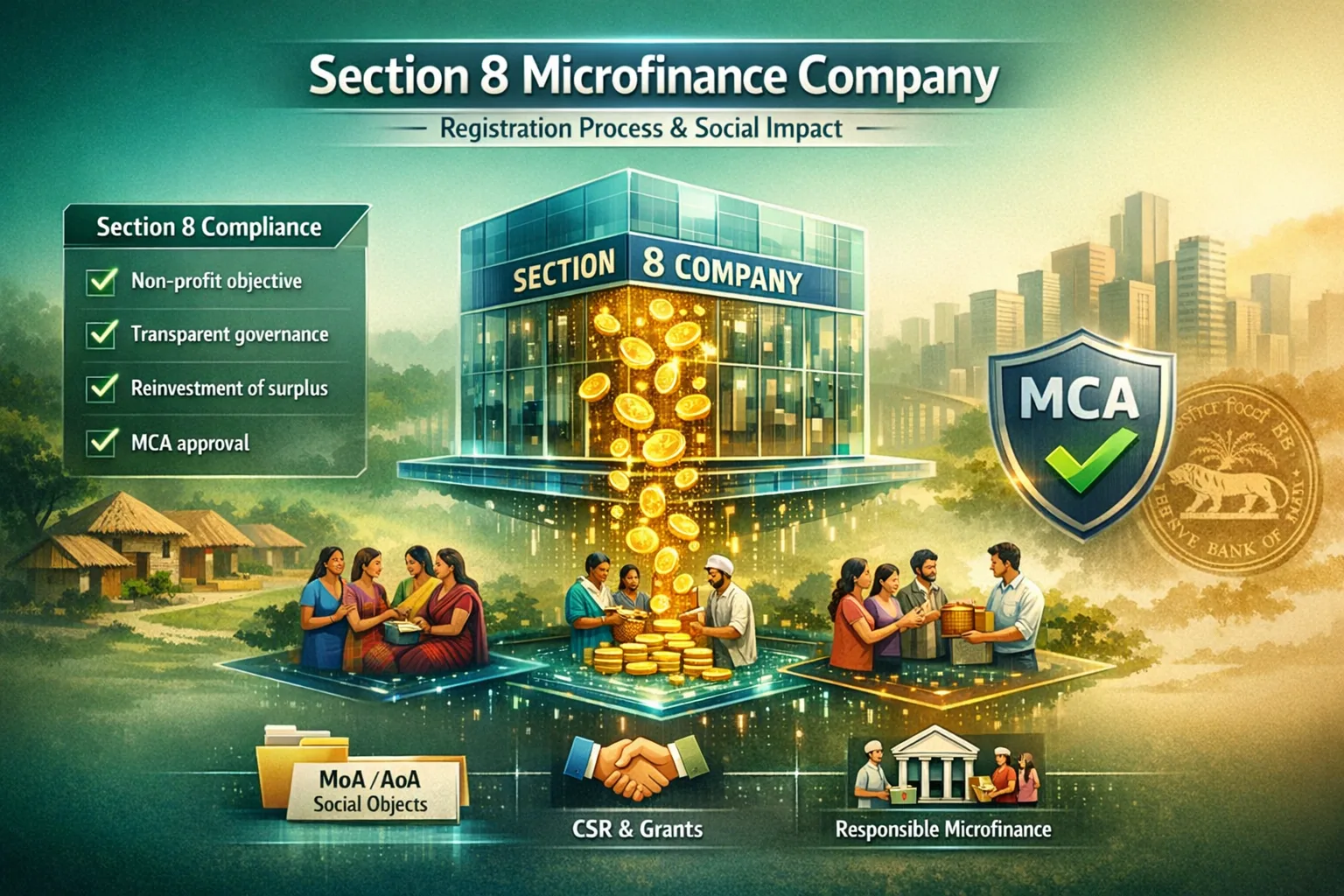
A Section 8 Microfinance Company is:
- A non-profit company registered under Section 8 of the Companies Act, 2013
- Formed for social objectives, not profit distribution
- Allowed to provide microfinance-related services
The key point is this:
Any surplus earned is reinvested into the mission—not distributed as dividends.
That’s what differentiates it from NBFC-MFIs or private finance companies.
Why Choose Section 8 for a Microfinance Company?
People often ask:
“Why not just register a normal NBFC?”
Here’s why founders choose Section 8:
- Focus on financial inclusion, not shareholder profit
- Easier access to grants, CSR funds, and donations
- Better trust among beneficiaries and NGOs
- Strong social credibility
That’s why the Section 8 microfinance company registration process is popular among NGOs and impact-driven founders.
Can a Section 8 Company Do Microfinance?
Yes—but with conditions.
A Section 8 company:
- Can provide micro-loans
- Can work with SHGs, JLGs, or low-income borrowers
- Must follow latest RBI guidelines for section 8 microfinance company (where applicable)
- Cannot behave like a commercial lender
The emphasis must always remain on social purpose over profit.
Requirements for Section 8 Microfinance Company Registration
Let’s talk eligibility before the process.
Basic Requirements
To start the Section 8 microfinance company registration process, you need:
- Minimum 2 directors (for a private Section 8 company)
- At least 2 members/subscribers
- One director must be an Indian resident
- Clear charitable and microfinance objective
There is no minimum capital requirement, which is a big advantage.
Objects Clause: The Heart of the Application
This is where most applications get rejected.
Your MoA (Memorandum of Association) must clearly mention:
- Microfinance
- Financial inclusion
- Support to economically weaker sections
- Livelihood development
The MCA closely examines whether your objectives justify a Section 8 license.
This is why drafting the MoA/AoA is the most critical step in the Section 8 microfinance company registration process.
Step-by-Step Section 8 Microfinance Company Registration Process
Now let’s break the process into simple, logical steps.
Step 1: Obtain DSC and DIN
The first step in the Section 8 microfinance company registration process is compliance readiness.
You must obtain:
- DSC (Digital Signature Certificate) for directors
- DIN (Director Identification Number)
Without these, no MCA filing can happen.
Step 2: Name Approval (SPICe Part A)
Next comes name approval through:
- SPICe Part A on the MCA portal
The name must:
- Reflect the nonprofit nature
- Avoid words suggesting profit or commercial lending
- Include words like "foundation," "society," "association," etc.
For microfinance, the name should subtly indicate:
- Financial inclusion
- Social lending
- Development focus
This step is crucial in the Section 8 microfinance company registration process.
Step 3: Drafting MoA and AoA (Very Important)
Now comes the backbone of your company.
You must draft:
- MoA with clear microfinance and charitable objects
- AoA defining governance, restrictions, and non-profit rules
The drafting must emphasize:
- No dividend distribution
- Income used only for objectives
- Social purpose over profit
If this step is weak, MCA may reject the Section 8 license.
Step 4: Filing SPICe Part B and AGILE-PRO
Once documents are ready, you file:
- SPICe Part B (incorporation form)
- AGILE-PRO (GST, EPFO, ESIC, bank account, etc.)
This step officially submits your Section 8 microfinance company registration process to MCA.
Step 5: Section 8 License Application
Unlike normal companies, Section 8 companies require special approval.
MCA reviews:
- Objects
- Declarations by directors
- Financial projections
- Intent and credibility
If satisfied, MCA grants the Section 8 license.
Step 6: Certificate of Incorporation (COI)
After approval:
- MCA issues Certificate of Incorporation (COI)
- Your Section 8 microfinance company legally comes into existence
At this point, your Section 8 microfinance company registration process is complete.
Registration Fees and Costs (Practical Clarity)
People often search:
- section 8 microfinance company registration fees
Here’s the realistic answer.
Government Fees
- Section 8 companies enjoy reduced MCA fees
- Stamp duty depends on the state.
Professional Fees
- Drafting MoA/AoA
- Handling MCA objections
- End-to-end compliance
Costs vary based on complexity and advisory support.
RBI Guidelines: An Important Reality Check
Many founders assume:
“Section 8 hai, RBI ka issue nahi hoga.”
That’s not entirely true.
While Section 8 companies are not NBFCs:
- Lending activities may still attract RBI oversight
- Especially if loans resemble commercial microfinance
Always stay aligned with the latest RBI guidelines for Section 8 microfinance companies to avoid regulatory trouble.
Section 8 Microfinance Company Rules You Must Follow
Once registered, you must follow strict rules:
- No dividend to members
- Income used only for stated objectives
- Annual compliance with MCA
- Transparent accounting
- No profit-driven lending practices
These Section 8 microfinance company rules ensure the social nature remains intact.
Can You Buy or Sell a Section 8 Microfinance Company?
You may see searches like
- section 8 microfinance company for sale
Legally speaking:
- Section 8 companies cannot be sold like assets
- Transfer of control is highly restricted
- MCA approval is mandatory for structural changes
Any “ready-made” Section 8 company must be evaluated carefully.
Section 8 Microfinance Company List in India
There is no single public database titled
- section 8 microfinance company list pdf
However:
- MCA portal records all Section 8 companies
- Activity classification helps identify microfinance-focused entities
Always verify status before collaboration.
Section 8 vs Small Finance Company Registration
Many people confuse:
- section 8 Microfinance Company Registration Process
- with small finance company registration
They are completely different.
|
Section 8 Microfinance |
Small Finance Company |
|
Non-profit |
For-profit |
|
MCA regulated |
RBI regulated |
|
No minimum capital |
Very high capital |
|
Social lending |
Commercial banking |
Choose based on your intent, not just opportunity.
Common Mistakes to Avoid
From real experience, avoid these:
- Weak or vague microfinance objectives
- Copy-paste MoA/AoA
- Ignoring RBI angle
- Treating Section 8 like a normal company
- Assuming profits can be distributed
These mistakes can derail your Section 8 microfinance company registration process.
Final Thoughts (From Real Experience)
Starting a Section 8 microfinance company is not just a legal process—it’s a commitment.
A commitment to:
- Financial inclusion
- Ethical lending
- Long-term social impact
The Section 8 microfinance company registration process is detailed because the law wants to ensure your intent is genuine.
If done correctly, it gives you:
- Credibility
- Trust
- A strong platform to create real change
If you’re serious about registering a Section 8 microfinance company and want the process handled smoothly—from drafting to MCA approval—professional guidance saves time, cost, and future compliance stress.
For expert support on Section 8 company registration, microfinance structuring, and end-to-end compliance, visit callmyca.com.