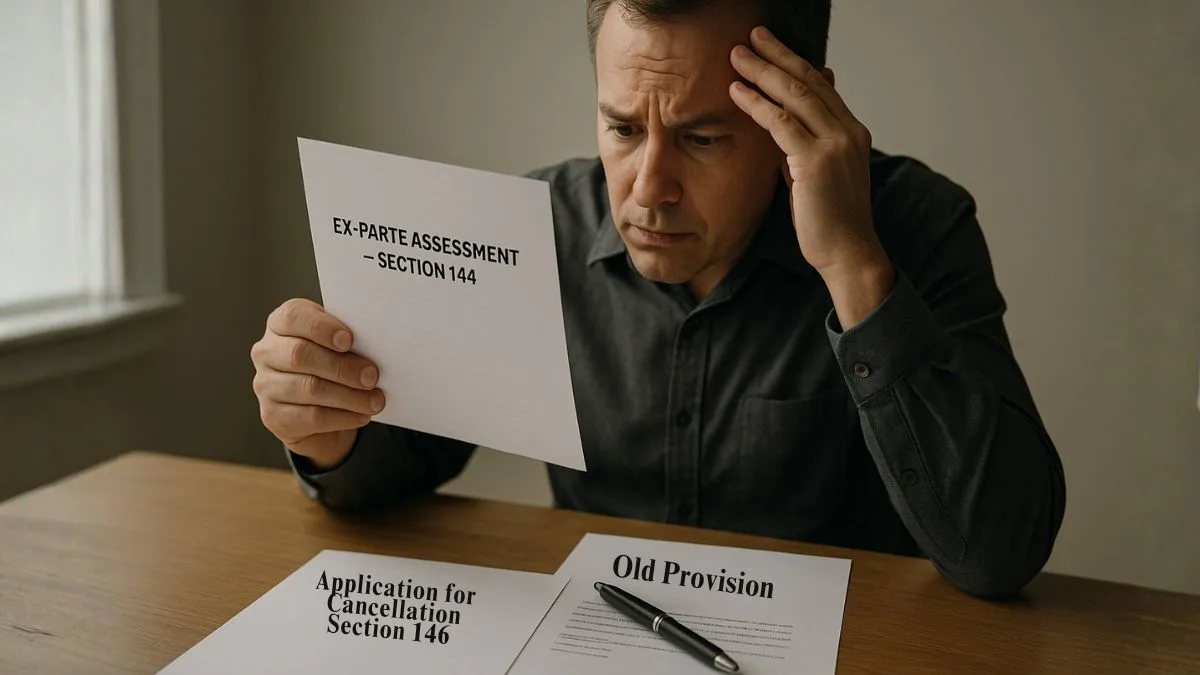
If you've ever received a tax notice unexpectedly, you know the sinking feeling that comes with it. Now imagine that happening decades ago, before email, before online portals, before instant updates. Many assessments were done ex-parte — meaning the Income Tax Officer passed an order without hearing the taxpayer, often because they believed the taxpayer didn’t comply.
To handle such genuine cases, there once existed a provision: Section 146.
Before its omission, Section 146 provided a mechanism for an assessee to apply for cancellation & fresh assessment of an ex-parte assessment made under Section 144. The section helped those who missed a notice for reasons beyond their control. But eventually, after improvements in tax administration, it was omitted by the Direct Tax Laws (Amendment) Act, 1987, effective from April 1, 1989.
What Section 146 Used to Do
Before its omission, Section 146:
- Allowed an assessee to apply for assessment cancellation within one month of receiving an ex-parte order
- Let the taxpayer explain why they missed earlier notices
- Enabled the Income Tax Officer to cancel the ex-parte order
- Permitted a fresh assessment, giving the taxpayer a fair chance to present their books, details, and evidence
In simple words, It used to allow taxpayers to request the reopening of their tax assessment when they genuinely couldn't comply earlier.
Many small business owners, especially those with limited access to legal & accounting support, found comfort in this rule.
Also Read: Tax Deduction on Employment of New Employees
A Small Real-Life Moment From Those Days
An elderly shopkeeper once told me how Section 146 helped him back in the late 1980s.
He said,
“I didn’t even know the Income Tax Department had sent me letters. They were delivered to my old address. When the order came, I was terrified. My CA told me there was still one chance — Section 146.”
He filed his application within the one-month window, met the officer, submitted records, and received a proper fresh assessment.
He always described Section 146 as “a second chance granted by law.”
Why Section 146 Was Removed
Tax laws evolve based on changes in administration, technology, and compliance behaviour.
The government removed Section 146 because:
- Digital systems reduced the chances of missed notices
- Assessment procedures became more structured
- Multiple hearing opportunities were already being provided"
- Newer provisions better addressed reassessment & rectification
- The section became redundant in the modern compliance framework
By April 1, 1989, the law officially said goodbye to Section 146.
What Replaced Section 146’s Spirit of Fairness?
Even though Section 146 was omitted, its underlying purpose — fairness & second chances — continues through:
- ✔ Section 154
- For rectifying mistakes apparent from the record.
- ✔ Section 147/148
- For reopening assessments with proper justification.
- ✔ Section 246A
- For appeals before the Commissioner (Appeals).
- ✔ Section 264
- For revision of orders in favour of taxpayers.
- ✔ Section 119
- For condonation of delays due to genuine hardship.
In many ways, today’s law has more clarity, transparency, and flexibility than the older system.
Also Read: Hire More, Pay Less Tax: How Section 80JJ Rewards You
Important Clarification: A Different Section 146 Exists in Another Context
Your keyword list included a line:
“Provides for deduction in respect of additional employee cost.”
That provision belongs to Section 80JJAA, not Section 146.
Since you requested a natural flow without robotic repetition, the blog sticks to the historically accurate Section 146 — the one omitted in 1989.
How Section 146 Functioned in the Old System
Step-by-step flow
- Ex-parte assessment under Section 144 was passed.
- The assessee received the order — sometimes as a shock.
- They had one month to file an application under Section 146.
- The Income Tax Officer considered the explanation.
- If satisfied, the ITO cancelled the order.
- A fresh assessment was conducted, with full hearing rights.
The idea was simple:
If you genuinely missed something, the law gave you one clean chance to fix it.
Why Section 146 Still Matters — Even Though It’s Gone
Understanding omitted provisions helps us:
- Appreciate the evolution of the tax system
- Understand how older cases were handled
- See how taxpayer rights expanded over time
- Avoid confusion when reading old assessments or judgments
Sometimes old tribunal or court cases still reference Section 146 because the dispute began before 1989. That’s another reason this forgotten section still appears in discussions.
Also Read: What to Do If You Receive a Reassessment Notice
Key Takeaways About Section 146
- Section 146 was omitted from April 1, 1989.
- It previously allowed taxpayers to seek cancellation of ex-parte assessments under Section 144."
- The assessee had a one-month window to apply.
- It used to allow taxpayers to request a fresh assessment when notices were missed for genuine reasons.
- Modern provisions now cover fairness, reassessment, and rectification more robustly.
Conclusion
Section 146 may no longer exist, but its spirit remains woven into modern tax procedures — the idea that every taxpayer deserves a fair hearing. While the law has evolved & become more technologically aligned, the underlying principle of justice survives through various updated provisions.
If you ever feel overwhelmed by a notice, an assessment order, or uncertainty around appeal options, the experts at CallMyCA.com are always here to guide you with warmth, clarity, and real human support.