I’ve spoken to many NGO founders who are genuinely shocked when their grant applications are rejected — not due to lack of impact, but because one basic registration was missing. That document is the Darpan Certificate.
In today’s ecosystem, doing good work is not enough. Government ministries, CSR bodies, and public authorities first want to know who you are, whether you’re traceable, and whether your organisation officially exists in the system. This is exactly where the Darpan Certificate comes in.
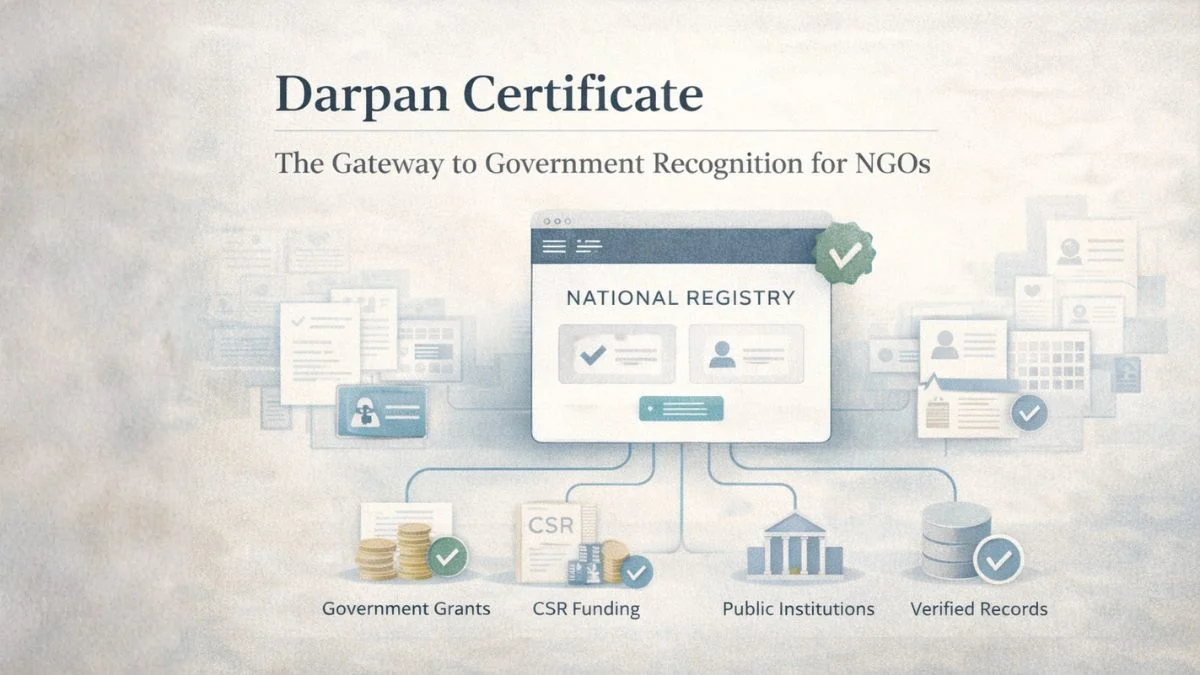
Issued through NITI Aayog’s NGO Darpan portal, the Darpan Certificate gives NGOs and VOs visibility, credibility, and access. If your organisation plans to apply for grants, tax exemptions, or government schemes, this certificate is no longer optional — it’s foundational.
What Is a Darpan Certificate?
A Darpan Certificate is a digital proof of registration for NGOs/VOs on India’s NITI Aayog NGO Darpan portal. Once registered and verified, the organisation receives a Unique Darpan ID.
This ID acts like a government-recognised identity card for NGOs.
It confirms that:
- Your organisation legally exists
- Your basic details are transparent and verifiable
- You are part of the Indian public-sector NGO ecosystem
The certificate is downloadable from the official NGO Darpan website after successful registration and profile verification.
Why the Darpan Certificate Matters More Than You Think
On paper, it looks like just another online registration. In practice, it opens critical doors.
Key benefits of having a Darpan Certificate
- Provides a Unique ID for NGOs to apply for grants and tax exemptions
- Mandatory for applying to most central government ministries
- Required under the NGO Module of MPLADS Division
- Improves credibility with donors and CSR partners
- Enables transparency and accountability
Simply put: no Darpan ID, no government funds.
Who Needs to Register on NGO Darpan?
NGOs and VOs must register on the NGO Darpan portal and obtain the Darpan certificate or unique ID to apply for government funds.
This includes:
- Trusts
- Societies
- Section 8 Companies
- Charitable and voluntary organisations
- NGOs seeking grants, aid, or recognition
Even if you’re newly formed and not applying for grants immediately, early registration avoids last-minute compliance stress.
Eligibility Requirements for Darpan Certificate
Before starting, make sure you meet these basics:
Mandatory requirements
- NGO must be legally registered (Trust, Society, or Section 8)
- NGO PAN card is compulsory
- Valid registration certificate
- Active bank account in NGO’s name
- Aadhaar and PAN of key office bearers
Without PAN, the system will not allow submission — this is non-negotiable.
Process of Darpan Certificate – Step-by-Step
The Process of Darpan Certificate is online, but accuracy matters.
Step 1: Create Login on NGO Darpan Portal
- Visit the official NGO Darpan website
- Register using NGO’s PAN and authorised email ID
Step 2: Fill Organisation Details
You’ll need to enter:
- Legal name of NGO
- Registration number and date
- Type of organisation
- Address and contact details
Step 3: Add Office Bearers
Details of:
- President
- Secretary
- Treasurer
(or equivalent roles)
Their Aadhaar and PAN details are required.
Step 4: Upload Documents
Upload:
- Registration certificate
- NGO PAN card
- Deed/MOA/Articles
- Office bearer IDs
Step 5: Final Submission & Verification
Once submitted, details go into verification.
After approval, your Darpan ID and certificate become available for download.
Where Is the Darpan Certificate Used?
The real value of a Darpan Certificate shows up later.
It is required for:
- Ministry grants and schemes
- NGO Module of MPLADS Division funding
- CSR project empanelment (often indirectly)
- Government tenders and collaborations
- Strengthening audit and credibility records
Many ministries have made it mandatory even before opening grant portals.
Common Mistakes NGOs Make
Over the years, I’ve seen NGOs delayed by weeks due to avoidable errors.
Common issues include:
- Mismatch between PAN and registration name
- Incorrect registration dates
- Missing office bearer details
- Incomplete document uploads
- Not updating profile after changes
One overlooked update can make your application appear inconsistent — and that’s where rejections start.
Darpan Certificate and Tax Exemptions
While the Darpan Certificate itself does not grant income tax exemption, it plays a supporting role.
It:
- Helps while applying for 12AB and 80G registration
- Acts as proof of government recognition
- Strengthens credibility during scrutiny
Many departments quietly cross-check Darpan data against tax registrations.
Is the Darpan Certificate Permanent?
The Darpan ID remains permanent, but:
- Profile details must be updated
- Office bearer or address changes must be reflected
- Inactive profiles may impact future applications
Think of it as a living compliance record.
Why Transparency Is the Real Goal
NITI Aayog didn’t create the Darpan system to “add paperwork.”
The intent was:
- One verified database of NGOs
- Reduced misuse of grants
- Cleaner flow of public funds
- Higher trust between NGOs and government
If your organization is genuine, Darpan actually works in your favor.
Conclusion
A Darpan Certificate is more than a digital formality. It is proof that your NGO belongs in the national ecosystem—transparent, recognized, and accountable.
If you plan to apply for grants, tax registrations, or government schemes, delaying Darpan registration only delays impact. Do it early. Do it correctly.
👉 If you want hassle-free Darpan registration, profile correction, or guidance on linking it with tax exemptions and grants, visit callmyca.com and get expert support that understands the NGO ecosystem inside out.