If you’ve ever received a company meeting notice and wondered, “What does this resolution actually mean for me?”, you’re not alone. I’ve seen even experienced directors pause when drafting notices simply because Section 102 demands clarity, not complexity.
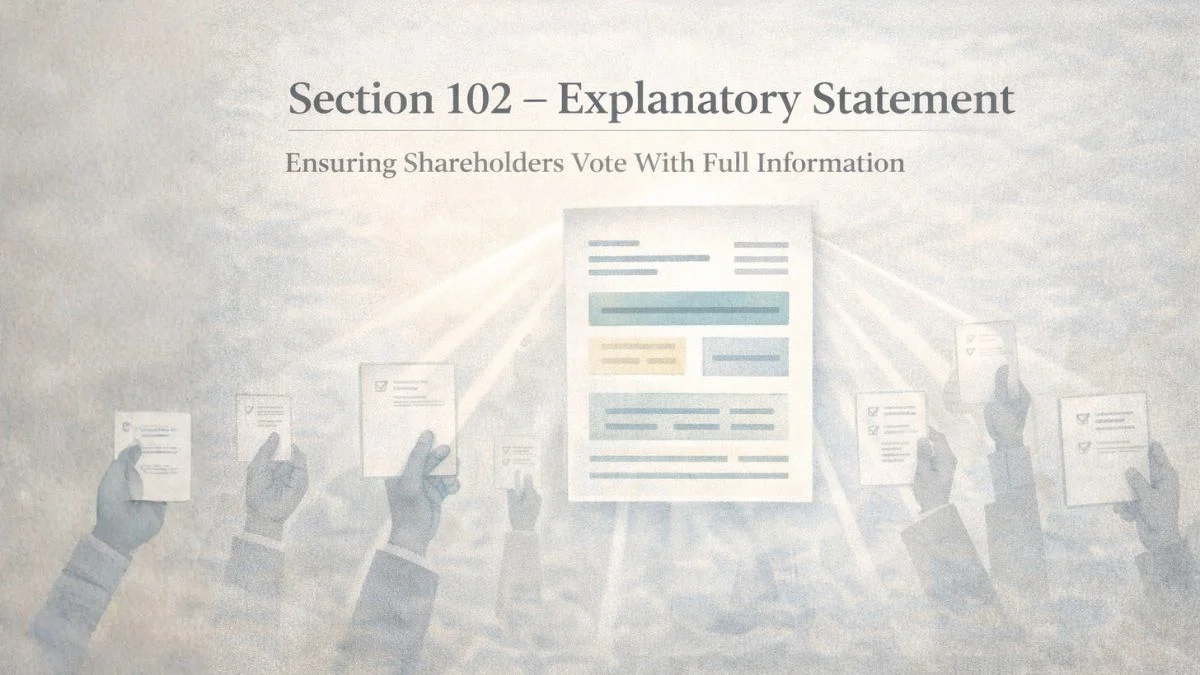
Under the Companies Act, 2013, an explanatory statement under Section 102 isn’t just a legal attachment—it’s a trust-building document. It explains why a decision is being placed before members, who stands to gain, and what the real impact could be.
What Is an Explanatory Statement Under Section 102?
An explanatory statement under Section 102 is a document that must accompany the notice of a general meeting whenever special business is proposed.
Simply put:
- Ordinary or routine matters don’t usually need detailed explanations
- Anything out of the ordinary does
The law requires the company to place all material facts before shareholders so they can make an informed decision—no surprises, no hidden interests.
Why Section 102 Exists
The philosophy behind Section 102 is simple but powerful:
shareholders should never vote in the dark.
The Companies Act, 2013 recognises that directors and management have access to far more information than ordinary members. Section 102 bridges this imbalance by ensuring transparency when decisions could:
- Affect ownership structure
- Impact company finances
- Benefit specific directors or key managerial personnel
From experience, companies that treat this as a disclosure obligation rather than a formality rarely face shareholder disputes.
What Qualifies as “Special Business”?
This is where misunderstandings often occur.
Special business generally includes:
- Appointment or removal of auditors (in certain cases)
- Issue of shares or securities
- Related party transactions
- Director appointments beyond routine re-appointments
- Borrowings above limits
Whenever a matter is not part of ordinary, day-to-day company operations, an explanatory statement is required.
Mandatory Contents of an Explanatory Statement
The Companies Act is very specific here.
An explanatory statement under Section 102 must include:
- All material facts relating to the special business
- Nature of concern or interest of:
- Directors
- Key managerial personnel
- Their relatives
- Financial or other implications of the resolution
- Any additional information required to understand the proposal fully
In practice, this means honesty over brevity. Leaving out relevant interests is where most compliance failures begin.
Disclosure of Director and KMP Interests
This is the heart of Section 102.
If a director, manager, or relative stands to gain—
- Directly or indirectly
- Financially or otherwise
…it must be disclosed clearly.
I’ve seen companies lose shareholder confidence simply because they buried this disclosure in vague sentences. Transparency here protects both the company and its management.
How Section 102 Helps Shareholders Make Informed Decisions
At its core, Section 102 isn’t anti-management—it’s pro-informed consent.
By laying out:
- The context of a proposal
- The rationale behind it
- The potential consequences
shareholders are empowered to vote with understanding rather than assumption.
This is particularly crucial in closely held companies where minority shareholders rely heavily on statutory disclosures.
Common Mistakes Companies Make Under Section 102
From practical exposure, these are the most frequent errors:
- Using generic, copy-paste explanations
- Failing to disclose indirect interests
- Assuming shareholders “already know”
- Over-legalising the language
An explanatory statement should explain, not intimidate.
Best Practices While Drafting an Explanatory Statement
If there’s one guiding principle, it’s sincerity.
Practical drafting tips:
- Write as if explaining the decision to a non-technical member
- Use bullet points for financial implications
- Clearly state who benefits and how
- Avoid unnecessary legal jargon
When assumed clarity replaces actual clarity, disputes arise.
Consequences of Non-Compliance With Section 102
Ignoring or mishandling Section 102 is not risk-free.
Potential implications include:
- Penalties on the company
- Penalties on defaulting officers
- Resolutions becoming vulnerable to legal challenge
In shareholder litigation, Section 102 compliance is often the first document examined.
Section 102 as a Governance Tool, Not a Burden
Companies that embrace Section 102 as a governance mechanism—not just a legal obligation—tend to build stronger trust with investors, members, and regulators.
From my experience, well-drafted explanatory statements reduce:
- Follow-up queries
- Meeting disruptions
- Post-meeting objections
That alone makes the effort worthwhile.
Conclusion
An explanatory statement under Section 102 is not about regulatory fear—it’s about responsibility. It ensures that decisions shaping a company’s future are made with honesty, transparency, and accountability.
Whether you’re a director approving resolutions or a company secretary issuing notices, Section 102 deserves careful attention—not rushed drafting.
👉 Need help drafting or reviewing an explanatory statement under Section 102? Visit callmyca.com for expert corporate compliance support that’s practical, precise, and experience-backed.