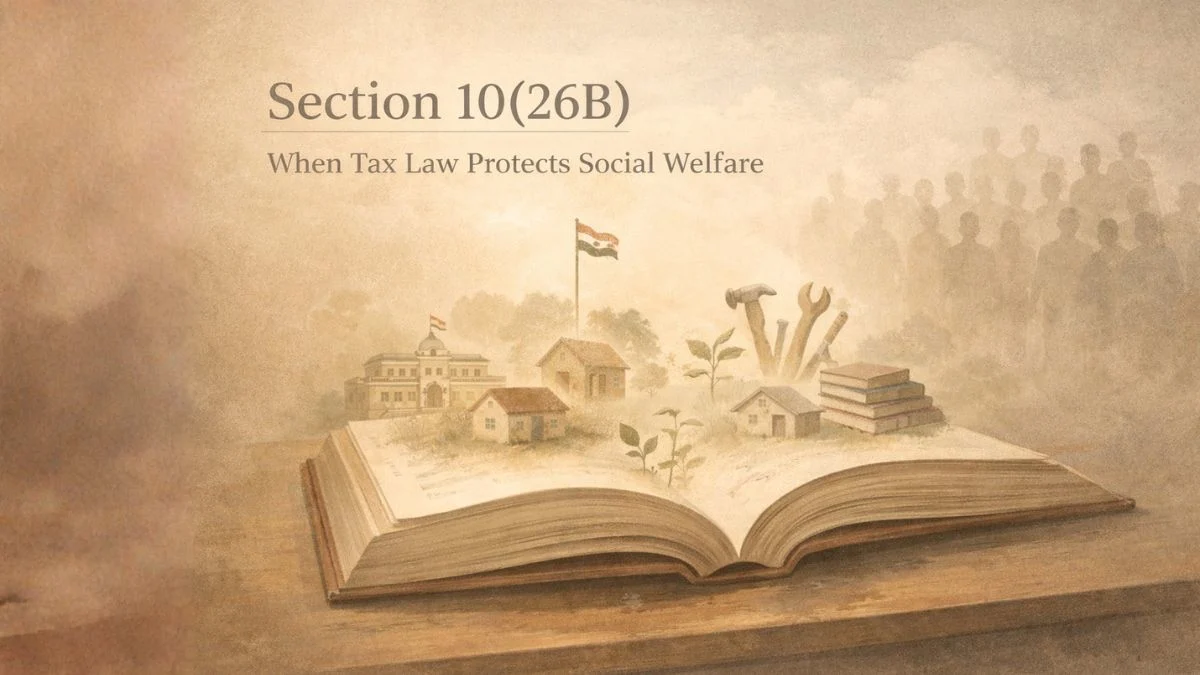
Every time I come across a socially purposeful section of the Income-tax Act, it shifts my perspective a little. We often think of tax laws as harsh or complicated, but some provisions truly aim to uplift communities. Section 10(26B) is one such example.
This section provides a tax exemption for the income of certain corporations and bodies establisahed to promote the interests of members of Scheduled Castes (SC), Scheduled Tribes (ST), or backward classes. By removing the tax burden, the law allows these organisations to utilise their entire income toward development, welfare, and empowerment.
What Section 10(26B) Really Says
At its core, Section 10(26B offers full exemption from income tax to certain government-established bodies that work exclusively for SC, ST, or backward-class communities.
These organisations may be involved in:
- Skill development
- Education
- Employment assistance
- Social empowerment
- Financial support programs
Because their purpose is deeply welfare-driven, the law ensures that their entire income remains untaxed—a huge relief for bodies that often run on limited funds.
Why This Provision Was Needed
If you’ve ever spoken to someone running a welfare-focused organisation, you know how tough it is to stretch every rupee. Add the weight of taxes, and suddenly, funds meant for community programs get eaten up by liabilities.
Section 10(26B ensures:
- No income tax deductions from welfare funds
- More resources available for community upliftment
- Operational freedom for government-backed corporations
- Long-term sustainability of social welfare programs
It’s a thoughtful provision created to ensure that welfare doesn’t pause because of taxation.
Who Exactly Can Claim This Exemption?
This exemption does not apply to just any charitable organisation. Section 10(26B) has strict eligibility conditions.
An institution qualifies only if:
- It is established by the Central or State Government, or
- Established under a Central or State Act,
- Its sole purpose is the promotion of SC/ST/backward classes,
- Its income is used strictly for welfare activities,
- Its operations are transparent and government-supervised.
This ensures the exemption is applied only to genuine, impactful institutions.
A Small Real-Life Scenario
A state-run Backward Classes Development Corporation once shared how the exemption made a big difference. They were running job training workshops and self-employment schemes for youth. Their yearly grant was already limited.
If they had to pay income tax on interest earned from savings or other receipts, fewer trainees could be supported.
But because they fell under Section 10(26B), their entire income remained intact.
More students got training.
More families got hope.
More communities moved forward.
This is the human side of a legal provision.
Key Features of Section 10(26B)
Here’s a simple breakdown:
- Full exemption from income tax
All income—grants, interest, receipts—is exempt.
- Applicable only to government-established bodies
This ensures credibility and prevents misuse.
- Exclusive welfare purpose requirement
If the organisation’s purpose shifts, the exemption may no longer apply.
- Focus on vulnerable communities
The beneficiaries must be SC/ST/backward classes.
- Helps sustain long-term development work
From scholarships to housing schemes, welfare becomes easier to fund.
Why Section 10(26B) Still Matters Today
Even today, many communities still face barriers in education, employment, funding, and social mobility. Welfare corporations working for them must remain financially strong.
This provision keeps them strong by ensuring every rupee stays where it belongs—working for the community.
Common Misunderstandings
People often confuse Section 10(26B) with:
- Section 12A (charitable trust registration)
- Section 80G (donor tax benefit)
- Section 10(26) (exemption for certain tribal individuals)
But Section 10(26B is unique because:
- It applies ONLY to institutions, not individuals
- It offers COMPLETE income tax exemption
- Eligibility depends on purpose and establishment
How This Provision Reflects India’s Commitment
When you read Section 10(26B carefully, you realise it's not just financial relief—it’s acknowledgment.
- It recognises historical disadvantages.
- It supports institutions working for equality.
- It demonstrates that tax law can also protect and uplift.
Conclusion
Section 10(26B) of the Income-tax Act does something powerful yet quiet — it removes tax burden from organisations dedicated to uplifting SC, ST, and backward-class communities. By granting exemption from income tax, the law helps ensure that vital welfare work continues without financial interruption.
If your organisation falls into this category or you’re planning to establish one, understanding this provision can make compliance easier and funding stronger.
For expert assistance with tax registrations, exemptions, and compliance, visit Callmyca.com — your trusted partner for clarity and compliance.