PPF Interest Exempt Under Section:
If there is one investment in India that almost everyone trusts blindly, it’s PPF—Public Provident Fund.
People may debate mutual funds, stocks, or real estate.
But when it comes to safety and tax benefits, PPF is usually the first name that comes up.
Yet, every year during tax season, I hear the same question again and again:
“Is PPF interest taxable or not?”
“Under which section is PPF interest exempt?”
Short Answer First (For Clarity)
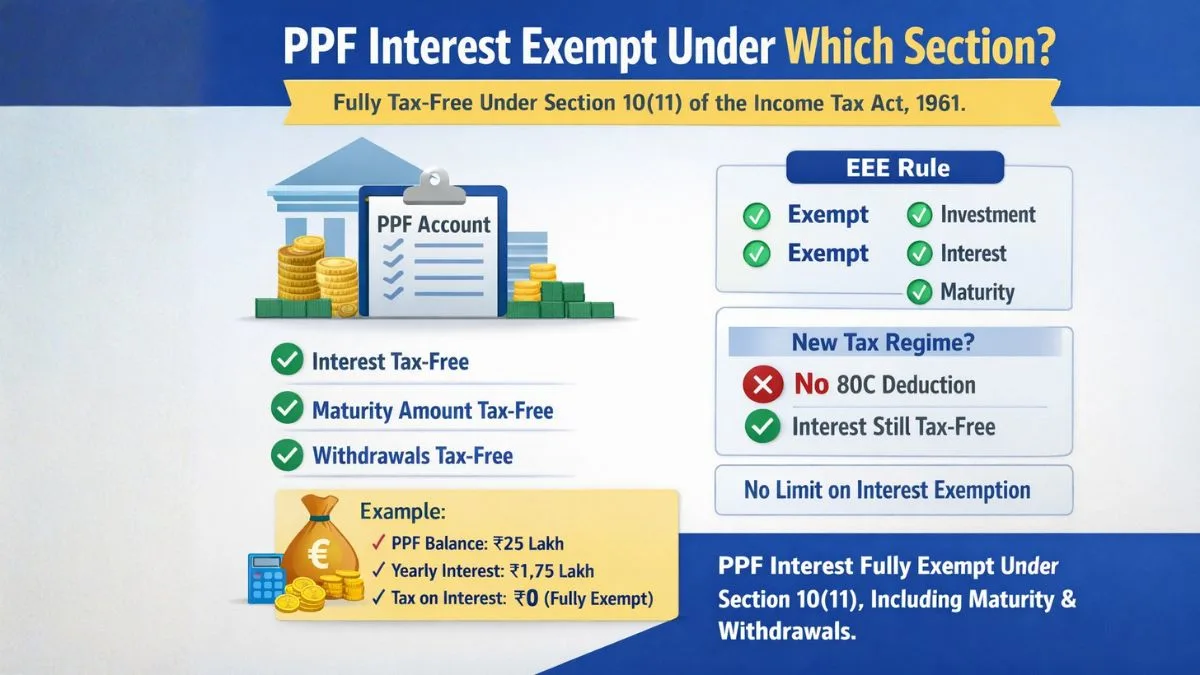
👉 PPF interest is fully exempt from income tax under Section 10(11) of the Income Tax Act, 1961.
That’s the direct answer.
Now let’s understand why, how, and what you should be careful about, especially in today’s new tax regime environment.
What Is PPF, and Why Does It Get Special Tax Treatment?
PPF is not just another investment product.
It is a government-backed long-term savings scheme designed to:
- Encourage disciplined savings
- Provide retirement security
- Offer guaranteed returns
- Give strong tax benefits
Because of this social objective, the Income Tax Act gives PPF one of the best tax treatments available.
PPF Follows the EEE Rule (very important).
PPF is classified as an EEE investment, which means:
- E – Exempt at the time of investment
- E – Exempt on interest earned
- E – Exempt on maturity / withdrawal
Most investments don’t get all three exemptions. PPF does.
PPF Interest Exempt Under Which Section?
Now let’s address the exact legal provision.
✔ PPF Interest Is Exempt Under Section 10(11)
As per the Income Tax Act:
Interest earned on a Public Provident Fund (PPF) account is fully exempt from income tax under Section 10(11).
This exemption covers:
- yearly interest credited to your PPF account
- accumulated interest over the years
That’s why you do not need to show PPF interest as taxable income in your return.
Does the Exemption Apply Only to Interest?
No. This is where PPF becomes extremely powerful.
Under Section 10(11), exemption applies to:
- Interest earned, and
- Maturity amount, and
- Withdrawal amount
So yes:
PPF interest, PPF withdrawal, and PPF maturity are all tax-free.
Is There Any Limit on PPF Interest Exemption?
This is a very common doubt.
Many people hear statements like:
“Interest on PPF is exempt for contributions made up to ₹5 lakh per annum.”
Let’s clarify this carefully.
Contribution Limit vs Interest Exemption
- Maximum contribution eligible for PPF: ₹1.5 lakh per year
- Tax deduction on contribution: Section 80C (up to ₹1.5 lakh)
- Interest exemption under Section 10(11): NO LIMIT
So even if:
- your PPF balance grows large
- interest amount becomes substantial
👉 Interest earned in the account is free from Income Tax under Section 10(11)
There is no separate monetary cap on interest exemption.
Do You Need to Report PPF Interest in ITR?
Another practical confusion.
The Answer:
- PPF interest is exempt, not taxable
- Exempt income is not added to total income
However:
- In some ITR forms, exempt income may be reported for disclosure
But it does not increase your tax liability.
PPF Interest Exempt Under New Tax Regime?
This is one of the most searched questions today.
Let’s clear it properly.
Contribution vs Interest (Very Important Difference)
Under the new tax regime:
- ❌ PPF contribution does not get Section 80C deduction
- ✅ PPF interest exemption under Section 10(11) still applies
So even if you opt for the new tax regime:
- You lose deduction on contribution
- But interest and maturity remain tax-free
This is because:
- Section 10(11) exemptions are independent of tax regime choice
Example to Make It Crystal Clear
Let’s take a simple real-life example.
- You invest ₹1.5 lakh per year in PPF
- After many years, your PPF balance becomes ₹25 lakh
- Interest earned in one year: ₹1.75 lakh
Tax Treatment:
- Contribution deduction:
- Old regime → allowed under 80C
- New regime → not allowed
- Old regime → allowed under 80C
- Interest of ₹1.75 lakh → completely tax-free
- Maturity amount → completely tax-free
All thanks to PPF interest exempt under Section 10(11).
What About Section 10(12)? Is That Relevant?
You may also see searches like
- “ppf interest exempt under section 10 12”
Here’s the clarity:
- Section 10(11) → PPF and similar government funds
- Section 10(12) → Recognised Provident Fund (EPF)
PPF specifically falls under Section 10(11).
Is PPF Interest Always Exempt?
As of now—yes.
PPF enjoys:
- Government backing
- Statutory exemption
- Stable policy support
There is no TDS, no slab-based taxation, and no reporting burden like FDs.
That’s why PPF is often called
“One of the cleanest tax-free investments in India.”
Common Myths About PPF Taxation
Let’s quickly bust a few myths:
❌ “PPF interest is taxable above a limit.”
✔ No, it is fully exempt.
❌ “Under new tax regime, PPF interest becomes taxable.”
✔ Wrong. Interest remains exempt.
❌ “PPF maturity is taxable.”
✔ Completely false.
Why the Government Gives This Benefit
The logic is simple:
- PPF locks money for long term
- Helps citizens build retirement corpus
- Reduces dependence on social security
That’s why the law clearly labels PPF interest as EXEMPT.
PPF in One Simple Line
If you remember only one thing, remember this:
PPF interest is fully exempt from income tax under Section 10(11), along with withdrawals and the maturity amount.
Quick Human-Friendly Summary
- PPF interest is fully tax-free
- Exempt under Section 10(11) of Income Tax Act, 1961
- Exemption applies to:
- interest
- withdrawals
- maturity amount
- interest
- No tax even under the new tax regime
- PPF follows EEE status
Final Thoughts (Real Talk)
In a tax system where:
- FD interest is taxable
- Mutual fund gains depend on holding period
- Even EPF has conditions
PPF stands out as a rare, clean, and predictable tax-free option.
Understanding PPF interest exempt under section 10(11) helps you:
- plan long-term savings better
- choose tax regime wisely
- avoid unnecessary confusion during filing
If you need help with tax planning, choosing between the old vs. new tax regime, or understanding how PPF fits into your overall strategy, expert guidance can make a big difference.
For practical tax advice and personalized support, visit callmyca.com.