
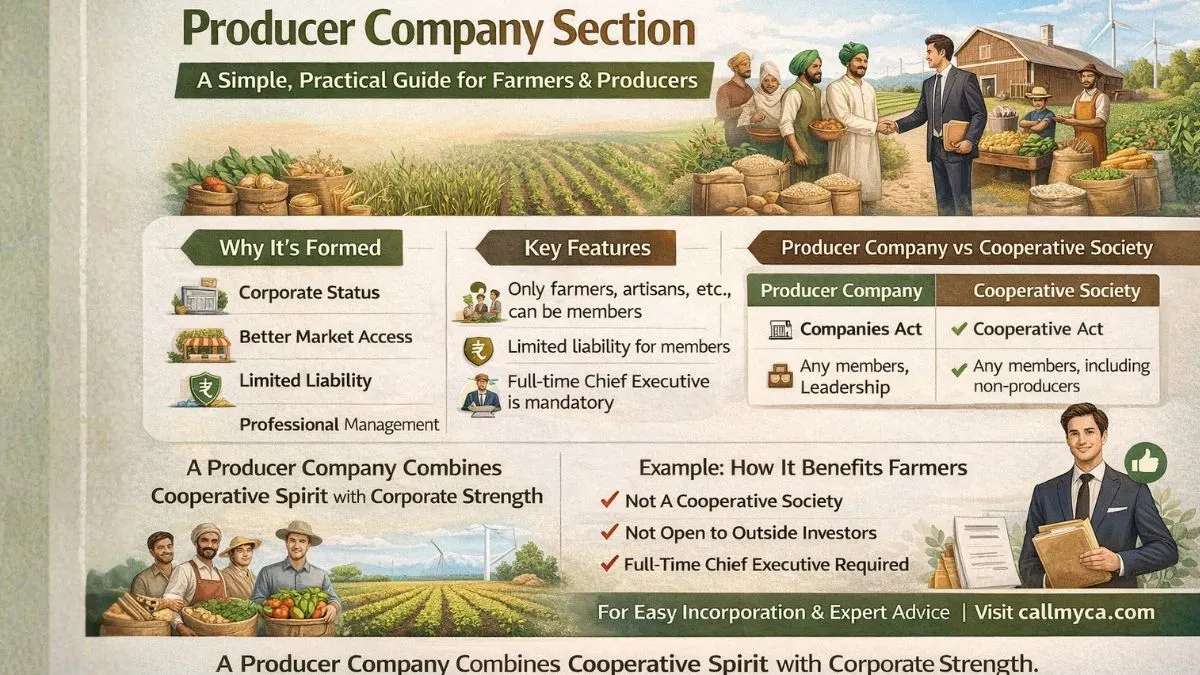
Producer Company Section: A Simple, Practical Guide for Farmers & Producers
If the term "producer company" does ring in your ears, and you often go blank trying to think about what it really is, be assured you are not alone. Many farmers, agriculturists, artisans, and even professionals deal with this concept while making plans for businesses on a collective basis, but due to legal terminology, things sound more complicated than they actually are.
A producer company was introduced to solve a very real problem: how can producers work together like a cooperative but still enjoy the flexibility and legal strength of a company?
That’s exactly where the producer company section comes in.
What Does “Producer Company Section” Mean?
Producer Company Section:
A reference to the section of Indian company law related to primary production companies. Primary production companies comprise individuals who are engaged in the production of goods like farmers, dairy manufacturers, fishermen, weavers, artisans, etc.
Legally speaking, a "producer company section" refers to the part of a company's governing laws that deals with companies formed by primary producers, such as farmers or artisans. This section under the Companies Act 2013 provides to incorporate a special type of corporate entity that has the mutual assistance benefits of a cooperative society along with the statutory advantages of a company.
This can be explained in simple words as that it builds a bridge or creates a connection between a society of cooperation and a private limited company.
Why Was the Concept of Producer Company Introduced?
Before producer companies were formed, two major alternatives were open to the producer:
- Form a cooperative society
- Operate as individuals or informal groups
Both had problems.
Cooperatives often suffered from:
- Excessive government control
- Political interference
- Poor governance
Individual producers, on the other hand, lacked:
- Bargaining power
- Market access
- Financial credibility
The producer company structure was created to fix these issues by giving producers:
- Corporate status
- Better governance
- Limited liability
- Professional management
Who Can Form a Producer Company?
A producer company can be formed by:
- 10 or more individual producers, or
- 2 or more producer institutions, or
- A combination of both
Only primary producers can be members. This means investors or outsiders who are not producers cannot control the company, which protects the interest of actual producers.
Key Features of a Producer Company
1. Producer-Owned Structure
Only producers can become members. Ownership stays within the producer community.
2. Limited Liability
Members are protected. Personal assets are not at risk beyond their shareholding.
3. Separate Legal Entity
The company exists independently of its members, just like any other registered company.
4. Professional Management
Unlike traditional cooperatives, producer companies can appoint professionals to run operations.
Mandatory Requirement of a Chief Executive
One of the most important legal requirements under the Producer Company section is leadership.
The law clearly mandates every producer company to have a full-time chief executive.
Why Is a Chief Executive Mandatory?
The idea is simple:
- Producers may be experts in production
- But daily management requires professional oversight
The Chief Executive:
-
Manages day-to-day operations
Implements board decisions
Ensures that all applicable statutes
Acts as a link between the Board and members
This requirement by itself makes a producer company far more organized than a cooperative.
Role and Responsibility of the Chief Executive
The office of Chief Executive is no symbol.
These responsibilities include:
Managing Business Operations
Maintaining books and records
Ensuring compliance with company laws
Representing the company operationally
Executing board-approved strategiesA producer company cannot exist or operate without a full-time chief executive. Difference between Producer Company and Cooperative Society
|
Aspect |
Producer Company |
Cooperative |
|
Governing Law |
Companies Act |
Cooperative Act |
|
Ownership |
Only producers |
Members |
|
Government Control |
Minimal |
High |
|
Management |
Professional |
Often elected |
|
Legal Structure |
Corporate |
Semi-corporate |
This comparison explains why many farmer groups now prefer producer companies.
Activities Allowed for a Producer Company
A producer company can engage in:
- Production
- Processing
- Marketing
- Selling
- Export of primary produce
- Providing education and training to members
- Supplying machinery, seeds, or technical services
The objective is not just profit but member benefit and sustainability.
Capital and Shares in a Producer Company
- Shares are issued only to members
- Shares are not freely transferable
- Voting rights are usually based on one member, one vote
This ensures that control stays democratic and producer-centric.
Profit Distribution in a Producer Company
Instead of dividends alone, producer companies distribute:
- Patronage bonus (based on participation)
- Limited dividends (subject to rules)
This aligns rewards with actual contribution, not just investment.
Compliance Requirements
Even though producer companies are producer-friendly, they are still companies.
They must:
- Conduct board meetings
- Maintain statutory registers
- File annual returns
- Appoint auditors
- Maintain accounts
However, compliance is still simpler and more structured than cooperatives.
Common Misunderstandings About Producer Companies
❌ “It’s the same as a cooperative.”
No. Governance and legal structure are very different.
❌ “Anyone can invest.”
Wrong. Only producers can be members.
❌ “No professionals needed”
Incorrect. A full-time chief executive is compulsory.
When Does a Producer Company Make Sense?
A producer company is ideal if:
- Producers want collective strength
- Market access is a challenge
- Government interference is a concern
- Long-term scalability is required
It is not suitable for purely investor-driven businesses.
Real-Life Example
Imagine 50 farmers growing organic vegetables. Individually, they sell at low margins. By forming a producer company:
- They negotiate better prices
- Brand their produce
- Hire a professional chief executive.
- Access funding and government schemes
This is exactly how producer companies are meant to work.
Final Thoughts
The producer company structure is one of the most powerful yet underutilized business models for farmers and primary producers in India. The producer company section under company law was designed to empower producers—not burden them.
The requirement that mandates every producer company to have a full-time chief executive ensures professionalism, accountability, and long-term sustainability.
When structured correctly, a producer company can transform livelihoods—not just balance sheets.
For professional assistance with Producer Company incorporation, compliance, and advisory, you can explore expert support at callmyca.com, just like in our previous blogs—practical guidance, without unnecessary legal confusion.









