Every investor wants to know one thing before selling an asset — how much tax will I pay? The answer depends not only on the profit you make but also on how long you’ve held the asset. That’s where Section 2(29A) comes in.
This section lays down the definition of a long-term capital asset — the deciding factor that determines whether your profit will be treated as long-term (lower tax) or short-term (higher tax). It may sound technical, but once you understand the logic behind it, you’ll see how it can actually help you save tax with smart planning.
What Exactly Is Section 2(29A)?
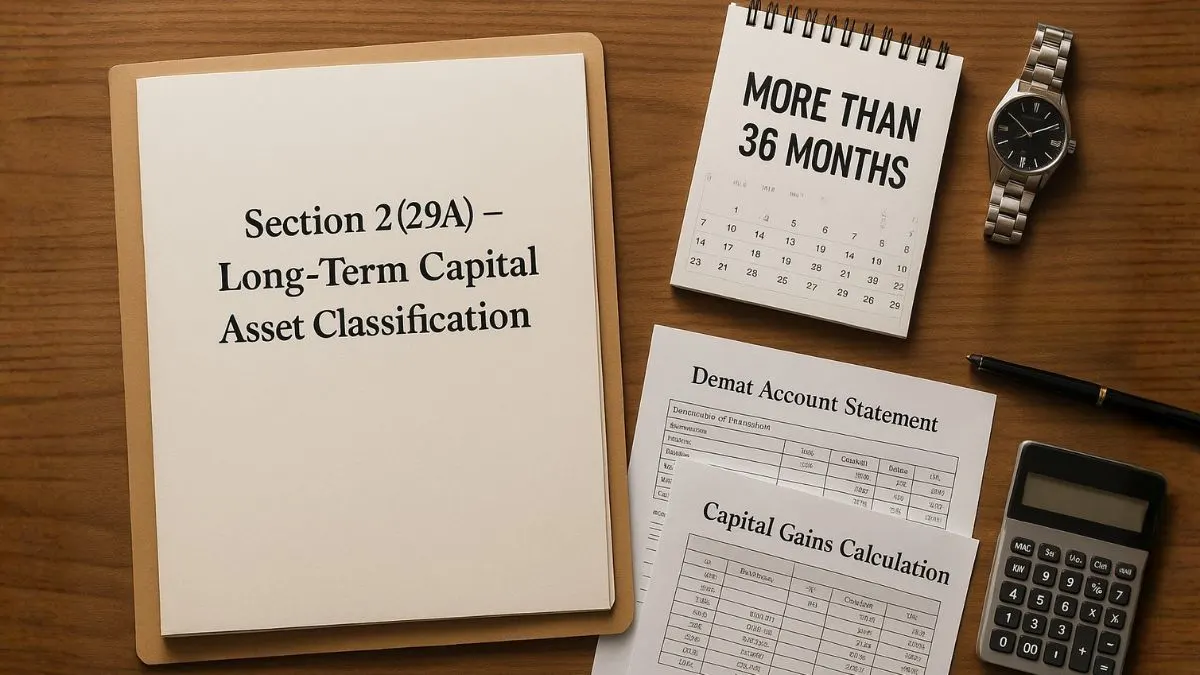
Section 2(29A) of the Income Tax Act defines a long-term capital asset as any capital asset that is held by a taxpayer for more than 36 months immediately before its transfer. In plain words, if you’ve owned something — say, a plot of land, property, or shares — for more than the specified holding period, it’s treated as long-term. The profit from selling it is then taxed at concessional long-term capital gains (LTCG) rates.
This section is the foundation for all future capital gain calculations. Without it, we couldn’t decide how to tax profits from asset sales.
The Exception to the 36-Month Rule
While 36 months is the general benchmark, the Income Tax Act provides shorter holding periods for certain types of assets to reflect their liquidity.
- 24 months for immovable property such as land or buildings."
- 12 months for listed equity shares, equity mutual fund units, and business trust units.
So, if you hold listed shares for 12 months or more, your gain is long-term. But if you sell them earlier, the profit becomes short-term — and your tax rate shoots up.
Also Read: Save Tax on Capital Gains by Investing in a Residential House
Why This Classification Matters
The classification isn’t just legal jargon — it directly influences how much tax you pay.
|
Type of Gain |
Holding Period |
Applicable Tax Rate |
Example |
|
Short-Term |
Up to 12/24/36 months |
Normal slab rate or 15% |
Sold house within 18 months |
|
Long-Term |
More than 12/24/36 months |
10% or 20% with indexation |
Sold house after 3 years |
That’s why Section 2(29A) is critical. A few months’ difference in timing could easily change your tax liability by thousands or even lakhs.
Simple Illustration
Let’s take a quick example.
Suppose you bought a flat in 2019 for ₹40 lakh & sold it in 2025 for ₹85 lakh. Since you held it for more than 36 months, the property qualifies as a long-term capital asset under Section 2(29A).
After applying indexation (say, your indexed cost is ₹52 lakh), your taxable gain is ₹33 lakh.
Tax @20% = ₹6.6 lakh.
Had you sold it earlier — say, within two years — the ₹45 lakh gain would be treated as short-term income & taxed at your regular slab rate.
What Qualifies as a Capital Asset
To understand what “long-term” means, we first need to understand what a capital asset is.
As per Section 2(14), a capital asset includes any kind of property — tangible or intangible, movable or immovable. It covers real estate, shares, mutual funds, jewellery, patents, and even goodwill.
Then comes Section 2(29A), which divides these assets into long-term & short-term categories depending on how long they’re held.
Long-Term vs Short-Term Gains – Core Difference
While Section 2(29A) defines long-term capital asset, Section 2(29B) defines long-term capital gain. The two go hand in hand.
The former decides what kind of asset you’re dealing with; the latter determines how the resulting gain will be taxed.
A simple way to remember this — “A” stands for Asset, & “B” stands for Benefit (or gain).
Indexation Advantage
The biggest benefit of holding an asset long-term is indexation.
Indexation adjusts your purchase cost for inflation, making sure you’re taxed only on real profits — not on inflationary increases in price.
For instance, if you bought a house in 2010 for ₹30 lakh & sold it in 2024 for ₹80 lakh, your indexed cost might rise to around ₹55 lakh.
That means only ₹25 lakh is treated as taxable gain, reducing your tax burden significantly.
This benefit applies only to long-term capital assets defined under Section 2(29A).
Also Read: Capital Gain Exemption on Sale of Agricultural Land
Exemptions and Special Provisions
Once your gain is classified as long-term, several exemptions become available under Sections 54, 54EC, and 54F of the Income Tax Act.
- Reinvesting in another residential property can make your gain tax-free (Section 54)."
- Investing in specified bonds like NHAI or REC within 6 months can also save tax (Section 54EC).
Similarly, the Act includes special provisions relating to voluntary contributions received by electoral trust and other entities, ensuring consistency in how income & exemptions are treated across different categories.
Tax Treatment in Brief
|
Type of Asset |
Holding Period for Long-Term |
Long-Term Tax Rate |
Short-Term Tax Rate |
|
Property |
>24 months |
20% with indexation |
Slab rate |
|
Listed Shares / Equity MF |
>12 months |
10% (above ₹1 lakh) |
15% |
|
Gold / Debt MF |
>36 months |
20% with indexation |
Slab rate |
So, the way Section 2(29A) classifies your asset directly decides your final tax rate.
Link with Section 10 and Scientific Research
Just as the Income Tax Act allows deductions for expenses relating to scientific research, it also rewards investors for long-term capital holding.
Both have one thing in common — encouraging productive, sustained use of capital.
Whether it’s research spending or asset investment, the law promotes long-term contribution to the economy.
Common Misunderstandings
- Myth: The holding period is always 36 months.
Fact: It varies — 12, 24, or 36 months depending on the asset. - Myth: All mutual funds enjoy a 12-month limit.
Fact: Only equity-oriented ones do; debt mutual funds follow 36 months. - Myth: Exemption applies automatically.
Fact: You must claim it while filing your income tax return.
Importance for Investors and Businesses
- For individual investors, Section 2(29A) helps with smarter investment timing — especially when dealing with real estate, gold, or shares.
- For businesses, it guides how to structure transactions & dispose of assets efficiently.
Even startups benefit, as holding intellectual property or shares long enough can lead to substantial savings under long-term tax rules.
Also Read: Capital Gains Exemption on Compulsory Acquisition
How the Courts Have Interpreted “Held”
Courts have clarified that the holding period begins from the date of allotment, not possession, in real estate cases.
For example, in CIT v. Vimal Chand Golecha (1993), the Rajasthan High Court ruled that ownership starts from the date of allotment letter.
Such interpretations help taxpayers prove genuine long-term ownership when computing gains.
Comparison Between Sections 2(29A) and 2(42A)
|
Criteria |
Section 2(29A) |
Section 2(42A) |
|
Defines |
Long-term capital asset |
Short-term capital asset |
|
Holding Period |
>12 / 24 / 36 months |
≤12 / 24 / 36 months |
|
Tax Benefit |
Lower tax, indexation |
No benefit, higher rate |
|
Example |
Land held for 3 years |
Land sold within 2 years |
Together, they maintain balance — rewarding patience while discouraging speculative short-term profits.
Planning Tip
If you’re close to completing the minimum holding period, it often makes sense to wait before selling. A few months can change your tax treatment from short-term to long-term, cutting your tax rate almost in half. That’s one of the simplest tax-saving tricks under Section 2(29A) that most people overlook.
Conclusion
Section 2(29A) of the Income Tax Act isn’t just a definition — it’s the cornerstone of capital gain taxation in India. It decides whether your investment is short-term or long-term and whether you get the benefit of indexation & reduced tax rates. Understanding this section helps you plan your sales and investments better, ensuring you pay only what’s fair — not more. So before selling your next asset, check your holding period. It might just save you a significant amount in tax.
Selling property, shares, or business assets soon? Don’t make a costly timing mistake. Reach out to CallMyCA.com — our experts will calculate your holding period, capital gains, and exemptions so you can file your return confidently & legally minimise your taxes.