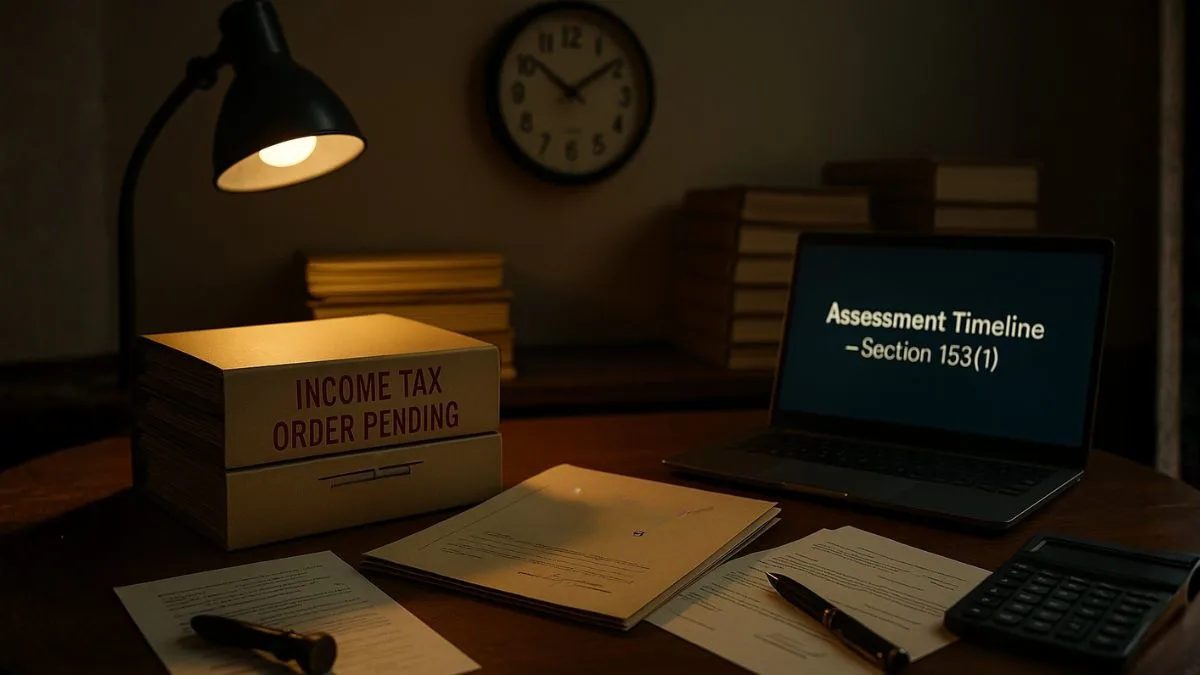
If you've ever waited for a tax notice to resolve, you know the feeling. For months, sometimes even years, that lingering doubt stays in the back of your mind — “Will I get the assessment order soon?” To avoid that anxiety turning into a lifelong tax cliffhanger, Parliament wrote Section 153(1). Think of it as a timer the Income Tax Department can’t pause unless allowed by law. Once the clock runs out, no fresh assessment order can suddenly appear in your inbox.
This rule matters not only to big corporations or tax litigators — even an ordinary salaried person selected for scrutiny relies on this timeline.
What the Law Actually Says
Put simply, the section deals with the time limit for completion of assessments, reassessments, and re-computations.
The Department gets:
Three years from the end of the relevant assessment year to finish its job & issue the assessment or reassessment order.
Example? If the Assessment Year is 2023-24, the department has time until 31 March 2027. Cross that line, & the opportunity evaporates."
This isn't an academic rule — it's a protection from administrative overreach.
Why This Time Limit Exists
Imagine a world where tax files remain open forever. Impossible to close books. Auditors uncertain. Businesses unable to plan investments. Individuals scared to spend refunds or benefits because “what if a notice comes later?”
Section 153(1) stops that. It forces closure. It gives everyone a cutoff point, so you can move on with your financial life confidently.
Also Read: Section 12BA: The Form Every Employer Must File for Employee Perquisites
Practical Impact for Taxpayers
Most taxpayers won't remember Section 153(1) by name. But they definitely feel its benefit every year.
- Scrutiny can't continue indefinitely
- Reassessment can't surprise you after years
- Books can be finalised responsibly
- Litigation cycles become predictable
It’s like putting a timer on the referee — not just the players.
When Assessments Get Special Handling
There are certain situations — search cases, tribunal directions, court intervention — where timelines can shift. But those are controlled exceptions, not loopholes.
For day-to-day assessments, the three-year window remains the guiding light.
Modern Tax System & Section 153(1)
In the age of faceless assessments, digital hearings, and online submissions, timelines matter even more. Technology speeds up communication, so the law demands that the authority also keeps pace with that speed."
The system isn't just designed to collect tax — it is structured to conclude proceedings cleanly.
Also Read: TDS on Property Transactions : The One Form Every Property Buyer Must File After a Purchase
A Broader Tax Philosophy
Interestingly, while this section enforces discipline, the same statute also encourages innovation. The Income Tax Act allows for deductions while computing taxes for expenses relating to scientific research, and provides for a deduction of expenses incurred on scientific research & development activities, including expenditure of a capital nature on scientific research.
Different purpose, same theme: clear rules that reward compliance & progress.
Final Thought
Section 153(1) isn’t about mathematics — it’s about fairness. Everyone deserves closure. Whether you're an employee, a business owner, or a professional, there comes a point where you should no longer be looking over your shoulder waiting for a tax order.
This section draws that line. If you ever receive a notice & the timeline looks confusing, don’t panic. Just lean on someone who reads these lines every day.
Our CA team at CallMyCA.com handles scrutiny replies, assessment timelines, and reassessment defenses with calm precision. One call & you’ll know exactly where you stand — before the department does.