Search and requisition cases are some of the most sensitive proceedings under the Income Tax Act. They involve detailed investigations, large volumes of seized documents, and several layers of scrutiny. To ensure these assessments are not completed without proper supervision, the law brings in a safeguard—mandatory approval from a higher authority.
This safeguard is found in Section 153D, which requires Assessing Officers to get prior approval from the Joint Commissioner or an even higher authority before issuing assessment or reassessment orders in search-related cases. This section is designed to introduce accountability, fairness, & accuracy in some of the most complex assessments handled by the department.
What Exactly Is Section 153D?
A legal checkpoint before any assessment order in search cases.
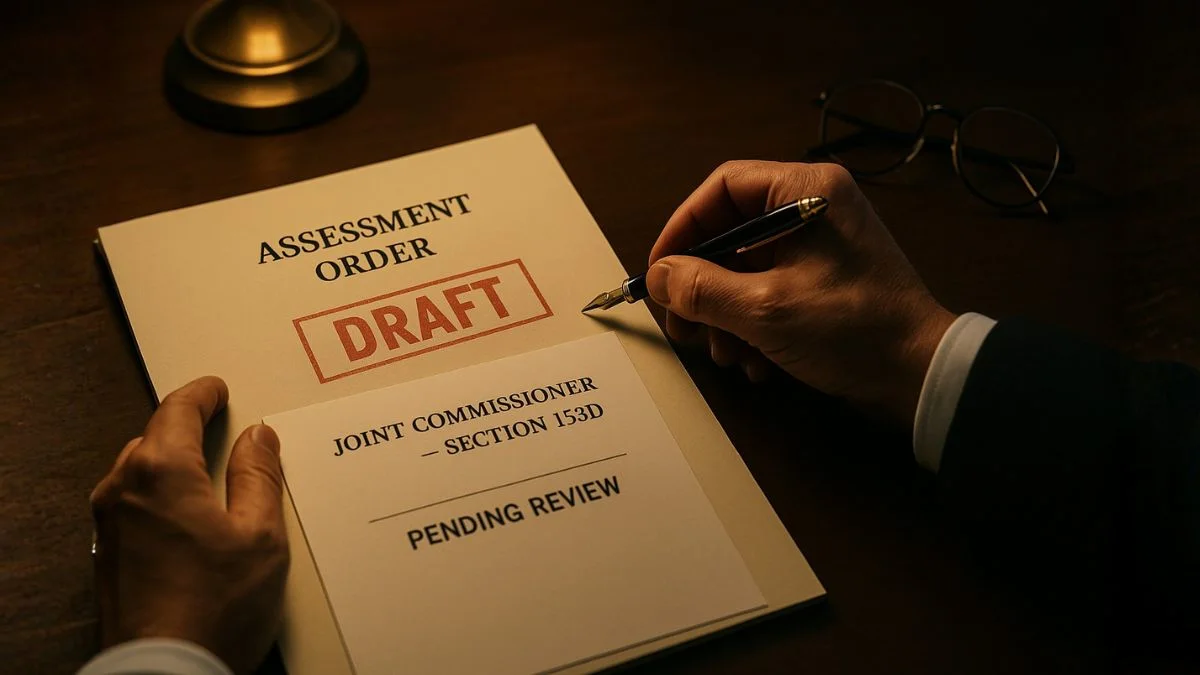
Section 153D requires an Assessing Officer (AO) to obtain the prior approval of the Joint Commissioner before passing an assessment order in cases arising from search or requisition.
Put simply, no order of assessment shall be made under Section 143 or Section 144 in these cases unless a senior officer reviews & approves it.
This requirement applies to:
- Search cases under Section 153A
- Requisitions under Section 153C
- Related reassessments
The purpose is to ensure that the AO’s conclusions are legally sound, factually correct, and aligned with departmental guidelines.
Why Does the Law Require Joint Commissioner Approval?
Search cases come with high stakes. They involve:
- Large amounts of unaccounted income
- Business books and digital records"
- Multiple assessments across years
- Sensitive financial details
To maintain fairness, assessments in search & seizure cases require prior approval from superior authorities. This prevents arbitrary additions or errors that could significantly affect taxpayers.
Also Read: Time Limit for Completion of Assessments, Reassessments, and Recomputation
The law aims to:
- add a higher degree of scrutiny
- prevent misuse of power
- reduce chances of incorrect assessments
- ensure uniformity in treatment
In essence, Section 153D introduces a much-needed layer of supervision.
A Simple Real-Life Scenario
A business owner I once knew faced a search operation that lasted two days. When the assessment proceedings began months later, he constantly worried about the AO drawing conclusions based only on isolated documents.
What truly reassured him was knowing that a Joint Commissioner must sign off on the final order. It meant a second pair of experienced eyes would go through everything before anything was finalised. That layer of oversight changed his stress into a sense of fairness.
How Section 153D Helps Taxpayers
Here’s how this provision quietly protects taxpayers:
✔ Ensures assessments are not rushed: Search cases produce a large amount of material. An AO may miss something, but a senior officer is more likely to catch errors.
✔ Introduces accountability: The AO must justify each addition or disallowance before the Joint Commissioner.
✔ Brings consistency across different search assessments: Senior officers ensure similar cases are treated in similar ways.
✔ Reduces litigation: When orders are reviewed by higher authorities, the chances of avoidable disputes decrease.
✔ Prevents misuse of search powers: Knowing that an order cannot be passed without approval keeps the process balanced.
Also Read: When a Tax Search Can Rewrite Your Past 6 Years of ITRs
What Does the AO Submit for Approval?
When the AO seeks prior approval under Section 153D, they typically submit:
- Assessment draft
- Details of seized documents
- Statements recorded during the search
- Working papers
- Proposed additions or disallowances
- Justification for each conclusion
This comprehensive review ensures the final assessment order is not based on guesswork or assumptions.
Practical Implications for Taxpayers
If you are involved in a search case, remember:
- The AO cannot issue your assessment order without prior approval
- You have the right to know whether this approval was taken
- If the approval is mechanical or missing, courts have struck down such assessment orders"
- Section 153D protects you from unreasonable or unsupported additions
It’s one of those sections that silently ensures fairness behind the scenes.
Also Read: Time Limit for Completion of Fresh Assessments
Conclusion
Section 153D may not be widely talked about, but it is one of the most important safeguards in search & requisition assessments. By mandating Joint Commissioner approval, the law ensures that decisions affecting your financial life are not made impulsively or without oversight.
For anyone dealing with search assessments, having the right guidance can make the entire process far less daunting. And if you need clarity or personalised support, the experts at CallMyCA.com are always ready to simplify the complex world of tax law for you.