
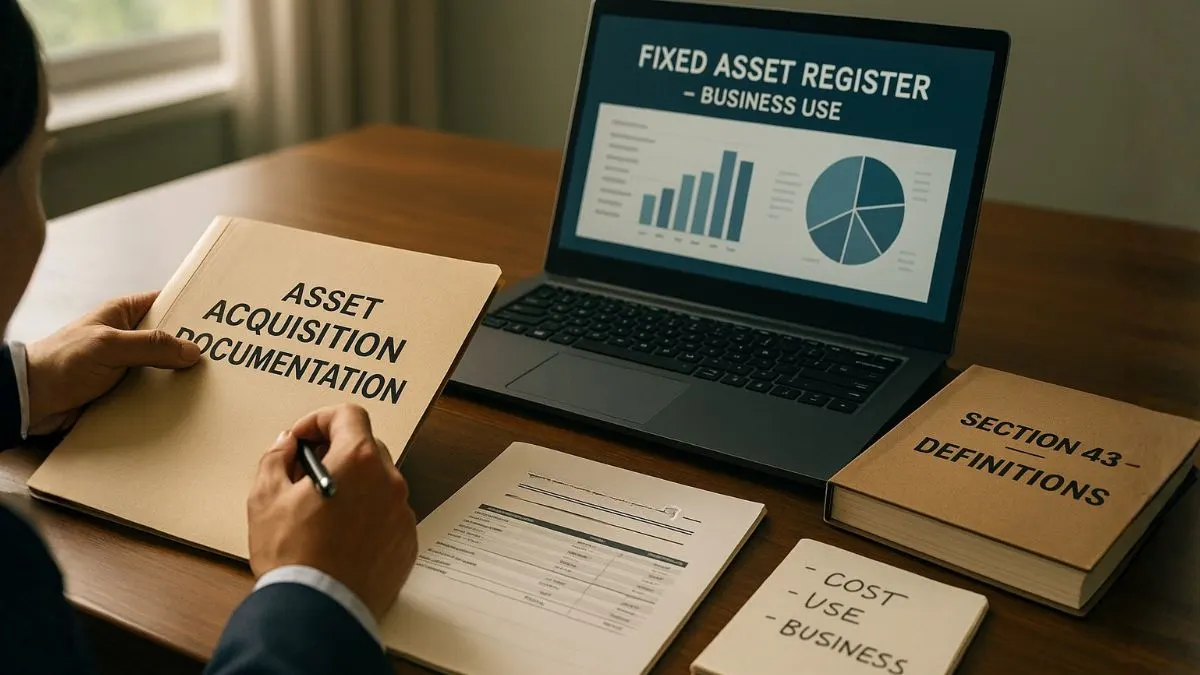
The Income Tax Act includes detailed definitions to avoid ambiguity in assessing taxable business income. Section 43 falls under Chapter IV-D, which deals with profits and gains from business or profession. The purpose of Section 43 is to lay down clear rules for the valuation of assets and liabilities, determining how depreciation, capital gains, and expenses are calculated. Each subsection of Section 43 has a specific role — and Section 43(3) focuses on one key term: “plant.”
This term might sound simple, but its tax implications are huge. Whether a business can claim depreciation or classify an expense as capital or revenue often depends on whether something qualifies as a “plant.”
What Section 43(3) States
Section 43(3) defines plant as:
“Plant includes ships, vehicles, books, scientific apparatus & surgical equipment used for the purposes of the business or profession but does not include tea bushes or livestock or buildings or furniture & fittings.”
In simpler terms, “plant” includes any item used for carrying out business operations, provided it’s not excluded by the section. This broad definition is intentionally flexible, allowing courts to adapt it to changing business environments and technologies. So, while machines and tools are obvious examples, the definition has been interpreted to include everything from cinema projectors to pipelines and even computers.
Key Features of Section 43(3)
Let’s unpack what makes this section so important for taxpayers:
- Inclusive Definition
The section uses the word “includes,” which means the examples given — ships, vehicles, books, & apparatus — are illustrative, not exhaustive. Anything used for business purposes can qualify if it meets the functional test. - Functional Approach Over Physical Form
The focus is not on what the item is, but how it is used. If an object plays a functional role in running the business, it can be treated as a plant." - Specific Exclusions
The definition excludes tea bushes, livestock, buildings, and furniture. These are treated differently under the law for depreciation purposes. - Link with Depreciation Rules
The term “plant” connects directly to Section 32, which deals with depreciation. Whether or not an asset is treated as a plant determines the depreciation rate and method applicable.
Also Read: Tax on Sale of Depreciable Assets
Practical Understanding — What Qualifies as a Plant
Over time, courts have expanded this interpretation. Some examples include:
- Machinery and Equipment — Standard examples like tools, engines, and manufacturing machines.
- Pipelines and Power Lines — Treated as plant because they’re integral to carrying out business.
- Books for Professionals — For doctors, lawyers, & architects, professional books are classified as plant.
- Computers and Software — Considered plant since they’re essential tools for business operation.
- Air Conditioning Units — If installed for production rather than comfort, they may qualify.
Interesting Judicial Interpretations
Courts have added depth to how “plant” is understood. Some landmark judgments include:
- Scientific Research Equipment (CIT v. Elecon Engineering Co. Ltd.)
The Gujarat High Court held that drawings, designs, & technical know-how used for manufacturing are part of “plant.” - Hotel Case (CIT v. Taj Mahal Hotel, 1971)
The Supreme Court ruled that sanitary and pipeline fittings in a hotel used for providing services to guests qualify as plant. - Decorative Assets (Scientific Engineering House Pvt. Ltd. v. CIT)
Technical documents & blueprints were held to be “plant” as they had functional utility.
These rulings show that courts prioritize the functional test — if the asset is an essential tool for the business, it’s a plant, regardless of its physical appearance.
Why This Definition Matters
The significance of Section 43(3) becomes clear when you consider its impact on tax depreciation. Depreciation reduces taxable income by allowing businesses to deduct a portion of an asset’s cost each year. For instance, if you buy machinery for ₹10 lakh, the depreciation claim depends on whether it’s categorized as “plant.” If yes, you could claim up to 15% annually under current rules. If not, the benefit may be much lower — or disallowed altogether.
This classification affects:
- The rate of depreciation (Section 32)
- Capital gains computation (Section 50)
- Balancing charge adjustments
- Accounting and valuation for business income
Also Read: Deductions Allowed Only on Actual Payment Basis
The Broader Framework of Section 43
While Section 43(3) focuses on defining “plant,” other parts of Section 43 set the stage for valuation principles. For example:
- Section 43(1) defines “actual cost.”
- Section 43(2) defines “written down value.”
- Section 43(6) defines “block of assets.”
- Section 43(5) explains “speculative transaction.”
Together, these clauses create a foundation for determining the tax impact of business assets — from how they’re acquired to how they’re depreciated or sold.
In essence, Section 43 provides the vocabulary of income computation for businesses. Without it, terms like “actual cost,” “block of assets,” or “plant” would be ambiguous.
Difference Between Building and Plant
One area that often creates confusion is distinguishing between “building” and “plant.”
A factory building, for example, might house heavy machinery. So, is the entire structure a plant?
The courts have drawn a line:
- If a structure merely shelters operations, it’s a building.
- But if it performs a specific business function (like a cold storage or a furnace), it’s treated as a plant.
This distinction can drastically change depreciation claims & tax outcomes.
Section 43(3) and Scientific Research
The term “plant” also influences deductions for scientific research. Under Sections 35 and 35AD, expenditure on scientific research — including capital outlays on plants & equipment — qualifies for special deductions.
So when a company invests in laboratory apparatus, testing tools, or research facilities, these items fall under the “plant” category, ensuring higher deductions and tax relief.
The Connection Between Section 43(3) and Other Business Provisions
To understand the broader network of the Income Tax Act:
- Section 32: Depreciation allowance is claimed only if the asset is classified as plant.
- Section 35AD: Investment-based deductions depend on plant valuation.
- Section 50: Defines capital gains arising from the sale of depreciable assets.
- Section 43(1) & (6): Establish cost & written down value for depreciation calculations.
This interlinking makes Section 43(3) the definitional backbone for many business tax computations.
Also Read: MSME Payment Rule Every Business Must Know
Illustration Example
Let’s consider a manufacturing company, ABC Tools Pvt. Ltd., which installs a new laser-cutting machine, builds an air-conditioned chamber around it, & purchases specialized software to operate it.
- The machine clearly qualifies as plant.
- The software, though intangible, also qualifies because it directly assists in the machine’s function.
- The air-conditioned enclosure, however, will depend — if it maintains environmental conditions essential for the machine’s operation, it too can be classified as a plant.
Such small differences can result in lakhs of rupees in allowable depreciation.
Modern-Day Relevance
With India’s shift toward a digital economy, the meaning of “plant” is evolving.
Modern assets like cloud servers, robotics, and 3D printers blur the traditional lines between tangible & intangible property.
Courts and tax authorities are increasingly applying the functional test — if an asset contributes directly to income generation, it qualifies as a plant, whether it’s physical or software-based.
For IT firms, data servers & cybersecurity tools; for hospitals, diagnostic equipment; and for media houses, digital broadcasting systems — all fall within the modern scope of Section 43(3).
Common Mistakes Businesses Make
- Misclassifying Furniture or Fixtures as Plant — Not everything used in business qualifies. If an item is more for comfort or décor than function, it’s not eligible.
- Ignoring Ancillary Tools — Accessories or support devices used in production (like control panels) also qualify as plant & should be capitalized correctly."
- Incorrect Depreciation Block Classification — Businesses often mix buildings, furniture, and plants in one block, leading to compliance issues during audit.
Accurate classification avoids penalties and ensures the full benefit of depreciation deductions.
Also Read: Conditions for Depreciation and Development Rebate
Key Takeaways
|
Aspect |
Explanation |
|
Relevant Section |
Section 43(3) of the Income Tax Act, 1961 |
|
Definition |
Defines “plant” for business income computation |
|
Purpose |
Establish rules for valuation of assets for tax |
|
Includes |
Ships, vehicles, books, scientific apparatus, surgical equipment |
|
Excludes |
Buildings, furniture, fittings, livestock, tea bushes |
|
Functional Test |
Anything used for business operations may qualify |
|
Depreciation Impact |
Determines eligibility under Section 32 |
|
Judicial Trend |
Broader interpretation to include intangible assets |
Conclusion
Section 43(3) of the Income Tax Act may look like a small definition clause, but it drives many of the valuation & depreciation rules that affect how businesses pay tax in India. By clarifying what counts as a “plant,” it ensures fairness, consistency, and compliance in how assets are treated for income computation. The section reflects the idea that taxation should follow function — if something helps you earn income, it deserves recognition under the law.
If your business invests in machinery, tools, or software, and you want to ensure they’re classified correctly for maximum depreciation and compliance, reach out to our experts at CallMyCA.com.









