
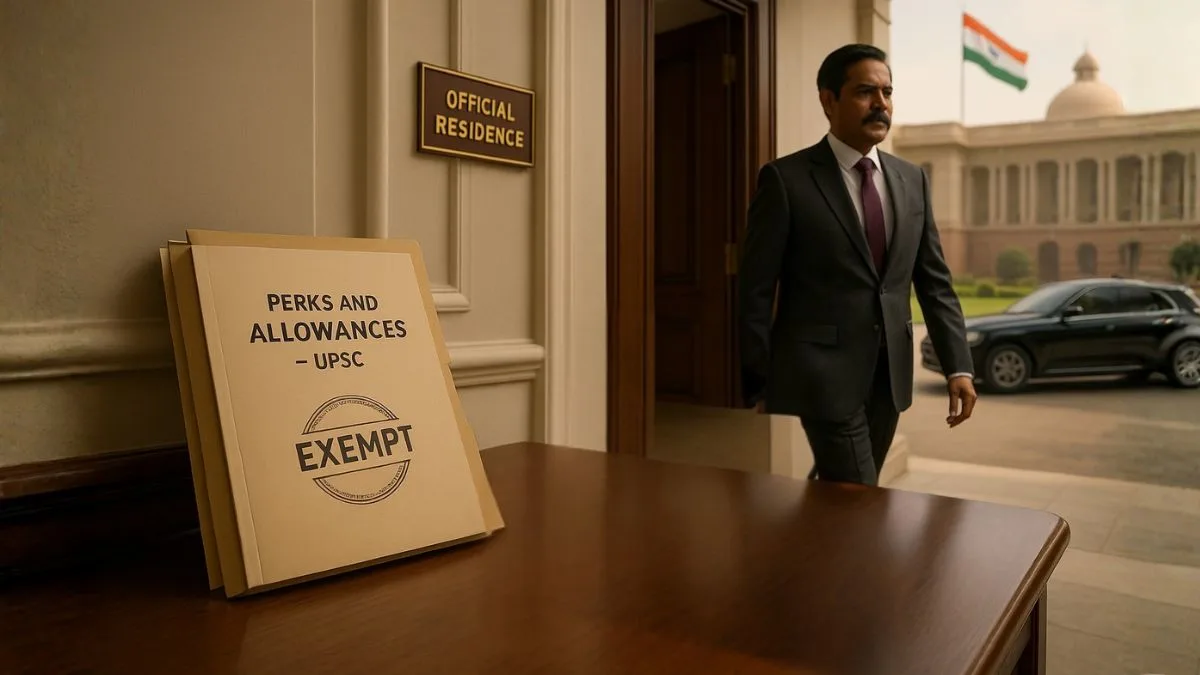
Not every tax exemption in India is about saving money. Some exist to protect institutions that form the backbone of our democracy. The Union Public Service Commission (UPSC) — the body that selects India’s top civil servants — falls squarely in that category. UPSC members must operate without fear or favor, and that includes independence from financial obligations that could influence their judgment. Recognizing this, the government introduced Section 10(45) — a provision that exempts certain official benefits & perquisites of UPSC members from taxation.
It’s less about privilege, more about preserving impartiality.
What Section 10(45) of the Income Tax Act Says
In straightforward terms, this section reads:
“Any allowance or perquisite, whether paid or allowed, as such to the Chairman or any other Member of the Union Public Service Commission, shall be exempt from income tax.” This means any official benefit or allowance, whether in cash or kind, given to the UPSC Chairman or Members, is completely tax-free, both during service and post-retirement — as long as it’s among those notified by the government.
So, the rule applies not only to current UPSC officials but also to those who’ve completed their tenure & continue to receive certain sanctioned benefits.
What Kind of Allowances Are Covered
The government issues periodic notifications in the Official Gazette specifying which allowances are covered.
The most notable among them include:
- Conveyance Allowance —
The law explicitly states that UPSC members are exempt from paying tax on conveyance allowance. This covers the costs of official travel, vehicle usage, and related expenses. - Rent-Free Accommodation —
The value of rent-free or government-provided accommodation is not taxable. For others, this would count as a perquisite, but for UPSC members, it’s exempt. - Medical Facilities and Reimbursements —
Healthcare-related reimbursements for the member & their family are exempt when provided as part of service conditions." - Sumptuary Allowance —
This allowance, meant for official hospitality & ceremonial expenses, is also exempt. - Leave Encashment or Pensionary Benefits —
Certain post-retirement benefits like leave encashment & commuted pension are exempt under government notification.
These exemptions ensure that the perks linked to the UPSC office remain administrative necessities, not taxable income.
Also Read: Tax Exemption for Notified Entities
Why This Exemption Is Special
Unlike exemptions for salaried employees (which require documentation or proof of expenses), Section 10(45) grants automatic exemption to UPSC Members because their allowances are integral to their constitutional function.
For example, no tax needs to be paid by UPSC members on conveyance allowance, not because it’s an employee benefit — but because it’s a tool to help them perform their duties independently & efficiently.
The section recognizes that these are not personal perks, but functional benefits necessary for a role that must stay insulated from political & bureaucratic influence.
The Legal Framework and Government Notification
This exemption became effective after Notification No. 55/2011 dated 28 July 2011, which officially listed the categories of exempt income.
The list includes:
- Conveyance allowance
- Sumptuary allowance
- Rent-free furnished residence
- Leave encashment at retirement
These apply to serving & retired UPSC members alike.
So, if a retired Member continues to receive benefits like accommodation or travel support, these remain fully exempt under Section 10(45).
How It Differs from Other Employee Exemptions
To understand how exclusive this benefit is, it helps to compare it with common salary-related exemptions:
|
Provision |
Who It Applies To |
Type of Income |
Tax Treatment |
|
Section 10(45) |
UPSC Chairman & Members |
Allowances, perquisites |
Fully exempt |
|
Section 10(14) |
Salaried employees |
Special allowances |
Exempt only if spent for official purposes |
|
Section 17(2) |
General employees |
Perquisites |
Taxable unless specifically exempt |
|
Section 10(45A) |
Election Commission / CAG |
Official allowances |
Similar to UPSC model |
Where others have to justify their exemptions, UPSC officials get it by constitutional design.
Also Read: The New Tax Exemption Rule for Specified Authorities
Practical Example: How Section 10(45) Works
Let’s say Dr. Meera Sharma, a retired UPSC Member, receives the following in FY 2024–25:
- Conveyance allowance – ₹60,000
- Sumptuary allowance – ₹1,00,000
- Medical reimbursement – ₹40,000
- Consultancy income from a private institute – ₹1,50,000
Here’s how it’s treated under income tax:
- The conveyance, sumptuary, & medical reimbursements are exempt under Section 10(45).
- Only the consultancy income is taxable under “Income from Other Sources.”
This example shows how UPSC-linked allowances are completely insulated from taxation, while personal earnings remain taxable.
Why Independence and Tax Exemption Go Hand-in-Hand
When the Constitution was framed, institutions like the UPSC were designed to be independent of executive interference. Financial independence was part of that design.
By freeing official allowances from taxation, Section 10(45) eliminates even the perception of financial dependence.
It ensures that members focus solely on merit & transparency — not administrative bureaucracy or personal taxation.
This approach echoes the same philosophy that governs judicial salaries and Election Commission benefits — independence through autonomy.
How the Exemption Applies in Practice
For UPSC members, the process is seamless. The Pay & Accounts Office (PAO) applies the exemption directly while calculating TDS. So, their Form 16 automatically excludes the exempt portions.
This means:
- No need to submit extra proofs.
- No separate claim during ITR filing.
- No tax deducted on these allowances.
For retired members, benefits received through government sanction letters are treated similarly — exempt at source.
Also Read: The Hidden Tax-Free Benefit on NRE & FCNR Accounts
Relevance for Other Constitutional Offices
The model set by Section 10(45) later influenced exemptions for other constitutional positions. The same logic — protecting independence — led to parallel provisions for:
- Election Commissioners & Chief Election Commissioner"
- Comptroller & Auditor General (CAG)
- Chairpersons of certain constitutional commissions
It created a consistent tax structure for high offices of integrity.
Impact and Significance
The impact of Section 10(45) goes beyond the UPSC. It shows how the Income Tax Act can uphold constitutional principles — not just fiscal logic. The exemption is not a financial privilege but a symbol of trust that certain roles must remain beyond personal financial consideration. It keeps India’s civil services recruitment body free from both administrative & monetary bias.
By ensuring that even post-retirement benefits remain tax-free, the provision extends dignity beyond tenure.
Key Takeaways
|
Particulars |
Details |
|
Relevant Provision |
Section 10(45) of the Income Tax Act, 1961 |
|
Beneficiaries |
Serving or Retired UPSC Chairman & Members |
|
Nature of Exemption |
Full exemption on notified allowances & perquisites |
|
Examples |
Conveyance allowance, rent-free accommodation, leave encashment, medical reimbursement |
|
Purpose |
Safeguard constitutional independence & neutrality |
|
TDS Applicability |
Not applicable on exempt income |
Also Read: Tax Exemption for Notified Entities
Conclusion
Section 10(45) of the Income Tax Act stands as a reminder that taxation is not just about revenue — it’s also about respect for roles that uphold democracy. By providing full tax exemption on allowances & perquisites to UPSC members, it protects financial neutrality and reinforces constitutional autonomy. For serving and retired officials, it means clarity & dignity. For the system, it means continuity of trust.
If you’re unsure how specific allowances or reimbursements apply in your case — or you want to verify eligibility for any income tax exemption — our CA experts at CallMyCA.com can help you decode the fine print.









