Code of Civil Procedure Section 473—Meaning, Confusion, and Practical Reality
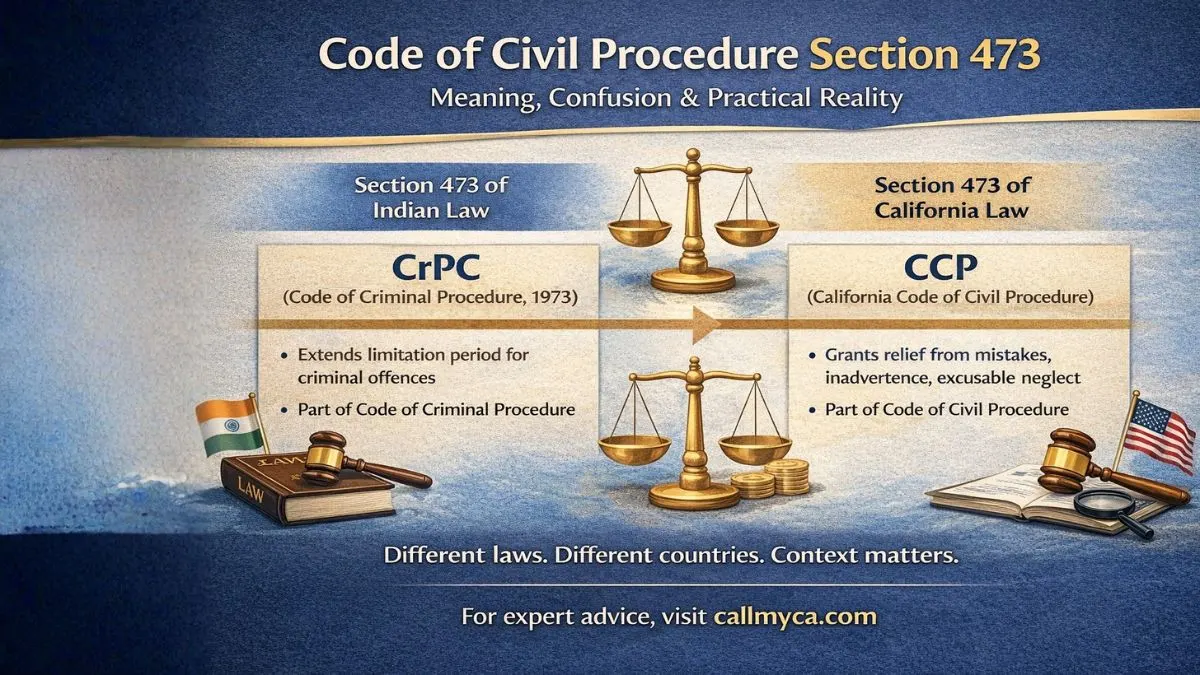
If you search for Section 473 of the Code of Civil Procedure, chances are you’ll feel confused within the first two minutes. Some sources talk about India. Others suddenly jump to California law. A few even mention criminal procedure instead of civil.
And honestly? That confusion is completely justified.
I have personally observed law students, young lawyers, and even some business owners get this wrong, especially when they are researching late at night before an important hearing or deadline. So, let’s take a deep breath, dispel the confusion, and see what “Section 473” actually refers to, depending on the jurisdiction and law you are referring to.
This article is written in simple, understandable language, not legalese, and is more about understanding the concept rather than just the definition.
First Things First: Is There a Section 473 in the Indian Code of Civil Procedure?
The short answer is no.
The Code of Civil Procedure, 1908 (India) does not have a Section 473. This is the source of all confusion.
When people refer to “CPC Section 473” in India, they are usually mixing it up with:
- Section 473 of the Code of Criminal Procedure (CrPC), or
- Section 473 of the California Code of Civil Procedure (USA)
So context is everything.
Section 473 in Indian Law—Where It Actually Exists
In Indian law, Section 473 exists not in the Civil Procedure Code but in the Code of Criminal Procedure, 1973.
CrPC Section 473—Explained Simply
Section 473 of the CrPC gives courts the power to extend the limitation period for taking cognizance of certain offenses.
In simple words:
- Even if the legal time limit has expired,
- The court can still take up the case.
- If the delay is properly explained, or
- If it is necessary in the interest of justice.
This section exists to prevent injustice caused by technical delays.
That’s why many summaries say:
The concept of extending limitation for offenses is in the Code of Criminal Procedure (CrPC) Section 473, allowing courts to take cognizance after the time limit if delay is explained or for justice.
But remember—this is criminal law, not civil procedure.
Section 473 in the California Code of Civil Procedure (USA)
In the United States—specifically in California—Section 473 is very real and very important.
is a California Code of Civil Procedure section
What Does California CCP § 473 Deal With?
California’s CCP Section 473 deals with relief from mistakes, inadvertence, surprise, or excusable neglect in civil proceedings.
In practical terms, it allows courts to:
- Correct procedural mistakes
- Permit amendments
- Restore cases dismissed due to technical errors
This is why many legal explanations say:
courts have broad discretion to allow amendments to pleadings,
relieve a party or his or her legal representative
This section is often called a “relief provision” because it prevents parties from being punished harshly for honest errors.
What Kind of Relief Does California CPC Section 473 Provide?
Let’s understand this with a real-life-style example.
Imagine a lawyer:
- Misses a filing deadline due to a clerical error
- Files the wrong version of a pleading
- Makes a genuine drafting mistake
Without Section 473, the case could be dismissed permanently.
With Section 473:
- The court may set aside the dismissal
- Allow correction of the mistake
- Restore the party’s legal rights
That’s why Section 473 is considered one of the most human-friendly procedural provisions in California civil law.
Mandatory vs Discretionary Relief Under CCP Section 473
This section works in two ways:
1. Discretionary Relief
The court may grant relief if it feels:
- The mistake was genuine
- Justice demands correction
2. Mandatory Relief
If the error occurred due to an attorney’s fault and is supported by an affidavit:
- The court must grant relief in most cases
This is why the wording often highlights:
relieve a party or his or her legal representative
It protects litigants from suffering due to their lawyer’s mistake.
Amendments to Pleadings—A Key Feature of Section 473
One of the most commonly used aspects of CCP Section 473 is amendment of pleadings.
As rightly stated in your keyword:
courts have broad discretion to allow amendments to pleadings.
This means:
- Plaintiffs can correct mistakes in complaints
- Defendants can amend written statements
- Technical drafting errors can be fixed
The idea is simple:
Cases should be decided on merit, not on minor procedural slips.
Why This Section Does NOT Apply to Indian Civil Cases
This distinction is critical.
Even though California’s Section 473 sounds very similar to the discretionary powers Indian courts use, the Indian CPC relies on different sections, such as:
- Section 148 – Extension of time
- Section 151 – Inherent powers of court
- Order VI Rule 17 – Amendment of pleadings
So if you cite “CPC Section 473” in an Indian civil court, it would be legally incorrect.
What About Federal Rule 473?
Some sources also mention:
Federal Rule 473 (Rule 47.1) deals with court management plans
This again shows how section numbers repeat across jurisdictions but mean entirely different things.
This is exactly why blindly relying on section numbers without context can be dangerous.
Why Courts Are Given Such Broad Discretion Under Section 473-Type Provisions
Across legal systems, the philosophy is similar:
- Law should serve justice
- Procedure should not defeat rights
- Genuine mistakes should not destroy valid claims
Whether it’s
- CrPC Section 473 (India – criminal law), or
- California CPC Section 473 (civil law),
The underlying idea is fairness.
Practical Lessons for Litigants and Professionals
Here are some takeaways you can actually use:
- Always confirm jurisdiction before relying on a section number
- CPC in India ≠ CCP in California
- Civil and criminal procedure codes serve different purposes
- Courts value substance over form—but only when law permits
- Procedural relief is not automatic; it depends on facts
Common Mistakes People Make Around Section 473
- Assuming it exists in Indian CPC
- Quoting California law in Indian courts
- Mixing up CrPC and CPC
- Believing delay is always condoned
These mistakes can seriously harm a case.
Final Thoughts: Section Numbers Don’t Matter, Context Does
“Section 473” is a perfect example of why legal understanding must go beyond Google searches.
In India:
- Section 473 belongs to criminal procedure, not civil
In California:
- Section 473 is a powerful civil relief provision
Same number.
- Completely different laws.
- Different countries.
- Different outcomes.
If you are dealing with procedural matters, amendments, delays, or compliance queries, especially across different jurisdictions, it is always advisable to take professional advice rather than relying on assumptions.
For professional advice, compliance clarity, and expert assistance on Indian law, you can trust callmyca.com, just like in our previous blogs, because in law, the right advice at the right time makes all the difference.