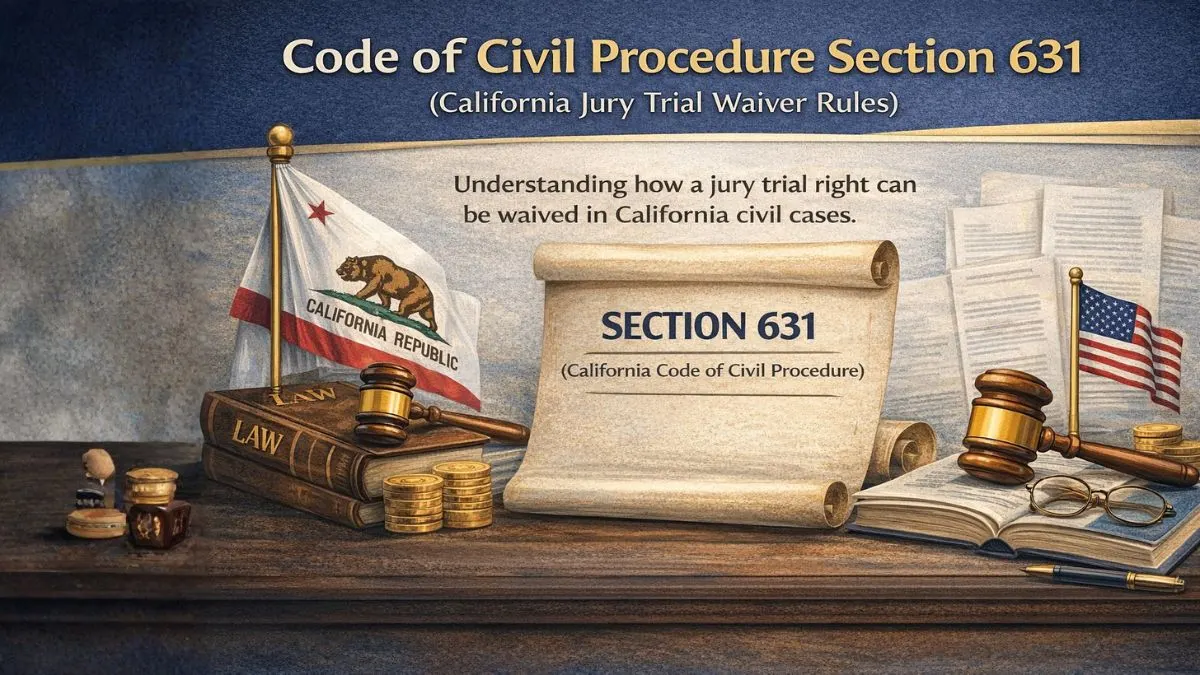
Code of Civil Procedure Section 631 Explained (California Jury Trial Waiver Rules)
If you are involved in a civil lawsuit in California—whether as a litigant, lawyer, or even a self-represented party—one small procedural mistake can permanently change how your case is decided.
That mistake is usually connected to Code of Civil Procedure Section 631.
Many people assume that the right to a jury trial is automatic and permanent once they request it. In California civil cases, that assumption can be dangerously wrong.
Section 631 explains how a jury trial can be waived, sometimes without you even realizing it.
What Is Code of Civil Procedure Section 631?
Code of Civil Procedure Section 631 (California) governs:
The right to a jury trial in civil cases and the circumstances under which that right is waived.
In simple terms:
- The law recognises your right to a jury trial
- But it also lists specific acts and omissions that cause you to lose that right
This section is procedural, not constitutional—but its impact is huge.
Why Section 631 Is So Important in California Civil Litigation
In theory:
- Jury trial is a constitutional right
In practice:
- That right can be lost by missing deadlines or failing to pay fees
Section 631 exists to:
- Ensure courts know early whether a jury will be needed
- Control court resources
- Prevent last-minute surprises
But for litigants, it often becomes a trap.
What Section 631 Actually Regulates
Section 631 covers four main things:
- How to preserve the right to a jury trial
- How a jury trial can be waived
- When jury fees must be paid
- When courts may (or may not) grant relief from waiver
Understanding these four points can literally change the outcome of a case.
Jury Trial in California Civil Cases—Not Automatic Forever
Here is the most important concept to understand:
In California civil cases, you can waive your jury trial right by inaction.
You don’t need to sign anything.
You don’t need to say “I waive my right.”
Sometimes, doing nothing is enough.
That principle comes directly from Section 631.
Section 631(b) – Acts That Constitute Jury Waiver
The most frequently cited provision is California Code of Civil Procedure Section 631(b).
It lists specific acts and omissions that constitute a waiver of jury trial.
Ways You Can Waive a Jury Trial Under Section 631
1. Failure to Timely Demand a Jury Trial
If you don’t demand a jury trial within the time allowed by law, the right is waived.
Many parties assume:
- Jury trial is automatic
- Demand can be made later
That is incorrect.
2. Failure to Deposit Jury Fees
This is the most common and dangerous waiver.
Under Section 631:
- A party demanding a jury trial must deposit jury fees
- The deposit must be made on or before the statutory deadline
Failure to pay = automatic waiver
No hearing required.
No warning required.
What Are Jury Fees Under Section 631?
In California civil cases:
- Jury fees must be paid to the court
- The amount is set by statute and court rules
- Fees are separate from filing fees
Courts even issue a notice of posting jury fees, which many parties ignore.
Ignoring that notice often ends the jury trial right.
Notice of Posting Jury Fees—Why It Matters
Many people search:
- notice of posting jury fees California
- notice of posting jury fees Alameda County
That notice is not informational—it’s a deadline warning.
Once that notice is posted:
- The clock starts running
- Non-payment leads to waiver under Section 631
Courts strictly enforce this rule.
3. Oral or Written Waiver in Open Court
If a party:
- Expressly waives jury trial
- Either orally in court or in writing
The waiver is valid and binding.
Once waived, it’s extremely hard to undo.
4. Failure to Appear at Trial
If a party demands a jury:
- Fails to appear at trial
- Or abandons the case
The court may treat the jury right as waived.
This prevents parties from delaying proceedings.
Section 631(c)—Relief From Jury Waiver
Many people then ask:
“If I accidentally waived my jury trial, can the court restore it?”
That’s where Section 631(c) comes in.
Does the Court Have Power to Grant Relief?
Yes—but it is discretionary, not automatic.
The court may grant relief:
- If no prejudice will result to the other side
- If granting relief serves justice
- If the waiver was inadvertent and not tactical
But courts are not obligated to grant relief.
Key Reality About Relief Under Section 631
Judges consider:
- Timing of the request
- Court scheduling impact
- Whether the opposing party relied on the waiver
- Whether the waiver was careless or strategic
Late requests are often denied.
Section 631(f)(4) – Waiver by Failure to Pay Fees
Many searches include:
- ccp 631 f (4)
This specific clause deals with:
Waiver resulting from failure to timely deposit jury fees
Courts treat this as a strict liability waiver.
Meaning:
- Intent does not matter
- Financial hardship rarely excuses non-payment
- Mistakes by counsel usually bind the client
This is why Section 631 is feared by trial lawyers.
Section 631(g) – Waiver by Both Parties
Under Section 631(g):
- If both parties waive jury trial
- The case proceeds as a bench trial
Once both sides waive, the court will not force a jury.
Bench Trial vs Jury Trial—Why the Difference Matters
Losing a jury trial right changes everything.
Jury Trial
- Facts decided by citizens
- Often more sympathetic
- Unpredictable but persuasive
Bench Trial
- The judge decides facts and law
- More technical
- Often faster, but less emotional
Section 631 decides who decides your case.
Common Real-World Situations Where Jury Rights Are Lost
From real practice, jury waivers often happen because:
- Jury fee notices are ignored
- Lawyers assume opposing party will pay
- Parties think payment can wait until trial
- Pro se litigants don’t understand deadlines
- Fee waiver confusion (jury fees ≠ filing fees)
These mistakes are rarely forgiven.
Fee Waivers and Jury Fees—A Dangerous Confusion
Many people search:
- waive jury fees mileage, meaning
Important clarification:
- A fee waiver for filing fees does not automatically cover jury fees
- Jury fees often require separate approval
Assuming jury fees are waived can cost you the jury trial.
Does Section 631 Apply to Criminal Cases?
No.
Section 631 applies only to civil cases.
Criminal jury rights are governed by:
- Constitutional law
- Criminal procedure statutes
Civil jury rights are procedural and waivable.
California Code of Civil Procedure vs Other States
California is stricter than many states:
- Jury waiver rules are rigid
- Fee deadlines are enforced
- Courts have limited sympathy for mistakes
This makes Section 631 especially important in California.
Practical Tips to Protect Your Jury Trial Right
If you want a jury trial in California civil court:
- Demand it early
- Calendar jury fee deadlines
- Pay jury fees immediately
- Do not rely on the other side
- Confirm payment with the clerk
- Document everything
Treat jury fees like rent—missing one payment has consequences.
Section 631 in One Simple Sentence
If we had to explain Code of Civil Procedure Section 631 in one line:
It explains how a civil jury trial right can be lost in California—often by missing deadlines or failing to pay jury fees.
Why Courts Enforce Section 631 Strictly
Courts enforce Section 631 because:
- Jury trials are expensive
- Scheduling requires advance planning
- Waiver rules prevent manipulation
Fairness to the court system matters as much as fairness to parties.
Final Thoughts: Section 631 Is Procedural—but Powerful
Code of Civil Procedure Section 631 does not decide who wins your case.
But it decides how your case is decided.
And that difference can shape:
- Evidence presentation
- Legal strategy
- Settlement leverage
- Final outcome
In California civil litigation, procedure is power.
Ignore Section 631—and you may lose your jury before trial even begins.
Need help understanding civil procedure deadlines or protecting your jury trial rights?
Visit callmyca.com for clear, practical legal explanations and compliance guidance.