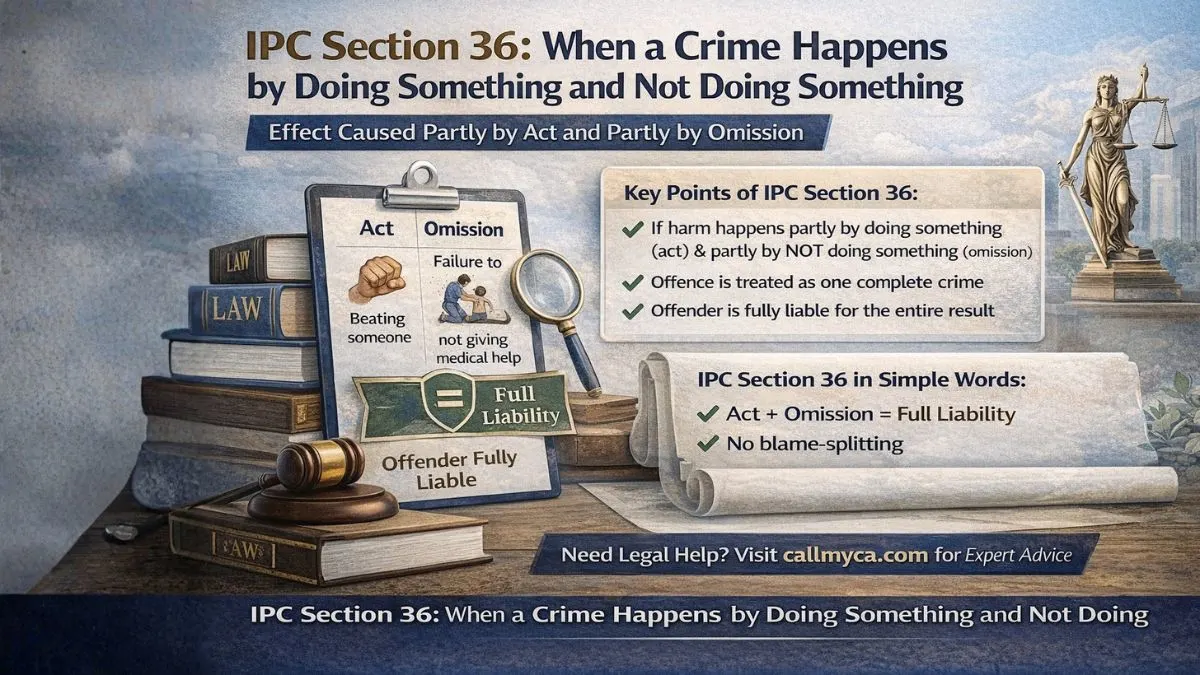
IPC Section 36: When a Crime Happens by Doing Something and Not Doing Something
Most people think crimes happen because of what someone did.
But Indian criminal law is a little smarter than that.
Sometimes, harm happens because of:
- an action, and
- a failure to act together.
That’s exactly what IPC Section 36 talks about.
What Is IPC Section 36?
In simple language, IPC Section 36 says:
👉 If an offence causes a result (like injury or death), and
👉 that result happens partly because of an act and partly because of an omission.
👉 Then the offense is treated as one complete offense.
The person responsible is fully liable, as if the entire result was caused by:
- only by the act, or
- only by the omission.
The official heading explains it perfectly:
Effect caused partly by act and partly by omission
Why IPC Section 36 Exists
Without Section 36, an accused could argue:
“Yes, I did something… but the real harm happened because I didn’t do something else.”
Or:
“I didn’t actively cause the result. I just failed to prevent it.”
IPC Section 36 closes this escape route.
The law clearly says:
You cannot split responsibility when the final result is the same.
Act vs Omission (Quick Clarity)
Before going further, let’s simplify these terms.
Act
Something you actively do
Example:
- beating someone
- locking someone in a room
Omission
Something you were legally expected to do, but didn’t
Example:
- not giving food
- not providing medical help when duty-bound
IPC Section 36 applies when both combine to cause harm.
Simple Example to Understand IPC Section 36
Let’s take a real-world type example (often used in law classes):
Example: Act Omission
- A person beats another person badly (act)
- Then locks him in a room and does not give food or medical help (omission)
- The victim dies
Under IPC Section 36:
- the death is treated as one offense.
- the accused is fully responsible
- it doesn’t matter that death happened partly due to neglect
The law treats it as if:
The entire effect was caused by the accused.
Why This Section Is Important in Criminal Law
Without Section 36:
- criminals could dodge responsibility
- cases would get stuck in technical arguments
- justice would become complicated
That’s why IPC Section 36 is a critical part of Indian criminal law.
It ensures:
- accountability
- clarity of liability
- focus on the result, not excuses
Is IPC Section 36 a Punishment Section?
No.
This is very important.
IPC Section 36 does NOT prescribe punishment.
It:
- explains how liability is fixed
- works along with other offence sections
Punishment depends on:
- the main offence (murder, hurt, negligence, etc.)
IPC Section 36 vs IPC Section 34 & 35 (Quick Context)
People often confuse these sections.
- Section 34 → common intention (multiple people)
- Section 35 → shared knowledge/intent
- Section 36 → single person, act omission
So Section 36 is about how the effect happened, not how many people were involved.
Does IPC Section 36 Apply Only to Death Cases?
No.
It applies to any offense where:
- a specific result is required, and
- that result is caused partly by action and partly by inaction
Examples:
- grievous hurt
- wrongful confinement
- criminal negligence
“The Person Who Did the Act Will Be Held Responsible”
One key idea behind IPC Section 36 is this:
The person who did the act will be held responsible for the effect caused by the act, even if omission also played a role.
This prevents:
- half-responsibility arguments
- shifting blame to circumstances
Has IPC Section 36 Been Replaced?
Yes, partially.
With the introduction of the Bharatiya Nyaya Sanhita (BNS):
- IPC Section 36 has been replaced with BNS Section 3
However:
- the legal principle remains the same
- old cases and interpretations are still relevant
So if you see:
“Section 36 IPC in BNS”
It refers to the same concept, just under the new code.
Important Clarification (Very Necessary)
There is NO connection between IPC Section 36 and:
- homosexuality
- morality-based offences
Some online sources mix unrelated topics.
Legally speaking:
IPC Section 36 is purely about criminal liability for act omission.
Why Courts Rely on IPC Section 36
Courts use this section to:
- avoid fragmented liability
- assess the complete chain of events
- deliver justice based on real-world conduct
Judges focus on:
“What caused the final harm?”
Not:
“How can liability be divided to reduce responsibility?”
IPC Section 36 in One Simple Line
If you remember only one thing, remember this:
IPC Section 36 says that if harm is caused partly by an act and partly by an omission, the offender is fully liable for the entire result.
Quick Human-Friendly Summary
- IPC Section 36 deals with effect caused partly by act and partly by omission
- It fixes full criminal liability
- It prevents technical escape arguments
- It does not define punishment
- Replaced by BNS Section 3, but principle remains
- Focuses on result, not excuses
Final Thoughts
IPC Section 36 reminds us of a simple truth:
Harm doesn’t always come from what you do.
Sometimes it comes from what you deliberately don’t do.
And the law is very clear:
- If your action and your neglect together cause damage,
- You are responsible for the outcome.
Understanding sections like this helps people see how criminal law actually thinks—not emotionally, but logically and fairly.
If you’re dealing with a criminal law issue or trying to understand liability under IPC or the new BNS framework, professional legal clarity is always worth it.
For expert guidance on legal provisions and practical interpretation, visit callmyca.com.