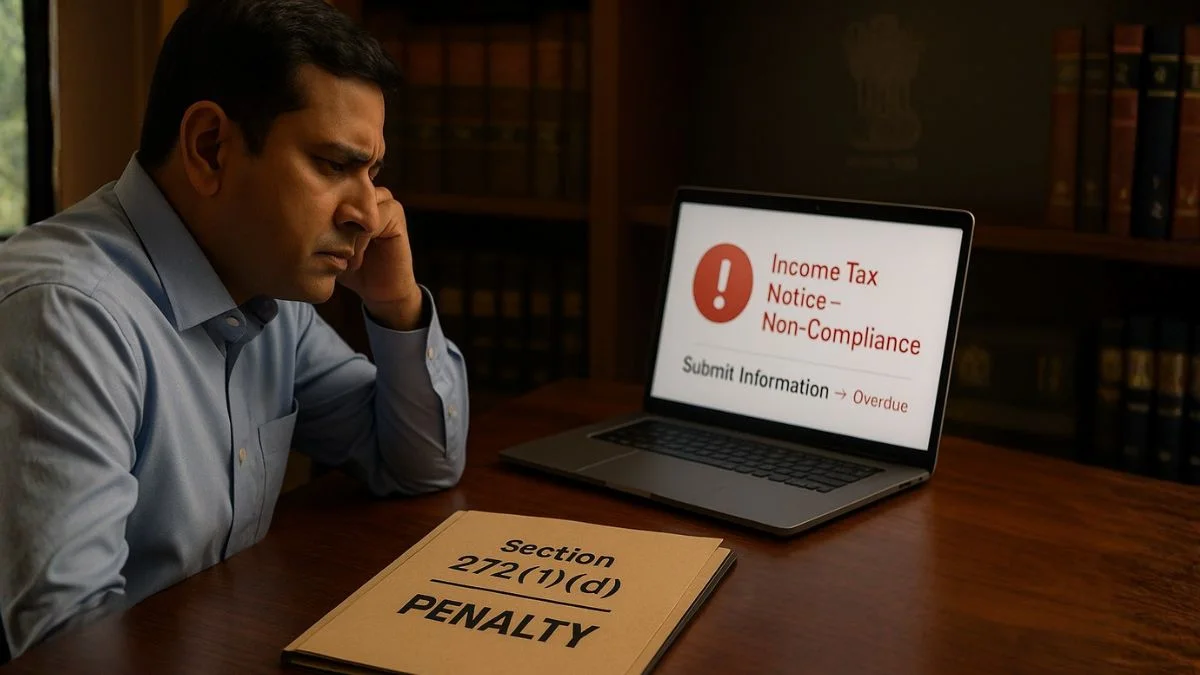
Many taxpayers panic the moment they receive an income-tax notice. Sometimes, this fear leads to delays, silence, or ignoring the notice completely. While some notices are routine & harmless, non-compliance can trigger serious penalties—not because the tax department wants to punish anyone, but because proper administration becomes impossible when taxpayers fail to respond. That is exactly why Section 272(1)(d) exists.
This provision ensures discipline in communication between taxpayers and authorities. When authorities ask for documents, responses, or clarifications, the law expects cooperation. Section 272(1)(d) steps in when this cooperation is missing. The section imposes a fixed penalty and acts as a deterrent against avoidance, especially in cases where concealment of particular income or furnishing of inaccurate particulars is suspected.
What Section 272(1)(d) of the Income Tax Act Actually Says
Section 272(1)(d) is straightforward:
It imposes a penalty on a person who fails to comply with specific notices or directions issued by the income-tax authority. The penalty for each failure is ₹10,000.
This penalty is not percentage-based, not dependent on income level, and not linked to tax payable. It is a fixed monetary penalty charged per default. So if a person ignores multiple notices, the penalty accumulates.
The key idea behind this section is not revenue generation—but timely cooperation. The Income-tax Department relies heavily on information provided by taxpayers. When the taxpayer does not comply, assessment work slows down or becomes inaccurate.
What Kind of Notices Fall Under Section 272(1)(d)?
This section applies when an assessee fails to comply with:
- Notices issued under Section 142(1) — requiring submission of accounts, documents, or statements
- Notices or directions issued under Section 142(2A) — requiring a special audit
- Notices seeking information necessary for inquiry
- Directions for producing books of account, proofs, or evidence
In simple words, whenever the assessing authority has asked for something specific & the assessee fails to respond or co-operate, Section 272(1)(d) comes into play.
For example:
If an Assessing Officer sends a notice asking you to furnish your bank statements or proof of income and you ignore it, this penalty becomes applicable.
Penalty Amount Under Section 272(1)(d)
The provision is very clear:
Penalty = ₹10,000 per failure
This means:
✔ If you ignore one notice → ₹10,000
✔ Ignore two notices → ₹20,000
✔ Ignore three → ₹30,000
It keeps increasing until you comply.
This fixed-penalty model ensures that a taxpayer cannot escape by delaying responses indefinitely.
Also Read: The Penalty Rule for Wrong or Missing PAN
Why the Law Imposes This Penalty
The tax ecosystem runs on timely exchange of information. Notices are issued for various reasons—sometimes routine, sometimes in-depth. When taxpayers do not respond:
- investigations get delayed
- discrepancies cannot be clarified
- genuine exemptions cannot be verified
- potential concealment of particular income remains unchecked
- the accuracy of assessments decreases
Section 272(1)(d) is meant to ensure that communication stays active & responsive.
It is not designed to punish taxpayers unnecessarily. In fact, most officers allow reasonable time and even grant extensions when requested properly. But when silence or avoidance becomes habitual, penalties are enforced.
Situations Where Section 272(1)(d) Is Commonly Invoked
Authorities typically use this provision when:
✔ The taxpayer ignores repeated notices
Even after reminders, if no compliance is made, the penalty applies.
✔ The assessee does not submit documents requested for scrutiny
Books of accounts, PAN details, invoices, proof of expenses, or bank statements.
✔ The assessee avoids personal hearings
If directions are issued to appear & the person does not attend."
✔ Information furnished is incomplete or not usable
Providing vague or partial details is treated as non-compliance.
✔ Suspected concealment of income
If concealment of particular income or furnishing of inaccurate particulars is suspected, strict compliance is demanded.
In these situations, Section 272(1)(d) acts as a corrective tool.
Difference Between Section 272(1)(d) and Penalties for Concealment
Your keyword mentions “concealment of particular income or furnishing of inaccurate particulars.”
However, it’s important to clarify:
👉 Section 272(1)(d) is NOT a penalty for concealment.
👉 That role belongs to Section 271(1)(c).
Section 272(1)(d) deals ONLY with non-compliance of notices.
But concealment cases often trigger strict scrutiny, during which authorities issue several notices. If the taxpayer avoids these notices, Section 272(1)(d) penalties may apply in addition to other penalties.
So while the two are different, they may appear together in serious cases.
Also Read: The Penalty Clause Nobody Talks About: What Section 272 Can Suddenly Cost You
Is Penalty Under Section 272(1)(d) Automatic?
No. It is not automatic. Before imposing the penalty, the Assessing Officer must:
✔ give the assessee a reasonable opportunity to explain
✔ allow clarifications about non-compliance
✔ consider reasons such as illness, technical issues, or genuine inability
If the explanation is satisfactory, the penalty may be waived.
If not, ₹10,000 per default is imposed.
Can the Penalty Be Avoided or Reduced?
Yes.
Penalties under Section 272(1)(d) can be avoided if:
✔ You respond on time: Even a simple acknowledgment or request for time is better than silence.
✔ You furnish documents promptly: Even scanned or soft copies are accepted these days.
✔ You give a valid explanation in writing: Reasons like medical emergencies, system errors, misplaced notices, or late delivery are often accepted.
✔ You act immediately after receiving a final reminder: Authorities appreciate cooperation.
✔ You hire a CA to respond professionally: A technical reply often resolves issues faster.
Ultimately, the objective is compliance—not punishment.
Can You Appeal Against a Penalty Under Section 272(1)(d)?
Yes.
The penalty order can be appealed before the:
✔ Joint Commissioner
✔ Commissioner (Appeals)
✔ Income Tax Appellate Tribunal (ITAT) — in advanced cases
Most penalties get dropped when the taxpayer shows genuine effort.
Practical Real-Life Example
Case 1 — Individual Taxpayer
Rohit receives a notice under Section 142(1) asking for salary slips & bank statements.
He ignores it, thinking it is unnecessary.
A second notice is issued. He again ignores it.
The officer imposes ₹20,000 penalty under Section 272(1)(d).
If he had simply responded or asked for more time, the penalty could have been avoided.
Case 2 — Small Business Owner
A business owner receives a notice asking for GST reconciliation & purchase invoices.
He submits incomplete information.
The officer treats this as non-compliance.
Penalty = ₹10,000.
Case 3 — Suspected Concealment Case
A taxpayer shows sudden, unexplained credit in bank accounts."
Multiple notices are issued. He avoids them.
Penalty under Section 272(1)(d) is applied, and later, a separate concealment penalty may also be levied.
Why Taxpayers Should Never Ignore Notices
Because non-compliance leads to:
- penalties
- adverse inference
- higher tax liability
- more scrutiny
- possible reopening of past years’ files
Notices are not always negative. Many times, they are routine or require simple clarifications. Responding quickly shows transparency and prevents penalties.
Also Read: Penalty for Failure to Get Accounts Audited
Section 272(1)(d) Promotes Discipline, Not Punishment
Section 272(1)(d) of the Income-tax Act serves a simple but powerful purpose:
It ensures taxpayers respond to notices and provide information when requested. It imposes a penalty for non-compliance with tax notices & sets ₹10,000 as the penalty for each failure. This keeps communication smooth and helps the department complete assessments effectively. It also plays a role when concealment of particular income or furnishing of inaccurate particulars is suspected.
Responding on time is always cheaper and easier than facing penalties.
Want professional help replying to income-tax notices — without stress or penalties? Visit Callmyca.com & let India’s trusted online CA team handle everything for you!