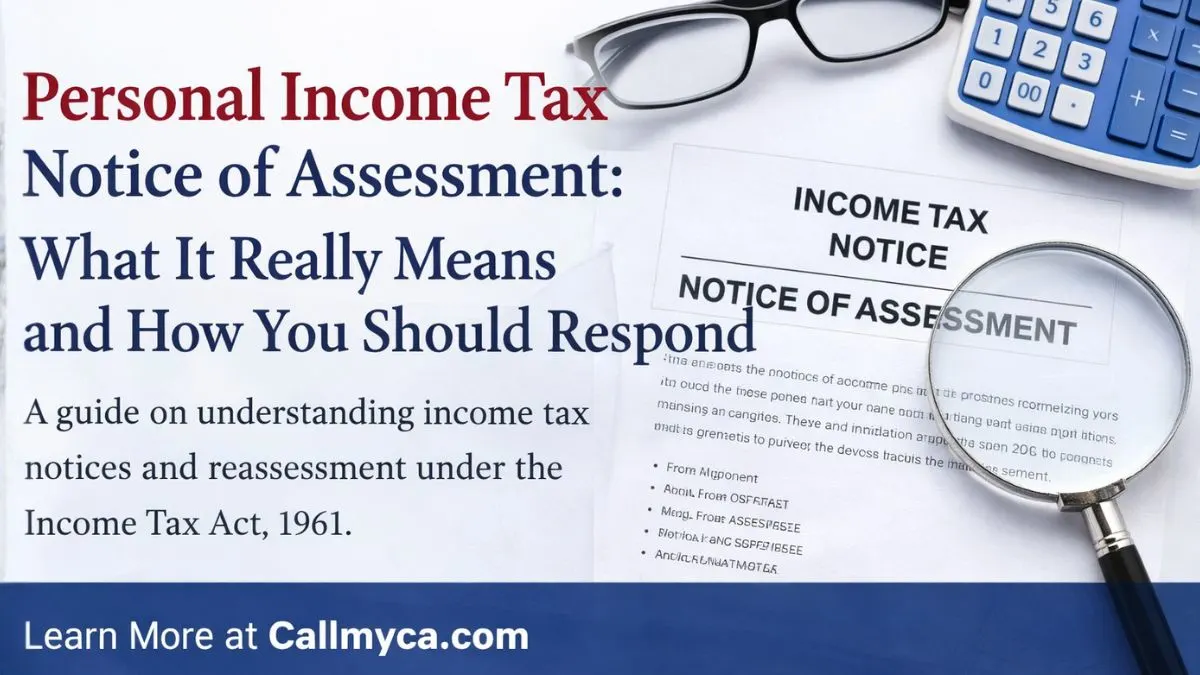
Personal Income Tax Notice of Assessment: What It Really Means and How You Should Respond
Summary
If you have recently received a personal income tax notice of assessment, don’t panic. In most cases, it is simply part of the normal assessment process under the Income Tax Act, 1961.
A personal income tax notice of assessment is an official statement summarizing your tax return, income, tax payable, refunds, or credits under the Income Tax Act, 1961. This guide explains income tax notices, taxation rules, assessment procedures, the role of the Assessing Officer, and how to respond to notices like Section 148 and 142(1) within deadlines while managing income tax compliance smoothly.
What Is a Personal Income Tax Notice of Assessment?
A personal income tax notice of assessment (NOA) is a formal document sent by the Income Tax Department after they process your return.
It basically tells you:
-
How much income they accepted
-
How much tax they calculate?
-
Whether you have to pay more
-
Or whether you will get a refund
Think of it like a final report card of your income tax return.
You filed your return.
The department checked it.
Now they are sharing the result.
That is what this notice is.
It does not automatically mean you have made a mistake.
Connection With the Income Tax Act, 1961
Every income tax notice and assessment in India works under the Income Tax Act, 1961.
This law gives authority to the department and the assessing officer to:
-
Examine your income
-
Verify your deductions
-
Check your investments
-
Review your documents
-
Ask questions if needed
The main purpose is simple:
To make sure everyone pays the right amount of tax—not more, not less.
That is how taxation stays fair.
Why Do People Receive Income Tax Notices?
Many people believe that getting a notice means trouble.
That is not true.
Most notices are routine.
Here are the common reasons:
1. Income Mismatch
Your salary, bank interest, or capital gains may not match Form 26AS or AIS.
2. Missing Income
Sometimes people forget to declare FD interest, freelance income, or stock profits.
3. High Deductions
If your deductions look unusually high, the department may verify them.
4. Random Selection
Some returns are selected randomly for assessment.
5. Escaped Income
If some income was not reported, a reassessment notice may come.
So yes, notices happen even to honest taxpayers.
Types of Income Tax Notices You May Receive
Different situations lead to different notices.
Section 143(1): Processing Notice
This is the most common one.
It only shows:
-
Tax payable
-
Refund
-
Small adjustments
Mostly, no action is needed.
Section 142(1): Information Notice
This asks you to submit documents or explanations.
Example: Bank statements, investment proof, etc.
Section 143(2): Scrutiny Notice
This means your return is under detailed review.
You must cooperate properly.
Section 148: Reassessment Notice
This comes when income is believed to have escaped assessment.
It is more serious and needs proper handling.
Each notice has its own deadline. Never ignore it.
How the Assessment Process Works in Reality
Many people think assessment is very complicated.
Actually, it follows a simple flow.
First, you file your return.
Then, the system checks it automatically.
If everything matches, you get intimation.
If something looks doubtful, the Assessing Officer reviews it.
They may ask for:
-
Salary slips
-
Bank details
-
Investment records
-
Business accounts
-
Property papers
After reviewing everything, they finalize the assessment.
Then the notice of assessment is issued.
That’s it.
Why Responding on Time Is Extremely Important
Every income tax notice has a time limit.
Missing it can cause problems like:
-
Penalty
-
Interest
-
Additional tax
-
Forced assessment
-
Legal action (rare, but possible)
Even if you are right, silence can make you look wrong.
So always reply.
On time.
Every time.
How to Respond to an Income Tax Notice Properly
Here is the practical way to handle it.
Step 1: Understand the Notice
Read it carefully. Check the section number and requirements.
Step 2: Log in to Portal
Visit the income tax e-filing website.
Step 3: Collect Proof
Keep ready:
-
Bank statements
-
Salary certificates
-
Investment proofs
-
Rent receipts
-
Capital gains report
Step 4: Prepare Your Reply
Write clearly. Stick to facts. No emotional language.
Step 5: Submit Online
Upload everything before the deadline.
If the notice is complex, don’t guess. Take help.
Common Mistakes People Make During Assessment
Many taxpayers create trouble for themselves.
Avoid these mistakes:
-
Ignoring notices
-
Uploading half documents
-
Giving wrong explanations
-
Missing deadlines
-
Copy-pasting random replies
One careless step can increase your tax burden.
Who Is the Assessing Officer?
The Assessing Officer is the official who checks your case.
Their job is to:
-
Verify income
-
Check tax calculation
-
Review documents
-
Pass assessment orders
-
Resolve disputes
They are doing their duty.
If you cooperate properly, things usually go smoothly.
What If You Don’t Agree With the Assessment?
You are not helpless.
If you feel the assessment is wrong, you can:
-
File rectification
-
Submit extra proof
-
File an appeal.
-
Approach the tribunal.
The law supports genuine taxpayers.
But everything must be done properly and legally.
Why Your Assessment Record Matters
Your tax record affects many things.
It impacts:
-
Bank loans
-
Home loans
-
Visa approvals
-
Business reputation
-
Investment trust
A clean income tax history builds credibility.
It shows you are financially responsible.
How to Avoid Future Income Tax Notices
You can reduce notices easily by following discipline.
Do this:
-
Report all income
-
Check AIS and 26AS
-
Keep records
-
File on time
-
Avoid fake claims
-
Take expert advice
Simple habits save big headaches.
Digital Assessment and Faceless System
Today, most assessments are online.
No physical visits.
No unnecessary meetings.
Everything happens digitally.
This improves:
-
Transparency
-
Speed
-
Safety
-
Convenience
Taxation is becoming more modern and efficient.
Why Professional Help Makes a Difference
Some notices look simple but are legally tricky.
Wrong handling may cost you lakhs.
Professionals help you:
-
Interpret notices
-
Draft replies
-
Represent legally
-
Reduce liability
-
Protect your rights
Sometimes, expert help is an investment, not a cost.
Final Thoughts
A personal income tax notice of assessment is not something to fear.
It is a normal part of the taxation system under the Income Tax Act, 1961.
If you understand the notice, respond on time, maintain proper records, and stay honest with your income and tax reporting, there is nothing to worry about.
Tax compliance is not just about avoiding penalties.
It is about building long-term financial trust.
And peace of mind.
Need Professional Support?
If you’ve received an income tax notice and want expert guidance without stress, let the professionals at Callmyca.com manage your assessment and compliance—so you stay confident, compliant, and financially secure.