PPF Interest Is Exempt Under Which Section? A Simple, Practical Explanation
If you’ve ever invested in PPF or are planning to, you’ve probably searched which section PPF interest is exempt under at some point—usually while filing your income tax return or checking whether that interest needs to be shown as income.
And honestly, the confusion is understandable.
Some people say it’s Section 10(11).
Others mention Section 10(12).
Then there’s talk about limits, provisos, the new tax regime, maturity exemption, and even Section 80C.
What Is PPF, and Why Is It So Popular?
Before jumping into exemptions, let’s understand why PPF (Public Provident Fund) is still one of India’s most loved long-term investments.
PPF offers:
- Guaranteed returns backed by the Government of India
- Long-term wealth creation
- Capital safety
- And most importantly—tax benefits at all stages
This makes PPF an EEE investment, which means:
- Exempt at contribution
- Exempt during accumulation
- Exempt at maturity
Very few instruments enjoy this status.
PPF Interest Is Exempt Under Which Section?
Let’s answer the core question clearly.
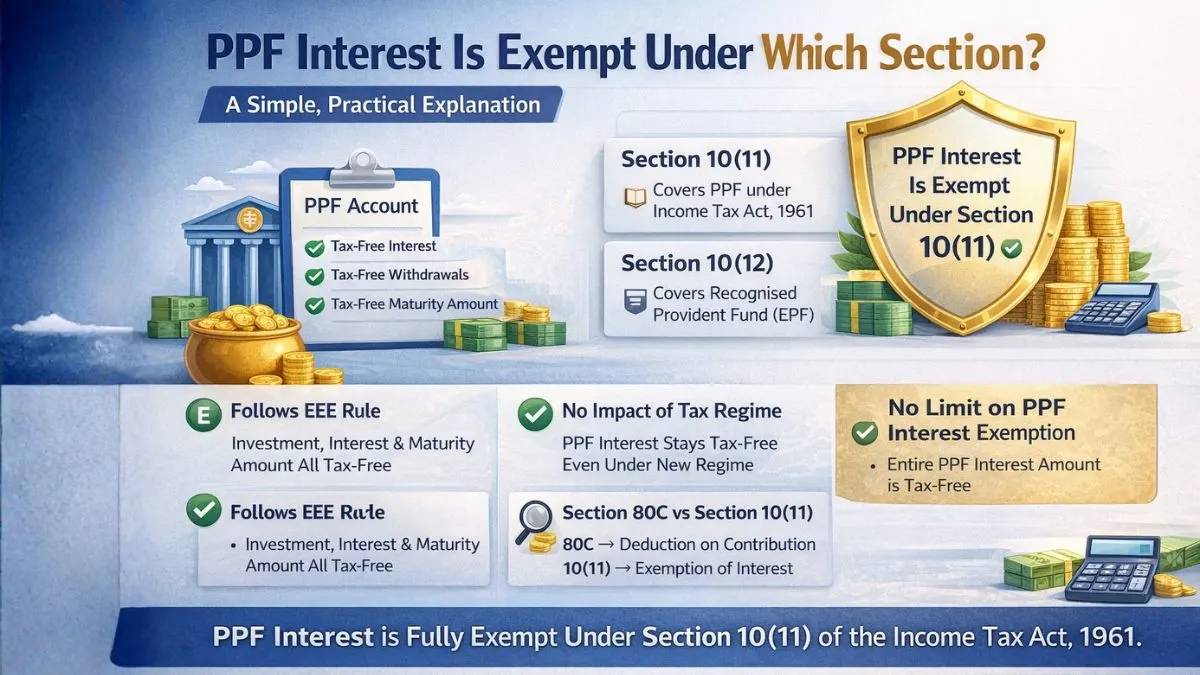
👉 PPF interest is exempt under Section 10(11) of the Income Tax Act, 1961.
This means:
- The interest you earn every year in your PPF account
- Is completely tax-free
- And does not need to be added to your taxable income
No hidden conditions. No income limits. No slabs.
Understanding Section 10(11) of Income Tax Act
Section 10(11) of the Income Tax Act provides exemption for interest received from certain provident funds.
In simple words:
Any interest earned from a statutory provident fund or similar notified funds is exempt from tax.
PPF falls squarely under this category.
This is why you’ll often see searches like
- ppf interest section
- section 1011 of the Income Tax Act
What About Section 10(12)? Is that for PPF?
Many people also search for PPF interest exempt under section 10 12, so let’s clarify this confusion.
- Section 10(12) applies mainly to:
- Recognised Provident Fund (RPF)
- EPF in salaried employment
- Recognised Provident Fund (RPF)
- PPF interest exemption specifically comes under Section 10 (11)
So if you’re dealing with PPF, always remember:
👉 Section 10(11), not 10(12)
PPF Interest Exempt Under Section 10(11)—Is There Any Limit?
Another very common query is
ppf interest exempt under section 10 11 limit
Here’s the simple answer:
👉 There is NO LIMIT on tax-free PPF interest.
Whether:
- Interest is ₹5,000
- ₹50,000
- Or ₹5 lakh
The entire interest remains tax-exempt.
This is a huge advantage compared to bank FDs, where interest is fully taxable.
PPF Interest Exempt Under Section 10(11) First Proviso—Does It Apply?
You might also see searches like
- ppf interest exempt under section 10(11 first proviso)
This causes unnecessary anxiety.
In practical terms:
- The first proviso does not restrict PPF interest exemption
- It mainly addresses classification and technical definitions
For a normal PPF investor:
👉 There is no impact on the tax-free status of PPF interest.
How Is PPF Interest Treated in ITR?
A very practical concern people have during return filing is
“Do I need to show PPF interest in my ITR?”
Here’s what you should do:
- PPF interest is exempt income
- It should be shown under “Exempt Income” schedule
- Not added to taxable income
Ignoring it completely may cause mismatches in future scrutiny.
PPF Interest Exempt Under New Tax Regime—Is It Still Tax-Free?
This is one of the most searched questions recently:
ppf interest exempt under new tax regime
The answer is a big relief for investors.
👉 Yes, PPF interest remains fully tax-exempt even under the new tax regime.
Why?
- Section 10 exemptions are still allowed
- The new tax regime only restricts deductions like 80C
- Exempt income is untouched
So even if you opt for the new regime:
- PPF interest stays tax-free
- PPF maturity stays tax-free
PPF Tax Exemption 80C—What Does It Cover?
Many people mix up interest exemption with contribution deduction.
PPF tax exemption 80c applies to:
- Amount invested in PPF
- Maximum deduction of ₹1.5 lakh per year
- Available only under old tax regime
Important distinction:
- Section 80C → Contribution deduction
- Section 10(11) → Interest exemption
Two different benefits. Two different sections.
PPF Maturity Exempt Under Which Section?
Another common doubt is
ppf maturity exempt under which section
Here’s the clear answer:
👉 PPF maturity amount is exempt under Section 10(11)
This includes:
- Principal invested
- Entire accumulated interest
So when your PPF matures after 15 years:
- The full amount received is tax-free
- No capital gains tax
- No income tax
Is PPF an EEE investment? Let’s Confirm
Yes, PPF is a classic EEE investment:
1. Exempt at Contribution
- Deduction under Section 80C (old regime)
2. Exempt During Accumulation
- Interest exempt under Section 10(11)
3. Exempt at Maturity
- Maturity amount exempt under Section 10(11)
This triple exemption is what makes PPF extremely powerful.
PPF Calculator—Why It’s Useful
People often search for a PPF calculator to estimate:
- Long-term returns
- Interest accumulation
- Maturity value
Using a PPF calculator helps you:
- Visualise tax-free compounding
- Plan long-term goals
- Compare with taxable instruments
Remember: whatever interest you see in that calculator is fully tax-free.
Common Myths About PPF Interest Taxation
Let’s bust a few myths:
❌ “PPF interest is taxable above a certain amount.”
❌ “New tax regime taxes PPF interest”
❌ “Interest must be added to income.”
❌ “Only maturity is exempt, not yearly interest.”
All of these are wrong.
PPF interest is completely exempt every year.
PPF vs EPF – Tax Treatment Comparison
|
Feature |
PPF |
EPF |
|
Governing section |
Section 10(11) |
Section 10(12) |
|
Interest tax |
Fully exempt |
Conditions apply |
|
Maturity tax |
Exempt |
Conditional |
|
Employer contribution |
Not applicable |
Limits apply |
This comparison shows why PPF is simpler from a tax perspective.
Does High Income Affect PPF Interest Exemption?
No.
Even if:
- You are in 30% tax slab
- You earn ₹1 crore annually
Your PPF interest remains:
- 100% tax-free
- No surcharge
- No cess
The tax slab does not matter for PPF interest.
What If You Have Multiple PPF Accounts?
Even then:
- Interest exemption applies
- Subject to PPF rules
- The contribution limit is combined
Tax exemption remains unaffected.
Why Government Keeps PPF Interest Tax-Free
PPF is designed to:
- Encourage long-term savings
- Promote financial discipline
- Support retirement planning
Tax exemption under Section 10(11) is intentional, not accidental.
Practical Tips for PPF Investors
If you invest in PPF:
- Don’t worry about interest taxation
- Show interest under exempt income in ITR
- Use PPF for long-term goals
- Combine with other tax-efficient instruments
- Don’t confuse deductions with exemptions
PPF works best when you let it compound peacefully.
Final Thoughts: PPF Interest Exemption Made Simple
So if you’re still wondering under which section PPF interest is exempt, remember this one line:
👉 PPF interest is fully exempt under Section 10(11) of the Income Tax Act, 1961.
No limits.
No tax slabs.
No impact of the new tax regime.
This clarity alone makes PPF one of the most stress-free investments in India.
Need help with tax planning, PPF strategy, or ITR filing?
Visit callmyca.com for clear, practical guidance on tax and financial planning