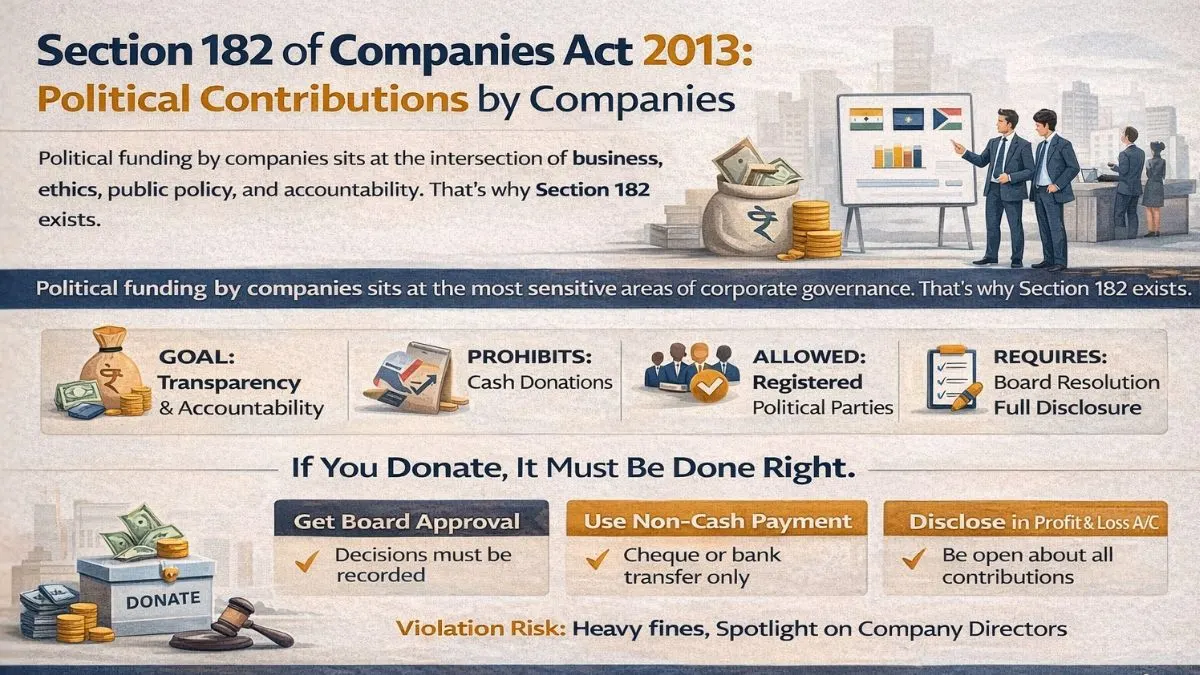
Section 182 of Companies Act 2013 – Political Contributions by Companies
Political funding by companies is one of the most sensitive areas of corporate governance. It sits at the intersection of business, ethics, public policy, and accountability. That’s exactly why section 182 of the Companies Act 2013 exists—and why regulators treat violations under this section very seriously.
I’ve seen many companies assume political contributions are just another CSR-like expense. Others believe donations routed through banking channels automatically make them compliant. Both assumptions are risky.
Section 182 of the Companies Act 2013 is not about encouraging or discouraging political donations. It is about regulating them strictly, ensuring transparency, preventing misuse of corporate funds, and curbing corruption in electoral financing.
What Does Section 182 of the Companies Act 2013 Deal With?
At its core, section 182 of the Companies Act 2013 deals with
- Political contributions by companies
- Prohibitions and restrictions regarding political contributions
- Disclosure requirements in financial statements
- Penalties for non-compliance
In short:
It lays down who can donate, how they can donate, to whom they can donate, and how it must be disclosed.
Why Section 182 Was Enacted
The legislative intent behind section 182 of the Companies Act 2013 is very clear.
It was enacted to curb corruption in electoral financing by:
- Preventing secret or cash-based donations
- Ensuring shareholders know how company funds are used
- Creating traceability and accountability
Political funding isn’t banned—but opaque funding is.
Which Companies Are Allowed to Make Political Contributions?
Under Section 182 of the Companies Act 2013, most companies are allowed to make political contributions—but with key exceptions.
Companies That Cannot Contribute
Political contributions are prohibited for:
- Government companies
- Companies that are less than 3 years old
This rule exists because
- Government companies use public money
- New companies may be used as shell vehicles
All other eligible companies may contribute, subject to conditions.
Who Can Receive Political Contributions?
An important clarification under section 182 of the Companies Act 2013 is that contributions can be made only to:
- Registered political parties
Donations to:
- Individuals
- Unregistered bodies
- Informal political groups
are not permitted.
This ensures funds go only to recognized entities under election law.
Board Resolution – Mandatory Approval
One of the most important compliance requirements is governance-level approval.
Under section 182 of the Companies Act 2013:
- A Board resolution is mandatory
- Political contributions cannot be made casually
This ensures:
- Collective responsibility of directors
- Proper recording of decision-making
- Protection for management and officers
Without a board resolution, the contribution itself becomes questionable.
Cash Contributions Are Strictly Prohibited
This is non-negotiable.
Under section 182 of the Companies Act 2013:
- Political contributions cannot be made in cash
- Contributions must be via:
- Cheque, or
- ECS/banking channels
- Cheque, or
This single rule addresses the biggest risk in political funding—untraceable money.
Even a small cash contribution can trigger penalties.
Is There a Limit on Political Contributions?
Under the Companies Act, section 182 of the Companies Act 2013 enables an Indian company to contribute any amount to any political party, subject to compliance.
This means:
- There is no percentage-based cap under the Act itself
- But all conditions, disclosures, and approvals must be followed
The focus is not on restricting amounts but on ensuring transparency.
Mandatory Disclosure in Profit & Loss Account
One of the strongest accountability tools in section 182 of the Companies Act 2013 is disclosure.
Every company shall disclose in its profit and loss account the total amount contributed by it
This disclosure must include:
- Total political contributions made during the year
- Not just the net figure, but complete transparency
This allows:
- Shareholders to evaluate governance choices
- Regulators to track compliance
- Auditors to flag irregularities
Nondisclosure is treated seriously.
Why Disclosure Is So Important
Disclosure ensures:
- Political funding is not hidden
- Minority shareholders are informed
- Directors are accountable
That’s why section 182 of the Companies Act 2013 links political contributions directly to financial statements—not just board minutes.
What Happens If the Rules Are Violated?
Violations under Section 182 of the Companies Act 2013 attract significant penalties.
Non-compliance may include:
- Making contributions without Board approval
- Making cash donations
- Contributing despite being ineligible
- Failing to disclose in P&L
Consequences can include:
- Heavy fines on the company
- Penalties on officers in default
- Governance red flags during audits and inspections
Political funding violations often escalate faster than routine compliance issues.
Practical Example – Correct Compliance
Let’s make this real.
Example
A private company, incorporated 5 years ago, decides to contribute ₹50 lakh to a registered political party.
To comply with section 182 of the Companies Act 2013, it must:
- Pass a Board resolution approving the contribution
- Make payment via check or ECS
- Ensure the recipient is a registered political party
- Disclose the total amount in its Profit & Loss account
If all four steps are followed, the contribution is fully compliant.
Practical Example – Non-Compliant Contribution
Now the risky version.
A company:
- Makes a cash contribution
- Does not pass a Board resolution
- Does not disclose the amount in P&L
Even if the intention was genuine, this:
- Violates Section 182
- Exposes directors and the company to penalties
- Raises serious governance concerns
Intent does not override procedure.
Common Mistakes Companies Make
From real compliance reviews, these mistakes come up repeatedly:
- Treating political contributions as routine expenses
- Missing Board approval
- Making indirect or cash-based payments
- Forgetting P&L disclosure
- Assuming small amounts don’t matter
Under section 182 of the Companies Act 2013, every amount matters.
Relationship with Corporate Governance
Political contributions are not just a legal issue—they are a governance issue.
That’s why:
- Boards must be involved
- Disclosures are mandatory
- Auditors pay close attention
This section ensures political funding does not become a backdoor misuse of corporate funds.
Why Section 182 Is Still Relevant Today
Even today, Section 182 of the Companies Act 2013 remains one of the most scrutinized provisions because it touches:
- Public trust
- Shareholder rights
- Electoral integrity
The law doesn’t ask companies who to support—but it insists that:
If you do support, you do it transparently and responsibly.
Key Compliance Checklist
Before making any political contribution, confirm:
- The company is not a government company
- The company is more than 3 years old
- The recipient is a registered political party
- A board resolution is passed
- Payment is non-cash
- Disclosure is made in P&L
If even one box is unchecked—stop.
Final Thoughts
Section 182 of the Companies Act 2013 is not anti-business or anti-politics. It is pro-transparency.
It:
Regulates political contributions by companies
Prevents misuse of corporate funds
Protects shareholders
Strengthens ethical governance
Helps curb corruption in electoral financing
In today’s compliance environment, political contributions are not just about legality—they’re about reputation.
The key takeaway:
Political funding is permitted, but secrecy is not.
For expert guidance on political contribution compliance, board approvals, disclosures, and corporate governance under the Companies Act, visit callmyca.com for practical, reliable support.