
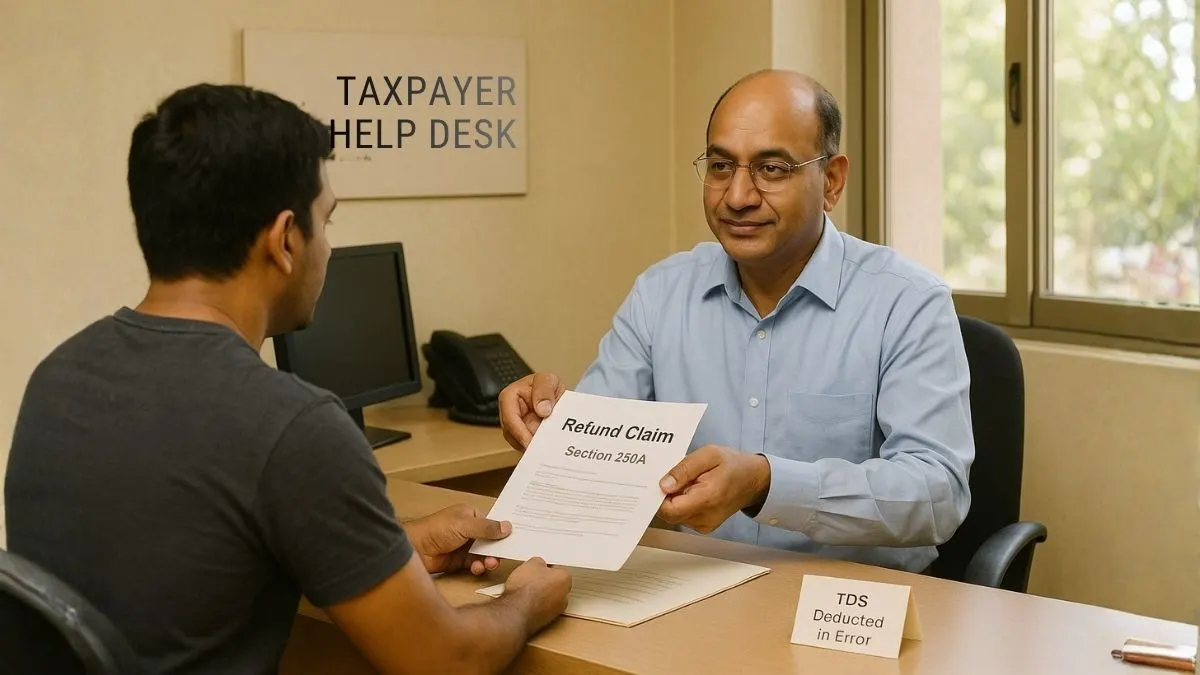
Every now and then, a business deducts tax at source just to stay on the safe side. Maybe it’s a consultant payment, maybe a foreign transaction — you think it might be taxable, so you deduct TDS. Later you find out… it wasn’t required.
Now what? That’s where Section 239A of the Income Tax Act quietly steps in. It lets you ask for a refund for denying liability to deduct tax in certain cases — in simple words, you can get back the tax you deposited by mistake.
Why This Section Exists
Before this section came into play, there wasn’t a clear route to recover such wrongly deducted tax. The payer couldn’t claim it, and the receiver often couldn’t either.
So, in 2022, lawmakers decided to fix this gap.
Section 239A gives a deductor the right to claim a refund if it later turns out the payment was non-taxable. It brings fairness to situations where tax was paid purely out of caution — not because the law actually demanded it.
The Core Idea
Let’s say you made a payment & deducted TDS thinking it was mandatory. Later you realize it wasn’t.
Through an application under Section 239A of the Income-tax Act, you can now request the department to refund the money.
It also covers cases where grossed-up tax was paid on non-taxable payments — for example, foreign remittances that were later found exempt under a tax treaty.
It’s basically a “no harm, no foul” clause for honest taxpayers.
Who Can Apply
The law is quite clear — the person who deducted & paid the tax (the deductor) is the one eligible to apply. The deductee — the person who received the payment — can’t make the same claim because the refund isn’t technically theirs.
The application is made to the Assessing Officer (AO) with supporting documents showing:
- why the deduction was made,"
- how the payment turned out to be non-taxable, and
- proof that the deducted tax was deposited.
Also Read: Penalty for Under-Reporting and Misreporting of Income
Step-by-Step Refund Process
- Prepare the Application:
File a written application under Section 239A explaining the mistake and quoting relevant law or treaty reference. - Submit Evidence:
Attach agreements, invoices, tax challans, & any correspondence proving that the payment shouldn’t have been taxed. - Assessment by the AO:
The Assessing Officer reviews your claim, verifies documents, and checks if the deductee has already claimed that TDS credit. - Decision and Refund:
If satisfied, the officer sanctions the refund. If not, they’ll record reasons for rejection.
Timelines are generally similar to normal refund claims under Section 239.
A Quick Real-World Example
Imagine an Indian firm pays ₹8 lakh to a UK-based designer for a one-time project. Unsure about taxability, the firm deducts 10 % TDS. Later, its CA confirms that the income isn’t taxable in India under the India-UK DTAA.
So, the firm had no liability to deduct tax in the first place. Under Section 239A, it can now apply for a refund of that TDS.
The Assessing Officer checks the treaty clause, verifies payment records, and, if everything’s clean, refunds the amount.
Simple, logical, & fair.
Key Points to Remember
- Payment must be non-taxable. You can’t use 239A for genuine taxable payments.
- Tax must actually be deposited. A mere deduction entry isn’t enough.
- No double benefit. If the deductee already took credit for the TDS, the deductor can’t claim it again.
- Proper documentation matters. Missing agreements or mismatched challans are the main reasons for rejections.
How It Differs from Section 239
|
Aspect |
Section 239 |
Section 239A |
|
Who Can Apply |
Any taxpayer with excess tax payment |
Deductor who wrongly deducted TDS |
|
Purpose |
General refund claim |
Refund for denying liability to deduct tax |
|
Nature of Tax |
Self-assessment / advance tax |
Tax deducted at source |
|
Scope |
Broad |
Specific to TDS errors |
So, Section 239A isn’t a replacement — it’s an addition meant specifically for erroneous TDS deductions.
Also Read: Penalty for Concealment or Misreporting
Administrative Checks and CBDT Guidelines
The CBDT monitors refund practices under this section to keep them consistent across field offices. It also issues instructions on timelines, evidence formats, and monetary limits for approval authority.
This ensures smaller cases don’t get stuck for months & genuine over-payments are refunded quickly.
What Courts Have Said
While still new, judicial interpretation already supports the intent behind 239A. Courts have reiterated that no tax can be collected without legal authority, echoing Article 265 of the Constitution.
In practice, it reinforces the principle that government cannot keep what wasn’t due — and taxpayers shouldn’t suffer for being over-cautious.
For Businesses and CAs Alike
If you’re a business owner, CFO, or practising CA, you know how often doubts arise during foreign remittances, royalty payments, or consultancy fees.
Many companies prefer to “play safe” & deduct tax just in case.
Section 239A gives peace of mind — if later you realize it wasn’t required, you can recover that money legally.
For CAs, this section is worth remembering while doing TDS audits or compliance reviews. It’s often the difference between a closed case & cash lying unclaimed with the IT Department.
Common Pitfalls to Avoid
- Late filing: Missing the time limit under Section 239.
- Weak reasoning: Not clearly establishing non-taxability."
- Credit mismatch: Forgetting to confirm that the deductee hasn’t already taken TDS credit.
- Ignoring documentation: Even a small missing annexure can slow down approval.
The more precise your paperwork, the faster the refund process.
Also Read: Section 234 – The Interest Penalty That Silently Drains Your Refund
Practical Scenario from the IT Industry
An Indian tech startup paid a U.S. developer for a software license & deducted TDS, assuming it was “royalty.” A year later, a court ruled that similar payments aren’t taxable in India. The startup filed under Section 239A of the Income Tax Act and successfully got back the grossed-up tax paid earlier.
For small firms, this kind of refund can make a big cash-flow difference.
Why It Matters Today
In a world where cross-border deals, cloud subscriptions, & digital services are common, taxability often depends on interpretation. Instead of fearing penalties or losing money, Section 239A offers a structured way to correct honest errors.
It encourages compliance while keeping the system human — if you paid tax by mistake, you shouldn’t be punished for doing the right thing.
Final Thought
At its heart, Section 239A is about fairness. It recognizes that taxpayers can be cautious & still deserve justice when over-payment happens. If you’ve found yourself in such a situation — deducted tax that wasn’t really due — don’t let that money stay idle.
Our experts at CallMyCA.com can help you assess eligibility, draft your refund application, and follow it up till approval. Because getting your own money back shouldn’t be harder than paying it.









