
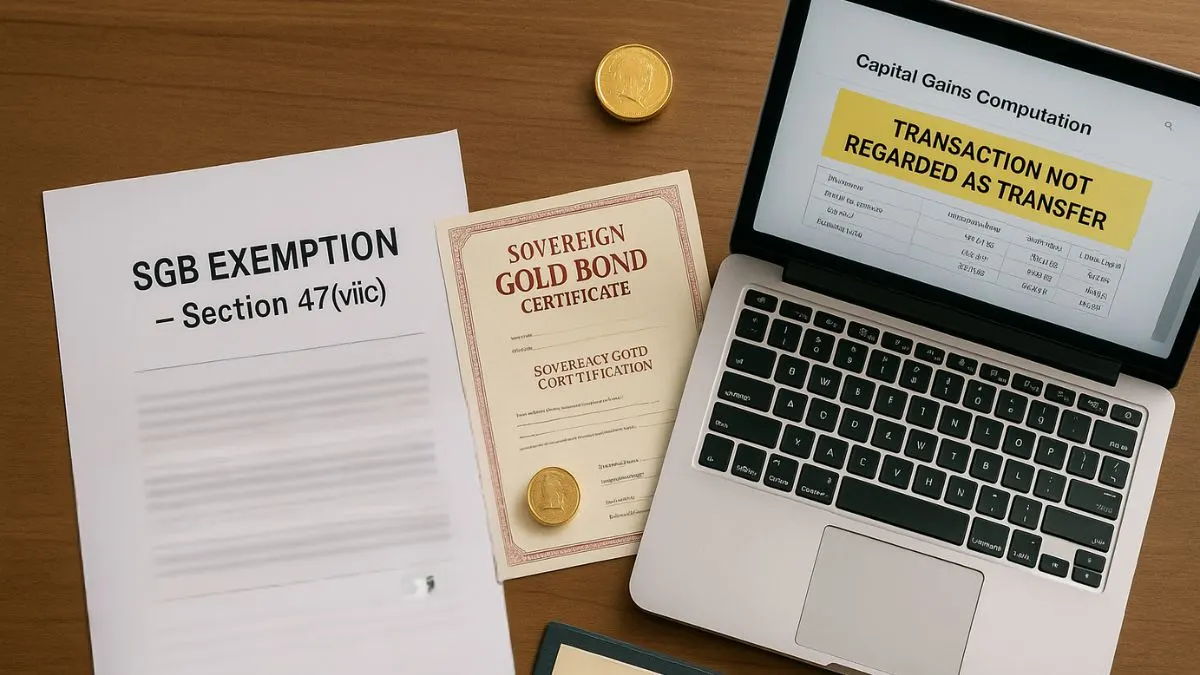
Gold has always been India’s favourite asset class — both a symbol of wealth and a secure investment. To help citizens invest in gold without physically holding it, the Government of India introduced the Sovereign Gold Bond (SGB) scheme.
But a common question keeps coming up every tax season — is the profit on redemption of SGBs taxable as capital gains?
That’s where Section 47(viic) of the Income Tax Act steps in. It clarifies that certain transactions — especially the maturity or redemption of SGBs — are not regarded as transfer, and therefore not liable to capital-gains tax. Let’s unpack this section in plain English to see how it protects your returns & ensures fair tax treatment.
How SGBs Changed the Gold Market
Before SGBs, investors either bought physical gold or traded gold ETFs. Both options had costs & storage risks. When SGBs were launched in 2015 by the RBI on behalf of the Government of India, they offered a safe, interest-earning alternative linked to gold prices. Investors earn an annual interest of 2.5 % on their investment and can redeem bonds after a fixed period. However, the key question was — should this redemption be treated as a “transfer” that triggers capital gains tax? The answer lies in Section 47(viic).
What Section 47(viic) Actually Says
Under Section 47(viic), any transfer of Sovereign Gold Bonds on redemption by an individual is not treated as a transfer for capital gains purposes."
Put simply, the capital gain on maturity of SGB is tax free u/s 47(viic). The law recognises that when you redeem your bond with the RBI on maturity, you’re just getting back your investment in monetary form, not selling it to someone else for profit. So there is no “transfer” in the true sense.
This is why Section 47(viic) is listed under “Transactions not regarded as transfer.”
Why This Provision Matters
Capital gains tax is triggered only when there’s a transfer of a capital asset. By declaring that SGB redemption is not a transfer, the law provides complete relief from capital gains on maturity. So even if the market price of gold has risen since you invested, you don’t have to pay tax when the bond matures. That’s a major incentive for long-term investors who prefer SGBs over physical gold.
It’s also a signal from the government — encouraging formal, documented investment in gold over cash transactions.
Also Read: Exempt Transfer of Assets and Shares on Conversion of a Company into an LLP
Transactions Not Regarded as Transfer — Broader Meaning
Section 47 of the Income Tax Act lists multiple cases where a transaction is not treated as a transfer, and thus no capital gains arise. Some common examples include:
- Transfer of assets between a holding & subsidiary company.
- Distribution of assets under a trust or will.
- Conversion of bonds or debentures into shares.
- Transfer of shares in amalgamation or demerger cases.
- And now, thanks to Section 47(viic) — redemption of Sovereign Gold Bonds.
Each of these clauses exempts certain transactions from being classified as transfers because they don’t represent a real change in ownership for tax purposes.
Example to Illustrate
Imagine you buy SGBs worth ₹5 lakh in 2020. By 2028, gold prices rise & the same investment is worth ₹7 lakh. When you redeem the bonds through the RBI on maturity, you get ₹7 lakh in return.
Technically, you’ve earned ₹2 lakh as a capital gain. But under Section 47(viic), this redemption is not regarded as a transfer, so no capital gains tax is payable.
However, if you sell the bonds on a stock exchange before maturity, that sale is considered a transfer, and capital gains rules under Section 45 apply.
How This Differs from Other Investments
Physical gold, ETFs, and gold mutual funds are subject to capital gains tax based on the holding period. But SGBs stand out because of the tax-free redemption benefit under Section 47(viic).
It means the government wants you to choose SGBs over traditional forms of gold. You earn interest during the tenure & get full exemption on redemption — making SGBs one of the most tax-efficient ways to own gold today.
Policy Rationale Behind Section 47(viic)
When SGBs were launched, the intent was clear — shift household savings from physical gold to financial assets. But to make it work, investors had to be assured that their returns would not be heavily taxed.
That’s why the government included Section 47(viic) in the Act — so that when you redeem an SGB on maturity, you’re not treated as if you sold a capital asset. It’s a logical extension of the principle that some transactions are not regarded as transfer because they don’t involve a real change of ownership.
Practical Tax Implications
- Maturity or Redemption of SGBs – Fully exempt under Section 47(viic).
- Sale of SGBs on Exchange before maturity – Taxable as capital gains.
- If held for more than 3 years → Long-term capital gain (20 % with indexation).
- If sold within 3 years → Short-term capital gain (taxed at slab rate).
- Interest earned on SGBs – Always taxable as “Income from Other Sources.”
Thus, Section 47(viic) protects only the capital gain part on redemption — not the annual interest.
Also Read: Meaning of “Transfer” in Capital Gains Taxation
Benefits for Investors
- Zero capital gains on maturity.
- Government-backed safety & guaranteed interest.
- No storage risk like physical gold.
- Eligible for loan collateral.
- Transparent records for IT filings.
These advantages make SGBs the preferred option for long-term investors who value tax efficiency and security.
Comparing Section 47(viic) with Other Subsections
|
Sub-section |
Description |
Nature of Exemption |
|
47(vi) |
Transfer in a merger between Indian companies |
Not a transfer |
|
47(vii) |
Shareholder transfer in merger scheme |
Not a transfer |
|
47(viic) |
Redemption of SGB by individual investor |
Not a transfer → Capital gain exempt |
|
47(xb) |
Conversion of bonds into shares |
Not a transfer |
This table shows that the legislature treats certain financial restructuring & government bond redemptions as non-taxable events to encourage investment.
Transactions Exempt vs Transactions Taxable
|
Case |
Example |
Tax Treatment |
|
Exempt under 47(viic) |
Redemption of SGBs on maturity |
Capital gain = Tax Free |
|
Taxable Transfer |
Selling SGB on NSE/BSE before maturity |
Capital gain tax applies |
|
Other Financial Transfers |
Sale of gold ETF units after 3 years |
Long-term CG tax 20 % with indexation |
The difference lies in whether the transaction is a “transfer” or a “redemption recognized by the issuer.” Only the latter enjoys the Section 47(viic) exemption.
Judicial and Policy View
So far, no controversy has arisen over this provision because its language is clear and unambiguous. CBDT & RBI notifications both affirm that the redemption of SGBs is exempt from capital gains."
This clarity builds investor confidence and reduces the compliance burden for taxpayers who hold SGBs to maturity.
Also Read: Special Provision for Full Value of Consideration for Transfer of Assets
Economic Significance
By excluding SGB redemption from capital-gains tax, the government achieves multiple objectives:
- Promotes financial gold investment instead of physical imports.
- Reduces India’s current account deficit caused by gold imports.
- Brings transparency and recorded ownership in gold assets.
- Makes gold savings accessible to middle-class families without tax penalty.
Section 47(viic) is therefore a small but crucial part of India’s financial modernisation story.
Scientific Research Parallel
Just as the Income Tax Act allows for deductions while computing taxes for expenses relating to scientific research, it also exempts certain transactions from being classified as transfers. Both provisions share the same goal — encouraging productive, transparent economic activity instead of penalising it with tax. Similarly, the Act provides for a deduction of expenses incurred on scientific research & development activities — again rewarding contribution over speculation.
Conclusion
Section 47(viic) of the Income Tax Act acts as a relief mechanism for investors in Sovereign Gold Bonds. It recognises that transactions not regarded as transfer — like SGB redemption — don’t constitute real sales and should not be taxed as capital gains. So, while the interest earned on bonds remains taxable, the capital gain on maturity of SGB is tax free u/s 47(viic) — making it one of the most investor-friendly clauses in the Income Tax Act.
If you want to plan your investments or understand how transactions not regarded as transfer affect your capital gains, our team at CallMyCA.com can guide you.
From tax planning to SGB reporting and investment advice, we make compliance easy & transparent — so you save smart and stay compliant.









