Union Budget 2026: Why Indian Stock Markets Will Remain Open on Sunday and What It Means for Sensex & Nifty
Every year, the Union Budget plays a crucial role in shaping India’s economic direction. From salaried professionals and business owners to long-term investors and traders, everyone watches this event closely.
But this year, the Union Budget 2026 is creating even more buzz than usual.
Why?
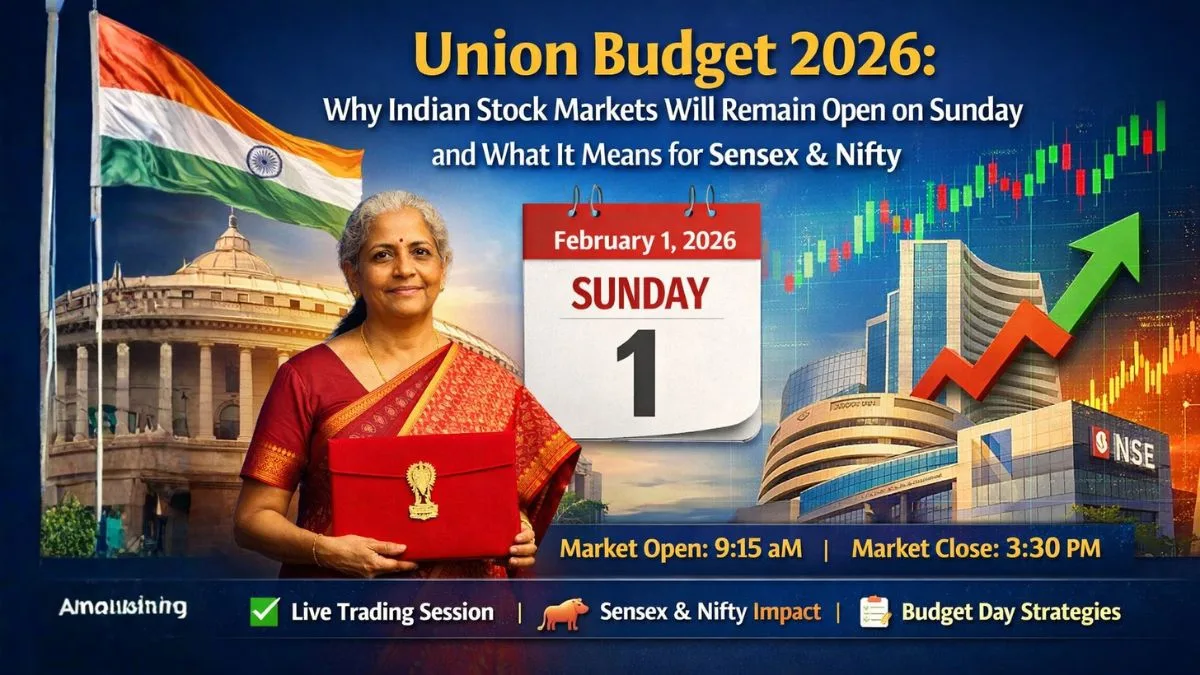
Because Indian stock markets will open on Sunday, February 1, 2026, giving investors a rare opportunity to react to the Budget in real time.
Yes, Indian stock markets will remain open for live trading on Sunday, February 1, 2026, even though it’s usually a holiday.
Why Are Markets Open on a Sunday in 2026?
Normally, Indian stock markets remain closed on Saturdays and Sundays. However, special situations call for special arrangements.
According to official updates and reports, India's stock exchanges will hold a regular live trading session on the Union Budget 2026–27 on February 1, despite it being a Sunday. Historically, Budget presentations have been held on February 1, with markets opening for trading even when the date falls on a weekend.
This practice ensures that:
-
Investors get fair access to information
-
Markets react transparently
-
There is no delayed price discovery
-
Volatility is managed in real time
In simple words, when the Budget is presented on a weekend, exchanges prefer not to delay trading until Monday.
That’s why BSE, NSE to conduct regular trading session on Budget Day, just like any normal weekday.
Official Timing of the Special Trading Session
On Budget Day, trading will follow the regular market schedule:
-
Market Opens: 9:15 AM
-
Market Closes: 3:30 PM
The Finance Minister will present the Budget in Parliament around 11:00 AM, which is when most of the major market movements usually happen.
So, investors should be prepared for sudden price swings.
Market Mood Ahead of Union Budget 2026
As Budget Day approaches, the mood in the market remains cautious.
At present, Sensex and Nifty are showing mixed trends. Many investors are choosing a “wait and watch” approach instead of making aggressive bets.
Why?
Because everyone is waiting for clarity on:
-
Tax policies
-
Government spending plans
-
Fiscal deficit targets
-
Infrastructure investments
-
Support for MSMEs
-
Incentives for businesses
Until these details are announced, most big players prefer to stay on the sidelines.
This cautious behavior is very normal before any major policy announcement.
What Do Past Budget Sessions Tell Us?
If you look at previous Budget Day performances, one thing becomes clear — markets are unpredictable.
Sometimes they rally strongly.
Sometimes they fall sharply.
And sometimes… nothing much happens.
For example, the Union Budget for FY 2025-2026 witnessed muted market reactions with little movement in both indices.
Despite high expectations, Sensex and Nifty barely moved that day.
This shows that Budget Day does not always guarantee profits. Everything depends on how well the announcements match market expectations.
That’s why Budget Day is often considered one of the most volatile trading sessions of the year.
Trading Strategy for Budget Day: What Experts Suggest
Budget Day is not for emotional trading. It requires patience, discipline, and proper planning.
Experts suggest staying alert during high-volatility periods.
As per market analysts:
On Budget Day, traders are advised to avoid the initial “whipsaw” phase between 9:15 am and 11:00 am, with the optimal exit window typically falling between 2:15 pm and 3:30 pm, once policy clarity emerges and implied volatility compresses. Echoing similar sentiment, Mayank Jain, Market Analyst at Share.
What does this mean in simple terms?
9:15 AM – 11:00 AM: High-Risk Zone
-
Sudden spikes
-
Sharp reversals
-
Fake breakouts
-
Emotional trading
Beginners should ideally stay away during this phase.
✅ 2:15 PM – 3:30 PM: Stable Phase
-
Better clarity on policies
-
Lower volatility
-
More predictable trends
This is when many experienced traders prefer to book profits.
How Union Budget 2026 May Impact Sensex and Nifty
Every investor wants to know one thing:
Will this Budget help the market grow?
The answer depends on key announcements such as:
-
Capital expenditure plans
-
Tax relief measures
-
Infrastructure investments
-
MSME support
-
Fiscal discipline
-
Startup incentives
If the government focuses on growth and stability, markets may respond positively.
But if expectations are not met, short-term corrections are also possible.
So, the reaction of Sensex and Nifty will largely depend on how “market-friendly” the budget turns out to be.
What Should Investors Do Before Budget Day?
With Indian stock markets opening on Sunday, February 1, 2026, preparation becomes even more important.
Here are some practical tips:
1. Avoid Emotional Trading
Do not buy or sell just because prices are moving fast.
2. Don’t Chase Sudden Rallies
A sudden jump doesn’t always mean long-term growth.
3. Focus on Quality Stocks
Stick to fundamentally strong companies.
4. Use Stop-Loss
Protect your capital at all times.
5. Think Long-Term
Budget Day is just one day. Wealth is built over years.
Remember: Budget Day is not about gambling. It’s about smart decision-making.
Why This Special Sunday Session Matters
The decision to open markets on Sunday highlights how important this Budget is for India’s economy.
When Indian stock markets will open on Sunday, February 1, 2026, it ensures:
-
Faster price discovery
-
Better transparency
-
Reduced speculation
-
More efficient trading
With Sensex, Nifty, BSE, and NSE all functioning normally, investors can react immediately instead of waiting for Monday.
This makes the entire process more fair and professional.
Final Thoughts
The Union Budget 2026: Why Indian Stock Markets Will Remain Open on Sunday and What It Means for Sensex & Nifty is more than just a headline—it reflects how seriously financial markets take this event.
With full-day trading on February 1, 2026, investors will witness real-time reactions to every major announcement.
Yes, short-term volatility is unavoidable.
Yes, price swings may look scary.
But for serious investors, fundamentals always matter more than headlines.
A disciplined strategy, proper research, and long-term thinking will always outperform speculation.
If you want professional tax, financial, and investment guidance, visit callmyca.com and get expert support for smarter money decisions.