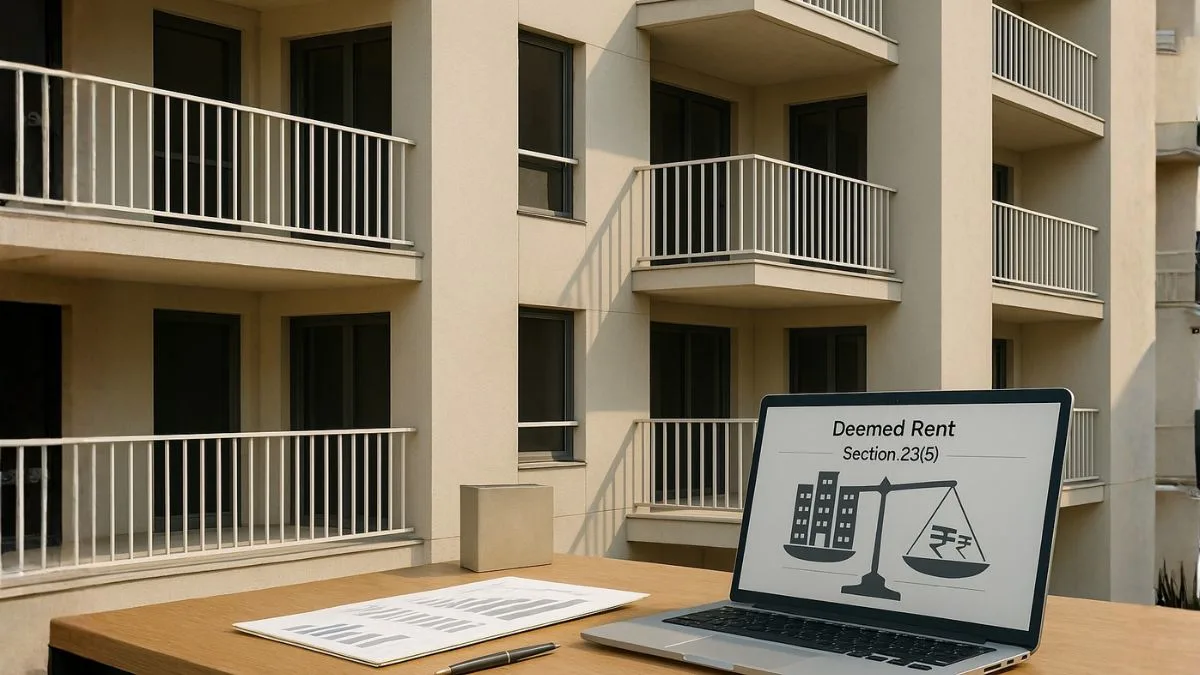
Until a few years ago, real-estate developers often faced a strange situation. Even when their completed flats remained unsold, tax officers calculated notional rent on those properties & treated it as income. Imagine paying tax on a property that hasn’t even generated a rupee in rent!
To correct this unfairness, the Finance Act 2017 inserted sub-section (5) to Section 23. The intent was simple — give developers breathing space after completion of a housing project before the concept of “deemed rent” kicks in. This two-year relief acknowledges that selling every unit immediately after completion is practically impossible.
Understanding “Annual Value” and “Deemed Rent”
Under Section 23(1), the annual value of a property is considered its taxable income under the head “Income from House Property.” If a property is vacant or self-occupied, the annual value may be NIL. However, if it is deemed to be let out, notional rent becomes taxable, even if no rent is actually received.
In the case of developers, the properties they build are stock-in-trade rather than investment assets. Yet before 2017, even these unsold flats attracted notional rent once the completion certificate was issued. The introduction of Section 23(5) resolved this by allowing a specific two-year moratorium before any deemed income arises.
What Exactly Does Section 23(5) Say?
The section provides that when a developer holds property as stock-in-trade, the annual value of such property shall be taken as NIL for a period of up to two years from the end of the financial year in which the certificate of completion for the project is obtained from the competent authority. After this two-year window, if any units remain unsold, notional rent will be computed for taxation under the head Income from House Property.
This means, for developers, income recognition now aligns better with market realities rather than arbitrary tax assumptions.
The Two-Year Moratorium – A Practical Relief
The two-year moratorium period given in Section 23(5) serves as a buffer. It recognises the time developers need to liquidate inventory. Real-estate cycles fluctuate; sometimes, despite completion, sales take months. The law now accepts this commercial reality.
Example:
Suppose a builder obtains a completion certificate on 15 June 2023. The moratorium begins after 31 March 2024, so notional rent will not apply until 31 March 2026. If flats remain unsold after that, their annual value will be computed as if they were rented out.
Also Read: Understanding Inventory Valuation and Tax Implications
Deemed Rent in the Hands of Developers
Once the moratorium period expires, the deemed rent in the hands of developers becomes taxable. The income is measured as the expected rent a property could reasonably fetch."
This prevents indefinite deferral of taxation on real-estate inventory. However, because developers already pay taxes under profits & gains of business or profession when the flats are eventually sold, Section 23(5) ensures that taxation timing—not double taxation—is the key concern.
Annual Value of Unsold Flats Deemed NIL for Two Years
The phrase “annual value of such unsold flats is deemed NIL for up to two years post-completion” captures the essence of this section. During that period, no notional income arises, so there is no requirement to pay tax merely because the project is complete.
This benefit applies only when:
- The property forms part of stock-in-trade of a business.
- Completion certificate has been received.
- The property is unsold and not let out during the moratorium.
If the developer rents it during the two years, the actual rent will, of course, become taxable.
Illustration – How It Works
Let’s take a simple case.
ABC Builders completed a residential project on 10 December 2022 & received its completion certificate. Out of 50 flats, 10 remain unsold as of March 2024.
Under Section 23(5):
- Annual value of these unsold flats is NIL up to 31 March 2025 (two years from the end of FY 2022-23).
- From 1 April 2025 onwards, if still unsold, a notional rent will be calculated for FY 2025-26 onward.
This way, ABC Builders isn’t taxed prematurely but can’t indefinitely avoid property-income tax either.
Interaction with Other Provisions
- Section 24(a) – allows a standard 30 % deduction from the annual value once it becomes taxable.
- Section 37(1) – construction & selling expenses remain deductible under business income when the units are sold.
- Section 50C – applies at the time of sale if the sale consideration is below stamp-duty value.
Thus, taxation flows logically from notional rent to eventual business profit, depending on the transaction stage.
Impact on Different Types of Developers
- Large Developers
For major real-estate companies holding hundreds of unsold flats, the moratorium prevents massive notional tax burdens. It improves liquidity and compliance comfort.
- Small Builders
Smaller developers benefit even more because they often sell gradually & cannot afford early taxation.
- Commercial Projects
Although Section 23(5) specifically mentions residential units, courts have interpreted the spirit similarly for commercial spaces used as stock-in-trade, reinforcing that the section’s objective is fairness, not limitation.
Also Read: Special Provision for Full Value of Consideration for Transfer of Assets
Practical Challenges in Application
Even with this clarity, a few grey areas persist:
- Valuation disputes: Determining fair rent after two years often leads to litigation.
- Partial completion: When part of a project receives completion, the moratorium starts for that portion only.
- Unsold parking or amenities: Whether these count as separate assets remains debated.
Still, the section has brought significant stability to tax assessments involving developers.
How This Provision Helps the Real-Estate Sector
Before 2017, tax notices demanding notional rent from developers had become routine. Many projects struggled with unsold inventory due to slow market cycles, especially after 2014. Section 23(5) brought relief at exactly the right moment.
It aligns tax liability with genuine cash inflows and recognises the economic lag between project completion & sale closure. This single amendment restored confidence among developers and streamlined reporting under Income from House Property.
Judicial Interpretations and CBDT Guidance
The CBDT clarified that the annual value of unsold flats is deemed NIL for two years from completion. Earlier, only one year’s grace was available; the 2019 amendment extended it to two years for better alignment with market cycles.
Courts have largely upheld this reasoning, confirming that Section 23(5) applies only to builders holding property as business inventory—not to investors or landlords.
Example – Extension Impact
Suppose XYZ Developers completed its project in March 2021 & had 30 unsold units. Initially, the law provided a one-year moratorium, meaning deemed rent would apply from April 2022. After the amendment, the period extended to two years, shifting the trigger to April 2023.
This extra year often makes a real difference for developers navigating tough market conditions or pandemic-related delays.
Policy Rationale Behind Section 23(5)
The section is a balancing act. On one side, the government must ensure that property isn’t held indefinitely without generating taxable income. On the other, genuine business realities—approvals, funding cycles, buyer delays—need consideration.
By granting a time-bound exemption, Section 23(5) achieves both fairness & revenue assurance. It nudges developers to sell inventory within two years but doesn’t punish them prematurely.
Also Read: Tax on Gifts, Cash, and Property Received Without Consideration
Comparison with Other Countries
Globally, similar mechanisms exist.
- In the UK, developers pay property tax only after occupation.
- In Singapore, additional tax applies after a grace period.
- In India, Section 23(5) takes a middle path — no rent deemed for two years, then taxation on notional basis.
It places India’s policy squarely between liberal & conservative models of property-income taxation.
Tips for Developers to Stay Compliant
- Track completion dates – the two-year clock starts immediately after the financial year of completion.
- Maintain inventory records – distinguish between sold, booked, and unsold units.
- Avoid letting out unsold units if you want to enjoy the NIL annual value benefit."
- Plan sales timelines – clear stock within the moratorium to prevent notional taxation.
- Consult a CA – especially for mixed-use projects where classification may get tricky.
Following these simple steps ensures that the intended relief truly benefits your business.
Broader Tax Planning Perspective
Section 23(5) shouldn’t be viewed in isolation. For a developer, it interacts closely with Section 43CA (valuation of stock-in-trade) and Section 145A (accounting standards). Smart tax planning involves balancing timing of revenue recognition, avoiding double taxation, & ensuring correct classification between business and property income.
Professional guidance here can save not just taxes but also prolonged disputes.
Final Thoughts
Section 23(5) of the Income Tax Act is a small provision with a big impact. It transformed how unsold inventory is treated in taxation, easing the burden on thousands of builders nationwide. By allowing a two-year moratorium and deeming the annual value of unsold flats as NIL, it creates breathing space for genuine businesses while keeping speculative hoarding in check.
If you’re a builder, developer, or property investor trying to understand how this rule affects your tax filing, our experts at CallMyCA.com can help you plan your compliance, reduce litigation risks, & file your returns the right way.
Let’s make taxation simpler — & smarter — together.