Every time a company sells or transfers a capital asset, capital gains tax usually comes into the picture. But not every transfer creates a real gain. Sometimes, assets are simply moved within the same business group — from a parent company to its subsidiary — for operational or legal convenience.
The Income Tax Act, 1961 understands this difference. That’s why it includes Section 47, which lists transactions not regarded as transfer. Among these, Section 47(iv) plays a crucial role. It exempts certain transactions from being classified as transfers, ensuring that internal restructuring doesn’t trigger unnecessary taxation.
Purpose Behind Section 47(iv)
The logic is straightforward.
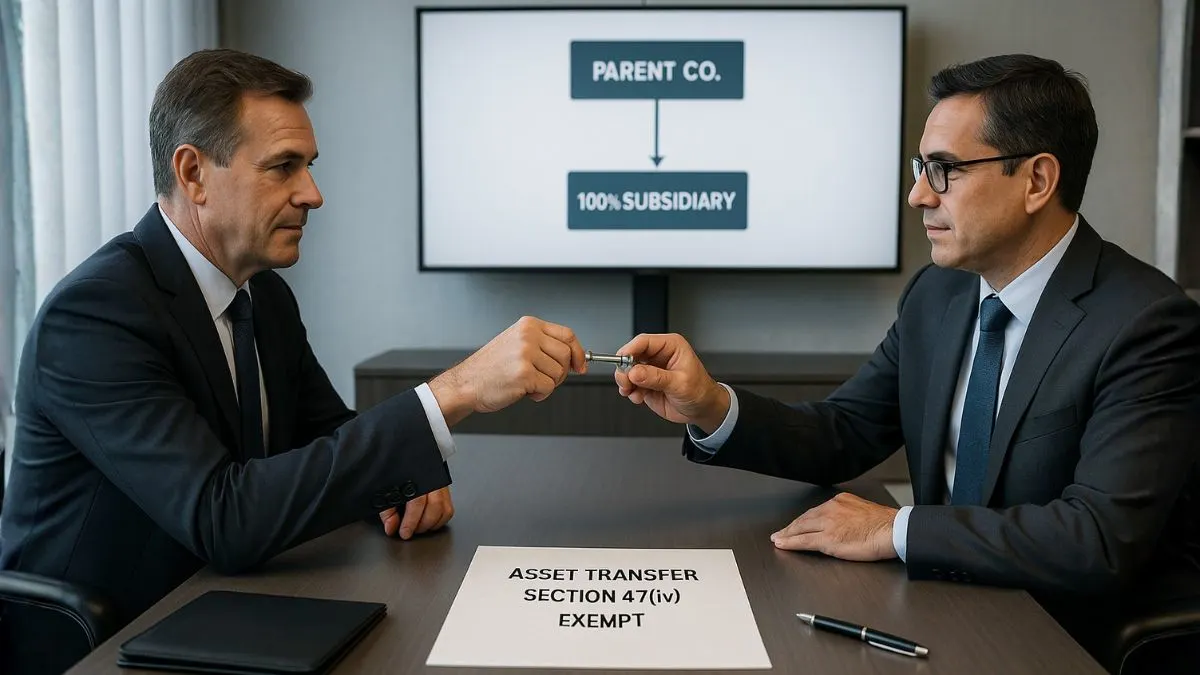
When a holding company transfers assets to its wholly owned subsidiary, there’s no change in ultimate ownership. The assets still remain under the same corporate umbrella. Taxing such a movement would serve no economic purpose — it would simply create a cash flow burden without any real gain.
That’s why Section 47(iv) steps in. It allows the parent company to transfer capital assets to its 100% Indian subsidiary without being treated as a taxable transfer.
What the Law Says
The actual wording of Section 47(iv) is concise yet powerful:
“Any transfer of a capital asset by a company to its wholly owned Indian subsidiary company shall not be regarded as a transfer.”
In simpler words — if a parent company owns the entire share capital of an Indian subsidiary, any capital asset transferred to that subsidiary is not considered a transfer under capital gains law.
Key Conditions for the Exemption
To use Section 47(iv) effectively, the following conditions must all be met:
- Transferor must be a company – This section applies only when the transferring entity is a company."
- Transferee must be a wholly owned subsidiary – The parent must hold 100% of the share capital. Even a single share held by someone else can disqualify the exemption.
- The subsidiary must be Indian – The benefit is available only when the subsidiary is incorporated in India.
- Asset must be a capital asset – The rule covers land, buildings, shares, machinery, & other capital assets. Stock-in-trade or goods meant for sale are excluded.
If these four criteria are satisfied, the transaction escapes capital gains tax completely at that stage.
Also Read: Cost of Acquisition Rules
Why This Exemption Exists
Corporate groups often move assets internally for various reasons — creating a separate legal entity for new ventures, complying with sectoral regulations, or isolating liabilities. Taxing such transactions every time assets shift within a group would discourage legitimate reorganizations.
Section 47(iv) ensures that genuine restructurings remain tax-neutral, encouraging smoother business operations while still preserving future tax collection when the asset eventually leaves the group.
Real Example
Let’s take a simple example.
ABC Ltd., a holding company, purchased an industrial plot in 2010 for ₹20 lakh. In 2025, it transfers the land to its wholly owned subsidiary, ABC Infrastructure Pvt. Ltd., whose entire share capital is held by ABC Ltd.
At the time of transfer, the land’s market value is ₹1 crore. Normally, this would trigger ₹80 lakh in capital gains.
But thanks to Section 47(iv), this transaction is not regarded as transfer. Hence, no capital gains tax applies right now.
However, when the subsidiary later sells the land to an outsider, taxation will arise. The cost of acquisition & holding period of the parent company will carry over to the subsidiary under Section 49(1)(iii)(e).
So, the government doesn’t lose tax — it’s simply deferred until a real sale happens.
When the Exemption Doesn’t Apply
This clause is powerful but conditional. The following cases will not qualify for relief:
- The parent company owns less than 100% of the subsidiary.
- The subsidiary is incorporated outside India.
- The transferred item is stock-in-trade, not a capital asset.
- The transaction is structured only for tax avoidance rather than genuine restructuring.
In such situations, the transaction will be treated as a normal transfer, and capital gains will be taxed under Section 45.
Related Section – Section 47(v)
Section 47(v) acts as the mirror image of 47(iv). It exempts the reverse situation — where a wholly owned Indian subsidiary transfers a capital asset to its holding company.
Together, these two provisions make sure that both directions of intra-group transfers (parent → subsidiary & subsidiary → parent) are tax neutral, as long as ownership and residency conditions are met.
Judicial Insight
Courts have consistently supported the intent of Section 47(iv).
In CIT vs. Bharat Petroleum Corporation Ltd., and later cases, the judiciary clarified that as long as the transaction is genuine and shareholding is 100%, the exemption should apply."
Courts also warn that even minor deviations — like indirect ownership or nominee shareholders — can lead to disqualification.
Hence, it’s vital to maintain complete clarity in ownership records & supporting documents.
Also Read: Exempt Transfer of Assets and Shares on Conversion of a Company into an LLP
Compliance & Documentation Checklist
To successfully claim the benefit under Section 47(iv), companies should maintain:
- Incorporation certificates of both parent & subsidiary.
- Board resolutions approving the transfer.
- Shareholding structure showing 100% ownership.
- Valuation report for fair market value.
- Transfer agreements & accounting entries clearly identifying the transaction.
Having these ready during assessment or audit makes your case solid & transparent.
How It Works in Corporate Restructuring
Section 47(iv) is widely used during business reorganizations:
- When a conglomerate wants to move one business division into a new subsidiary.
- When companies prepare for mergers, acquisitions, or spin-offs.
- During group consolidation before public listing or foreign investment.
Without this clause, such strategic moves would lead to large tax liabilities on paper gains.
The section helps companies restructure efficiently without immediate cash outflow.
Example of Non-Compliance
Consider TechNova Ltd., which owns 99% of TechNova Systems Pvt. Ltd., while the remaining 1% is held by a director.
If TechNova Ltd. transfers shares or machinery to its subsidiary, the exemption under Section 47(iv) cannot be claimed because ownership is not complete.
The transfer becomes taxable, even though it’s within the same group.
A single share outside the parent company’s name can change the tax outcome entirely.
Link Between Section 47(iv) and Section 49(1)
Section 47(iv) ensures no tax arises during transfer. Section 49(1)(iii)(e) ensures that when the subsidiary eventually sells the asset, it uses the parent’s original cost & holding period.
Together, these sections maintain tax continuity — meaning the government collects tax later, when real profit is realized, not during internal movement.
Frequently Overlooked Points
- Indirect ownership through another subsidiary is not acceptable. It must be direct ownership.
- The exemption applies only to capital assets, not current assets.
- If the parent company is foreign but the subsidiary is Indian, Section 47(iv) still applies only if the transferor is a company (not a foreign LLP or trust).
- Depreciable assets transferred under this section continue at the same written-down value in the subsidiary’s books.
These details often get missed but can decide whether a transaction is exempt or taxable.
Also Read: The Golden Rule — Why Selling SGBs Doesn’t Trigger Capital Gains Tax
Why Section 47(iv) Matters for Businesses
For medium and large corporations, this clause is not just a tax relief — it’s a strategic enabler. It allows restructuring of operations, asset transfers, or business divisions without immediate financial strain.
Even family-owned groups & start-ups use this provision to separate businesses cleanly while maintaining ownership under a holding company.
Key Takeaways
|
Aspect |
Summary |
|
Relevant Law |
Section 47(iv) of the Income Tax Act, 1961 |
|
Nature |
Transactions not regarded as transfer |
|
Coverage |
Transfer of capital assets by a company to its wholly owned Indian subsidiary |
|
Exemption Type |
Full exemption from capital gains tax (subject to conditions) |
|
Later Sale |
Taxable in the hands of subsidiary under Section 49(1) |
|
Ownership Condition |
100% direct shareholding |
|
Residency Condition |
Subsidiary must be Indian |
|
Objective |
Facilitate internal corporate restructuring |
Real-World Scenario
Imagine a manufacturing giant planning to spin off its logistics division. Instead of selling the assets outright, it transfers them to a 100% subsidiary under Section 47(iv). This way, the group creates a separate business unit without paying capital gains tax immediately.
Later, when the subsidiary raises funds or partners with investors, it does so on a clean, tax-compliant foundation.
That’s how large groups like Tata, Reliance, and Aditya Birla use this provision to streamline internal operations.
Also Read: Income Computation & Disclosure Standards (ICDS)
Conclusion
Section 47(iv) is one of the most practical & business-friendly clauses in the Indian tax framework. By declaring certain transactions not regarded as transfer, it ensures that internal restructuring within a corporate family doesn’t trigger unnecessary tax. It promotes economic efficiency, transparency, and smoother reorganizations — all while preserving the government’s right to tax future gains.
If your business plans to transfer assets between group companies, structuring it right can save substantial tax without crossing compliance lines.
At CallMyCA.com, our tax professionals can help you document & execute such transactions properly — so you restructure confidently while staying fully compliant.