
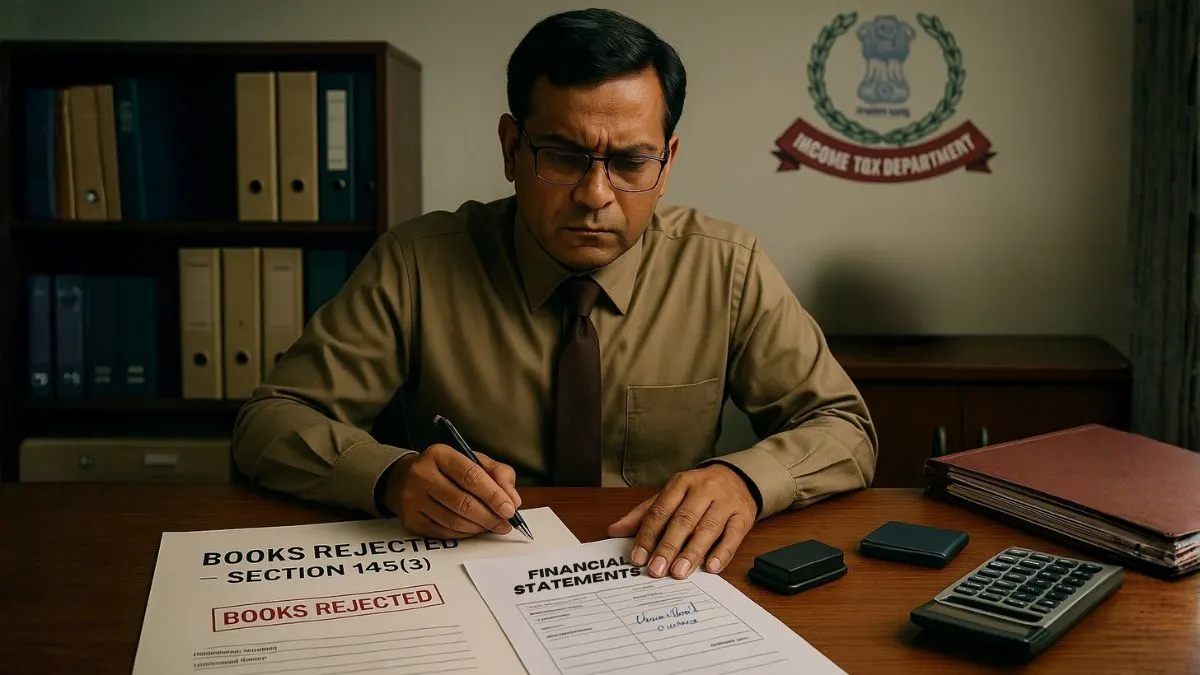
The Income Tax Act doesn’t just focus on collecting tax — it focuses on accurate computation of income. Section 145 lays down the basic rule: income must be computed based on the method of accounting regularly employed by the taxpayer — either cash or mercantile system. However, sometimes taxpayers maintain books that do not reflect the true picture of their profits. That’s where Section 145(3) steps in. It acts as a safeguard for the department, allowing the Assessing Officer (AO) to intervene when he’s not satisfied with the correctness or completeness of the accounts.
But here’s something important most people miss — section 145 was not an assessment but a computation section. It only provides the framework for how income is calculated; it doesn’t directly impose any tax or penalty by itself.
What Does Section 145(3) Say in Simple Words?
Section 145(3) states that:
“Where the Assessing Officer is not satisfied about the correctness or completeness of the accounts of the assessee, or where the method of accounting or accounting standards notified under subsection (2) have not been regularly followed by the assessee, the Assessing Officer may make an assessment in the manner provided in section 144.”
In simpler terms — if your books are inconsistent, manipulated, or incomplete, the AO can ignore them & calculate your income using his best judgment assessment.
When Can the Assessing Officer Reject Books of Accounts?
The Assessing Officer has the power, but it’s not unlimited. He must have concrete reasons to doubt the reliability of your books. Common grounds for rejection include:
- Books are not properly maintained, or key ledgers are missing.
- Stock register is incomplete or not verifiable."
- Large cash transactions without explanation.
- Significant mismatch between sales, purchases, or closing stock.
- Use of accounting methods that distort income.
- Non-compliance with Income Computation & Disclosure Standards (ICDS) under Section 145(2).
However, it’s equally true that books of accounts cannot be rejected merely because profits appear low or because minor errors exist. Courts have repeatedly held that suspicion is not evidence.
Section 145(3): Not an Assessment, But a Computation Provision
A subtle yet crucial distinction exists here. Section 145 doesn’t authorize tax collection — it tells you how to compute income correctly. The actual assessment — the power to determine total taxable income — is governed by Section 143(3) or Section 144 (best judgment assessment).
Thus, when an Assessing Officer invokes Section 145(3), he is not penalizing the taxpayer; he’s simply rejecting the unreliable books & recalculating income on a reasonable basis.
It’s like saying, “I can’t rely on your version of the story, so I’ll use evidence & estimates to reach a fair conclusion.”
Also Read: Penalty for Concealment or Misreporting
Example: How Section 145(3) Works
Let’s say a trader declares ₹40 lakhs as income for the year. During scrutiny, the AO notices that the trader’s sales ledger doesn’t match GST filings and the stock register is missing. He issues a show-cause notice under Section 145(3).
If the trader fails to justify the discrepancies, the AO rejects the books & uses a reasonable gross profit ratio from similar businesses to estimate total income — say ₹50 lakhs. The difference of ₹10 lakhs becomes taxable as undisclosed income."
This process is known as best judgment assessment, carried out under Section 144.
Power vs. Limitation — The AO’s Responsibility
While the law gives the AO significant power, it also sets boundaries. Courts have made it clear that this power must be used judiciously, not arbitrarily.
In CIT vs. A. Krishnaswami Mudaliar (1964), the Supreme Court held that:
“The rejection of accounts must be based on concrete evidence, not on conjectures or surmises.”
This means the AO must first point out specific defects & give the taxpayer a fair chance to explain before invoking Section 145(3).
Can the Books Be Rejected for Low Profit?
No. Low profit alone isn’t a reason for rejection. Many legitimate factors — like market slowdown, higher raw material costs, or delayed payments — can reduce margins.
Courts have ruled that unless the AO finds factual inaccuracies or accounting irregularities, books of accounts cannot be rejected merely because profits seem too low compared to previous years or industry averages.
Importance of Accounting Standards Under Section 145(2)
Section 145(2) empowers the Central Government to notify Income Computation & Disclosure Standards (ICDS). These standards ensure uniformity and transparency in accounting.
If a taxpayer fails to follow these notified standards, the AO can treat the accounts as incomplete & proceed under Section 145(3).
For instance, non-recognition of revenue on accrual basis or under-reporting of closing stock value could trigger rejection.
Assessing Officer’s Next Step — Best Judgment Assessment
Once the AO rejects the books, he can proceed to make assessment based on available records, comparable cases, or logical estimation. This is called a best judgment assessment under Section 144.
However, it’s not a license to guess. The AO must rely on data, industry trends, or earlier years’ results. For example, he might use a fixed gross profit percentage to compute income when books are unreliable.
Also Read: TDS on Virtual Digital Assets (Crypto, NFTs & More)
Consequences of Non-Compliance
If the AO establishes that the taxpayer deliberately withheld information or maintained false books, it may lead to imposition of penalties & interest for non-compliance.
- Section 271(1)(c) – for concealment of income or furnishing inaccurate particulars.
- Section 270A – for under-reporting or misreporting of income.
- Section 234A/B/C – for interest on delayed filing or payment.
So while Section 145(3) itself doesn’t levy penalties, it can trigger a chain of consequences if the AO proves deliberate misreporting.
Real-Life Example – Rejection of Books Upheld
In one landmark case (ACIT vs. Aggarwal Engineering Co.), the taxpayer failed to produce a proper stock register, & cash receipts couldn’t be matched with sales invoices. The AO rejected the accounts under Section 145(3), and the Tribunal upheld it, stating that “books lacking vital details cannot be considered correct or complete.”
The key takeaway — the AO must have tangible reasons; & once proven, courts usually uphold his action.
Real-Life Example – Rejection Set Aside
Conversely, in CIT vs. Paradise Holidays (P) Ltd., the AO rejected books merely because profit margins dropped compared to the previous year. The Tribunal struck it down, ruling that every business faces changing market conditions, & decline in profit is not evidence of manipulation.
The moral? Section 145(3) is not a tool for suspicion — it’s a remedy for inconsistency.
Role of the Taxpayer – How to Avoid Rejection
Here’s how you can protect your books from being questioned:
- Maintain proper records: Keep ledgers, invoices, & stock registers updated.
- Follow the same accounting method every year (cash or mercantile)."
- Comply with ICDS & statutory disclosures.
- Reconcile GST, TDS, and accounting entries regularly."
- Respond promptly to AO queries with documentary evidence.
Transparency is your best defence. Even minor inconsistencies can raise red flags if left unexplained.
Penalty and Interest for Non-Compliance
When income is reassessed due to rejection of books, additional tax liability arises. Along with that, penalties & interest may apply.
If the AO proves concealment or deliberate misstatement, he can levy penalty under Section 271(1)(c) or Section 270A. Further, interest under Sections 234A, 234B, and 234C is charged for delayed payment.
In short, even though Section 145(3) itself doesn’t punish you, it opens the door for enforcement under related provisions.
Section 145(3) in the Modern Context
In today’s era of digital accounting, it’s easier than ever for the tax department to cross-verify figures using AIS, TIS, & GST databases. That’s why accuracy & consistency are critical. While the old manual system allowed some margin for clerical mistakes, digital mismatch between GST turnover and income-tax returns immediately draws scrutiny.
Thus, Section 145(3) has become even more relevant — it keeps businesses disciplined & ensures genuine records align with reported data.
Judicial Wisdom – Balancing Power and Fairness
Courts have always reminded the tax department that the Assessing Officer’s satisfaction must be objective, not arbitrary. The rejection of books cannot be mechanical. It must be preceded by clear reasoning & opportunity for the taxpayer to explain.
At the same time, they’ve upheld that the department has every right to protect revenue when fraud or inconsistency is proven. The law strikes a balance — fairness to honest taxpayers, firmness against manipulation.
Final Thoughts
Section 145(3) of the Income Tax Act is one of those provisions that quietly uphold the integrity of India’s taxation system. It doesn’t target anyone unfairly — it simply ensures that income is computed based on truth, not convenience. The section reminds taxpayers to maintain transparency & consistency, while reminding Assessing Officers to act with reason and evidence. In essence, it’s not about fear of rejection; it’s about accountability on both sides.
If your books are under scrutiny or you’ve received a notice under Section 145(3), don’t panic. Expert guidance can make a huge difference. At CallMyCA.com, our CAs help you prepare accurate documentation, defend your case professionally, & handle assessments smoothly — ensuring your business remains compliant and stress-free.









