
2026 Union Budget of India: What This Year’s Budget Really Tells Us
Every year, when the budget is announced, people stop for a moment and try to understand one thing—where is the country going next?
The Union Budget 2026–27 was no different.
Union Finance Minister Nirmala Sitharaman presented the Union Budget for 2026–27 on Sunday, February 1, 2026. From morning news debates to social media discussions, everyone was trying to decode what this budget really means.
Three Kartavyas: The Core Idea Behind This Budget
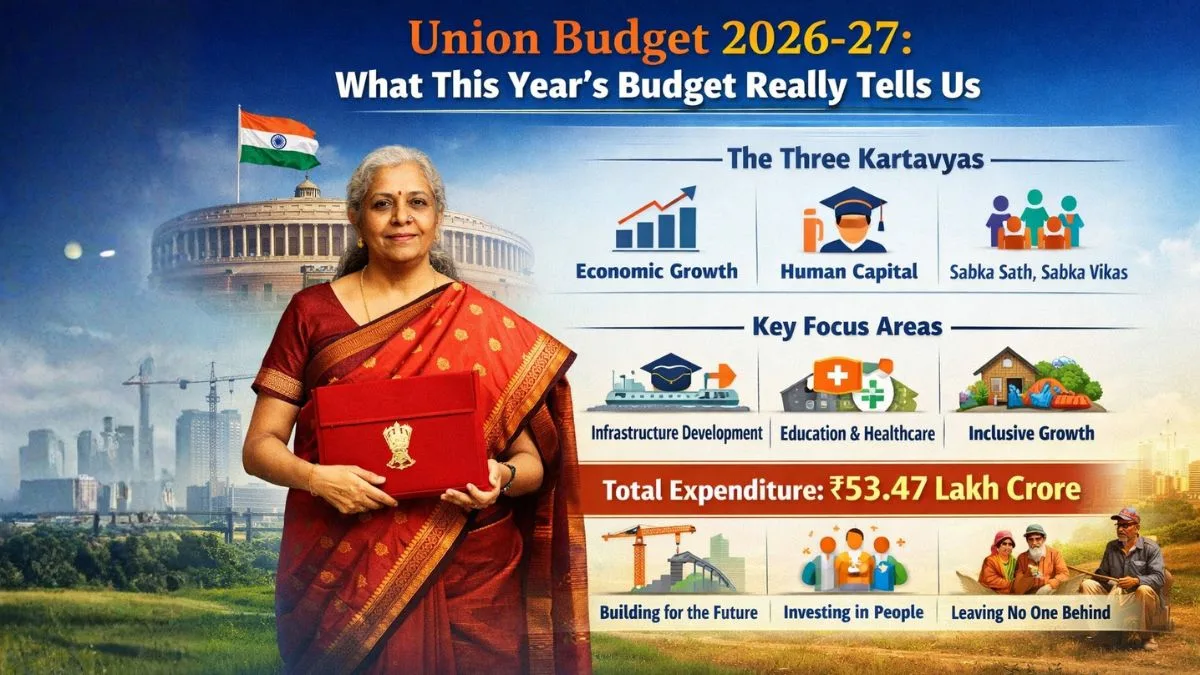
The government has built the 2026 Union Budget of India around three main “Kartavyas”:
-
Accelerating economic growth
-
Fulfilling aspirations through human capital
-
Advancing Sabka Sath, Sabka Vikas
In simple words, the message is clear: grow the economy, invest in people, and make sure no one is left behind.
Instead of chasing quick popularity, the Union Budget 2026-27 is trying to play the long game.
A Mature and Confidence-Driven Policy Stance
If you look closely, this budget follows a mature and confidence-driven policy stance.
Over the last few years, India has dealt with global inflation, wars, slowdowns, and uncertainty. In such times, many governments panic.
This one didn’t.
There are no sudden policy flips. No risky experiments. Just continuity and discipline. That’s a big signal for investors and businesses—"Relax, we’re sticking to the plan."
Money Matters: Where Is the Government Spending?
Now let’s talk numbers.
Expenditure: The government is estimated to spend Rs 53,47,315 crore in 2026-27, which is about 7.7% higher than last year.
That’s not small money.
Most of this is going into infrastructure, welfare schemes, and development projects. Roads, railways, digital systems, housing—the basics that actually support growth.
Why Capital Expenditure Is Getting So Much Attention
One big focus area is capital spending.
The government is putting more money into highways, freight corridors, urban infrastructure, and public utilities.
These projects don’t give instant results. You don’t feel them next week or next month. But five or ten years later, they change how the economy works.
That’s exactly the thinking behind this budget.
Human Capital: Investing in People, Not Just Projects
The second Kartavya is about people.
Education, healthcare, skill training, and digital learning—all of these get attention in the Union Budget 2026–27.
Why?
Because buildings and machines mean nothing without skilled workers. The government clearly understands that future jobs will be in technology, renewable energy, research, and advanced manufacturing.
So the focus is on preparing today’s youth for tomorrow’s industries.
Sabka Sath, Sabka Vikas Still Matters
Sometimes people think “inclusive growth” is just a slogan. But in this budget, it’s still very much present.
Rural housing, water supply, farmer support, women's welfare, and employment schemes—all continue.
The idea of Sabka Sath, Sabka Vikas runs quietly through the entire budget.
No big shouting. Just steady work.
Why Union Budget Documents 2026-2027 Are Important
If you really want to understand this budget, don’t just watch TV debates.
Read the Union Budget Documents 2026-2027.
They show where the money is coming from, where it’s going, and what reforms are planned. It’s detailed and boring sometimes—but that’s where the real story is.
What Does This Mean for Ordinary People?
For most Indians, budgets are not about percentages and deficits. They are about daily life.
-
Salaried people want job security and stable taxes.
-
Small businesses want better transport and easier schemes.
-
Rural families want housing, water, and schools.
-
Investors want policy stability.
The Union Budget 2026–27 may not give instant rewards, but it is clearly trying to build long-term comfort.
So, Is This a “Good” Budget?
It depends on what you expect.
If you want freebies and big announcements, you may feel disappointed.
If you want stability, planning, and slow but steady growth—this budget delivers.
With a total expenditure of Rs 53,47,315 crore and a clear focus on infrastructure and skills, the government is choosing patience over popularity.
Final Thoughts
The 2026 Union Budget of India is not flashy.
It doesn’t try to impress in one day.
Instead, it quietly follows a mature and confidence-driven policy stance, focusing on growth, human capital, and Sabka Sath, Sabka Vikas.
Over time, that approach usually works better.
And that’s probably the biggest takeaway from the Union Budget 2026–27.
If you want to understand how budget changes, tax rules, and financial policies affect your personal or business finances, platforms like callmyca.com can help you get practical, real-world guidance.









