
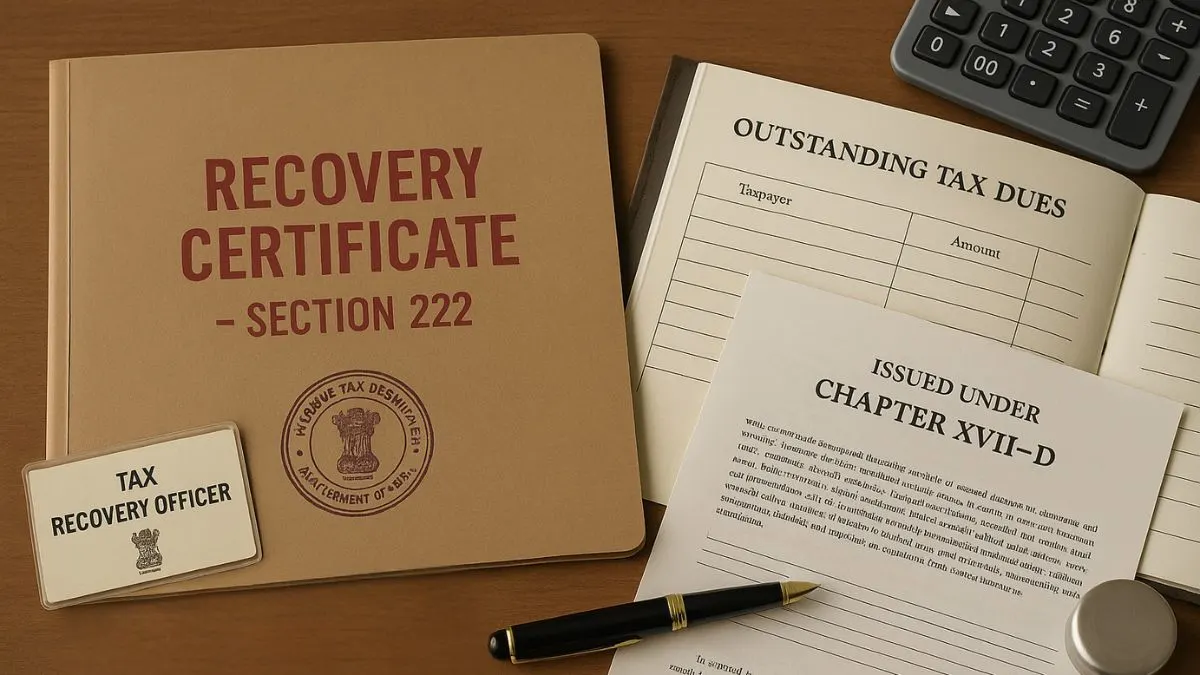
Most people don’t realize how far the Income Tax Department can go if taxes remain unpaid even after repeated notices. Section 222 of the Income Tax Act is one of those provisions that quietly ensures the system doesn’t stop when someone delays payment.
It comes into play only after several chances are given to the taxpayer. Once the due date passes & the dues remain unpaid, the law allows the department to hand over the case to a Tax Recovery Officer (TRO) — the person authorized to collect taxes that haven’t been paid despite reminders. The process starts formally when a Certificate to Tax Recovery Officer is issued by the Assessing Officer.
Let’s unpack how this mechanism works and what it means for both taxpayers and the government.
What Section 222 Really Means
Section 222 is a recovery provision under the Income Tax Act, 1961. It gives the Assessing Officer authority to issue a certificate specifying the amount due to a Tax Recovery Officer competent to take action under section 222 when a taxpayer defaults on payment. This certificate isn’t just a formality — it’s a legal authorization that allows the TRO to initiate recovery. Once it’s issued, the TRO can attach property, freeze bank accounts, or even sell assets to recover the government’s dues.
The section essentially bridges the gap between assessment (where tax is calculated) & collection (where dues are enforced).
Role of the Tax Recovery Officer
The Tax Recovery Officer (TRO) functions like an enforcement authority under the Income Tax Department. Once empowered by the Assessing Officer’s certificate, the TRO follows the procedure outlined in the Second Schedule of the Act.
The officer can:
- Attach movable or immovable assets owned by the taxpayer.
- Sell the attached assets to recover dues.
- Issue orders to third parties such as employers or banks to deduct and remit dues.
- In rare and severe cases, order arrest & detention for wilful defaulters.
Every step has to follow the due process of law. The TRO cannot act arbitrarily — each notice, attachment, and sale follows a prescribed structure under the rules.
Also Read: Section 226(3): When the Tax Department Can Freeze Your Money
How Recovery Actually Happens
The recovery process under Section 222 is sequential and transparent.
- Notice of Demand (Section 156):
The process starts when a taxpayer receives a demand notice requiring payment within 30 days. - Default by Taxpayer:
If the taxpayer ignores or fails to pay within the given time, it becomes a case of default. - Issue of Certificate:
The Assessing Officer then issues a Certificate to Tax Recovery Officer under Section 222, specifying the unpaid amount. - Action by the TRO:
The Tax Recovery Officer begins enforcement — this could include attachment, auction, or garnishee orders. - Adjustment Against Refunds or Credits:
If any refund or asset is due to the taxpayer, it can be adjusted first before more serious action is taken.
The intention behind this process isn’t punishment — it’s recovery with fairness & accountability.
Understanding the Certificate to Tax Recovery Officer
This certificate is the key legal instrument under Section 222. It’s a formal document signed by the Assessing Officer containing details such as:
- The taxpayer’s name and PAN.
- Assessment year & nature of demand.
- Total tax due, including penalties or interest.
Once signed and sent, it grants the TRO authority to act. From this point onward, the department’s recovery wing can lawfully proceed with enforcement steps.
It’s important to note that this certificate can cover not just tax but also interest, penalties, and any other dues payable under the Act.
Legal Powers of the TRO
The Tax Recovery Officer works within the boundaries of the Second Schedule of the Income Tax Act, which serves as a detailed guide for recovery procedures.
Some of the key powers include:
- Attachment of Property: Movable or immovable assets may be temporarily attached until dues are cleared."
- Auction of Assets: If the default continues, attached assets can be auctioned after giving prior notice.
- Garnishee Orders: The TRO may instruct a third party (like a bank or tenant) holding the taxpayer’s money to pay it directly to the department.
- Arrest & Detention: In extreme cases, if someone wilfully evades payment, the TRO can seek permission for arrest as a last resort.
Each step must comply with the due process outlined in the Second Schedule.
The Second Schedule – A Rulebook for Recovery
While Section 222 authorizes recovery, the Second Schedule provides a complete legal roadmap for how it should be done.
It explains:
- How and when notices must be served.
- The correct way to attach property.
- Conditions before conducting a sale.
- How objections and appeals can be handled.
This ensures every action remains transparent & legally sound — protecting the interests of both taxpayers and the government.
Also Read: Understanding Penalties for Default in Tax Payments
Real-Life Example
Imagine an individual who owes ₹15 lakh in unpaid taxes. After the final assessment, the Assessing Officer issues a demand notice. Thirty days pass, and there’s still no payment.
The Assessing Officer then issues a Certificate to Tax Recovery Officer. The TRO sends one last notice for voluntary compliance. When the taxpayer doesn’t respond, the officer attaches a piece of property and recovers dues through its sale.
Throughout the process, the taxpayer has the right to appeal, pay dues, or settle the issue before the property is sold.
Rights of the Taxpayer
Even though Section 222 gives wide powers to the tax department, the law also protects taxpayers from misuse.
- Recovery can start only after a demand notice and a waiting period.
- The taxpayer is given written communication at each stage.
- Basic personal assets, like those essential for living, are exempt from attachment.
- If an appeal or stay order is pending, the TRO generally pauses enforcement.
These protections ensure recovery actions remain balanced & humane.
Comparison with Other Recovery Provisions
|
Section |
Area Covered |
Key Feature |
|
Interest on delayed payment |
Adds interest for default period |
|
|
222 |
Certificate-based recovery |
Authorizes TRO to act |
|
226 |
Recovery from third parties |
Allows employer or bank to pay directly |
|
Restriction on foreign travel |
For large and wilful defaulters |
Together, these sections form a strong framework for tax collection without overstepping fairness.
Judicial Oversight
Courts have consistently held that recovery actions must respect procedural law.
For example, in CIT v. K.M. Adam (1982), it was clarified that authorities must strictly follow the Second Schedule to ensure no arbitrary recovery is made.
Such rulings have shaped the balance between the department’s powers & taxpayers’ rights.
Relation with Other Provisions
Just as the Income Tax Act allows deductions for scientific research to promote innovation, Section 222 helps maintain discipline in tax payment.
Both ensure that the system remains equitable — rewarding compliance and penalizing neglect."
While deductions encourage spending in productive areas, Section 222 ensures the collected taxes come back into circulation for public welfare.
Also Read: Capital Gains Exemption on Compulsory Acquisition
Why Businesses Should Pay Attention
Businesses are often the ones hit hardest by delayed compliance. Once recovery proceedings start, the department can freeze accounts or attach company assets, which directly affects daily operations.
For individuals, property attachment or garnishee orders can create financial strain & reputation damage.
Hence, even if there’s a dispute, responding promptly to tax notices is the smarter route.
How to Avoid Recovery Proceedings
- Don’t ignore demand notices. Always reply or pay within the deadline.
- If you disagree, appeal. File a rectification or appeal with a stay request.
- Ask for instalments. Section 220(3) allows paying dues in parts.
- Stay in touch with your Assessing Officer. Communication helps avoid unnecessary escalation.
A proactive approach saves time, stress, and the possibility of recovery under Section 222.
Key Takeaway
Section 222 is not about punishment — it’s about ensuring fairness & compliance. It empowers the Tax Recovery Officer to act when all other measures have failed, but it also gives taxpayers multiple opportunities to settle or appeal before any property is attached or sold.
It’s the balance of authority and accountability that makes this section so effective in the tax system.
Conclusion
Section 222 of the Income Tax Act provides the structure for recovering tax dues through legal & procedural means. Once a Certificate to Tax Recovery Officer is issued, the recovery process begins — fairly, transparently, and within the limits of law.
The Tax Recovery Officer competent to take action under section 222 ensures the system doesn’t allow prolonged defaults, protecting the government’s revenue while respecting taxpayer rights.
If you’ve received a recovery notice or a certificate under Section 222, don’t wait for it to escalate. Reach out to CallMyCA.com — our experts can help you respond correctly, negotiate with the department, and prevent property attachment or account freezing before it’s too late.









